
Rare earth elements are essential to the manufacturing of high-tech devices, including cellphones, batteries, T.V and computer monitors and etc. According to 2009 data, China has 36% of the world’s reserves (36 million tons), but it produces 97% of the world’s rare earth elements.
Since September, when China temporarily suspended the export of rare earth metals to Japan because of the territorial dispute over Diaoyu Island, the tension over the rare earth supply has elevated and other countries have joined in the debate. The Federation of German Industries claimed that rare earths were becoming a“geopolitical issue”, even though the Chinese government claimed that rare earth metals would not be used as a “bargaining tool”. The latest development is that the U.S Secretary of State, Hillary Clinton, raised the embargo issue at a news conference yesterday.

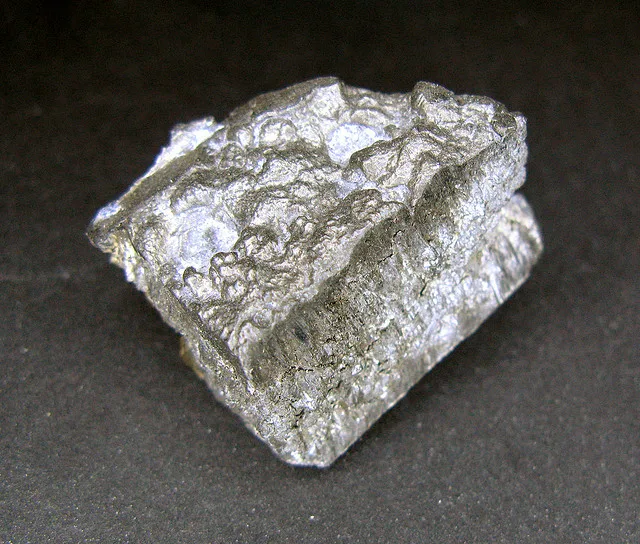
Fragment d'yttrium pur à 99,9% (l'un des métaux extraits des terres rares).
So much for the international scene. Domestically, with the rise of nationalistic sentiment, a majority of mainland Chinese support the government’s restriction on exporting rare earth metals.
History of rare earth export
The debate over rare earth actually started last year. Even back then, blogger SMPB looked at the issue as a matter of national security. The blogger reviewed the history of China’s rare earth export:
Back in 2002 after entering the WTO, China had little knowledge about the significant of rare earth and published a report on the 6 major trends of rare earth business. The report embraced the WTO agreement and aimed at making profits by controlling the price and building up the export channels, turning China into the dominant power in the rare earth trade.
However, in April 2009, the Ministry of Land and Resources of the People’s Republic of China, announced a quota system in the mining of rare earth. The decision has reduced the amount of rare earth production and suspended permission for new mining projects. Moreover, the Chinese government also imposed restrictions on the export of rare earth metals through an export tax. The new policy has alerted the European Union, the U.S, Japan and Korea. On 22 of June, 2009, the European Union and the U.S decided to negotiate with the Chinese government. If negotiations failed, they would file a complaint to the WTO. Sources from the EU said that “The Chinese government’s export tax on raw materials had distorted the global market and brought harm to European and American corporates”.
The blogger believed that the export restrictions are a matter of national security:
The 20 industrial raw materials brought to the WTO table by EU and the US has a deeper significance: national security. Rare earth is the most essential material for the production of high tech weapons. China’s earlier exports have endangered its own national security by helping foreign countries in the development of high tech weapons. This strategy issue is the unstated reason behind the debate..
International bullying?
n the new round of debate, blogger, exsoldier, also looks at the issue as international bullying of China. His blog title is “Foreign powers are pressuring China to export rare earths”. The blogger quotes a report, Rare Earth Elements: The Global Supply Chain (pdf) written by Marc Humphries, an analyst in energy policy, and points out that:
If we look at the reserve per capita, the rare earth reserves in the U.S and Russia are higher than China’s. However, because China is at the lowest level of the production chain, it produces 97% of the world’s rare earth elements. The ratio of reserve to production is totally out of balance. The U.S has 13% of the world’s rare earth reserves but it produces none and depends 100% on importation. Hence, it is not true to say that Chinese restrictions on rare earth exports have lead to the shortage of supply. Rare earth is never in short supply, it is the cheap Chinese rare earth that is in short supply..

The nationalistic rhetoric has some resonance in internet forums. In Baidu Tieba, many accuse rare earth smugglers as traitors. In response to recent news about rare earth smuggling, Dandelion (成长的蒲公英a) says:
For your personal interest you can sell out the country? China is a developing country and there is still a long way to go. The key issue is of course economics. When rich countries said Chinese people like to take a small advantage, they are so disrespectful of Chinese people. They have been taking a big advantage of us! They don’t want to lose their own raw material reserves, they don’t want to destroy their country’s environment. Therefore, they come to buy Chinese rare earths. Although rare earth is expensive and profitable, its value has largely exceeded the price. We are actually selling gold for the price of vegetables. Even though you are now rich, you mean nothing to them. Only when our country is strong and our economy continues to growth, can we then walk without lowering our head and say proudly: We are Chinese! Let’s not ruin the country’s policy for our personal gain. The 1.3 billion people have to be united for China’s bright future. (Besides, let’s despise the American, the Japanese…. despise those who smuggle rare earth for personal gain. What you sell is not rare earth, but the dignity of Chinese people and the future of China. The smuggler from Tsingtao is sick. He has forgotten the Nanjing Massacre. He even dares to sell them to Japanese. Don’t you worry that the next atomic bomb will be targeted at you?)
However, who has made the decision to sell rare earth in the first place? YierYier Wei questions the decision maker in Baidu Teiba and the nationalistic sentiments are quickly directed towards corrupt government officials:
YierYierWei: Chinese authority, you will never know how important rare earths are.124.231.90.*: They only know where to eat and enjoy life, and get corrupted whenever they can.
Missing szy: The government officials are not elected. People’s opinions don’t count.
Aukulisi: After they sell away all our rare earths, they will migrate to other countries. They won’t care if we are alive or dead. Apart from embargoing the rare earths, we have to block the government officials from emigrating.
——

This article originally appeared on Global Voices Online, and was written by Oiwan Lam et traduit par Suzanne Lehn.
Photo FlickR CC : xiuaming ; Thorius ; vfowler.
💬 Discussion
No comments yet. Be the first to comment!