
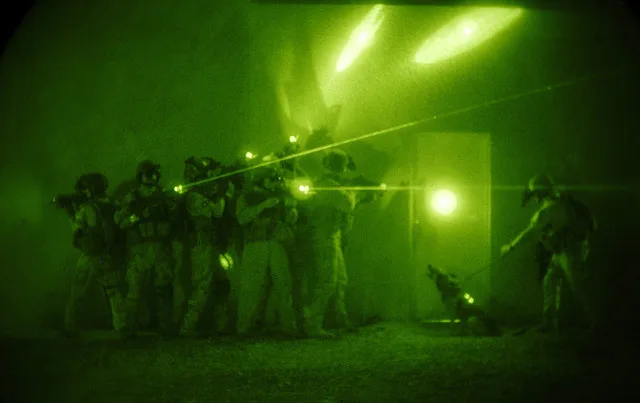
76. That, in billions of dollars, is the value of contracts entered into by the Pentagon and the U.S. private military companies (PMCs), between 2003 and 2007 (PDF). Had it not been brought to our attention by the solemn Congressional Research Service – the federal agency in charge of sifting through public policy – one would believe such a stratospheric figure to be unreal. For those who are not familiar with military spending, suffice it to say the figure is equivalent to just over 10% of the overall defence budget for the 2011 fiscal year. More tellingly, this budget only covers the “Iraq theater”, i.e. Iraq, Bahrain, Jordan, Kuwait, Qatar, Oman, Saudi Arabia, Turkey and the UAE. No mention here of the War in Afghanistan or insurgent-style guerrilla conflicts, involving militias or drug cartels in Africa or South America.
According to official accounts, the U.S. Army withdrew from Iraq on August 31, 2010, following a schedule established by Barack Obama himself. On that same evening, in the Oval Office of the White House, the president expressed the need to “pass the baton to civilians”. Of course, he was referring to diplomats, advisers, USAID (Agency for International Development). But the term also includes the grey area of mercenaries and other ‘soldiers of fortune’.
In 2008, during the presidential campaign, Hillary Clinton took out her own mortar to shoot down the big – kevlar-clad, M-16 toting – guns: she proposed a vote to “ban Blackwater and other mercenary companies in Iraq and Afghanistan”. Two years and a half later, the highly controversial company changed its name to ‘Xe’, after a series of Congress audits forced a makeover. Rather, Blackwater has been split into a series of alleles through a joint venture, as evidenced by a contract of $2.2 billion signed by the State Department – headed by Hillary Clinton herself – last month.

“Personal Security Detachment”
The Warlogs exhumed by Wikileaks, though purged of any mention of names (whether of informants or companies), contain over 3,000 references to PSD, ‘Personal Security Detachment’. When adding the adjective “French”, the Wikileaks database offers 3 results, while a broader research on the country reveals 326 hits. Everyone knows France is not militarily engaged in Iraq, since 2003 when Dominique de Villepin pulled a world-renowned diplomatic stunt from the UN benches.
So how can we explain the presence of French citizens on the outskirts of Baghdad near Basra?
To better understand the contours of this new geography of battle, it should be noted that foreign intelligence agents are counted among the PSD in the reports. Thus, the French man “shot through the window of a vehicle on Nov. 21, 2006” is not a mercenary, but an agent of the DGES (Directorate-General for External Security) killed during an incident at a checkpoint, one month before the release of hostage journalists Christian Chesnot and Georges Malbrunot.
The rule and its exceptions
It is extremely difficult to quantify the French private presence in theaters of operation, perhaps because the French legislation, trying somehow to regulate mercenary activities, is a victim of its own shortcomings. Since 2003, the law punishes “any person specially recruited to fight in an armed conflict who is not a national of a State party to said armed conflict“ with a five-year imprisonment and a 75,000 euros fine. As for those who recruit, equip or remunerate these individuals, the text provides a seven-year sentence and a 100,000 euros fine.
Connoisseurs would consider this to be a backfiring strategy, a warning for PMCs to better control their activities. For its architects, the law seeks only to establish a “legal risk, and make this particular environment more professional and clean”. On November 2004 a former collaborator of the famous Bob Denard attacked the law on Le Monde Diplomatic based on the fact that “no mercenary will meet all the six criteria imposed by this law”, as most are “on mission” on behalf of third countries, and thus integrated de facto in the armed forces of the concerned country.

In addition, French law only strictly condemns “active participation in combat”, leaving the way open for all other components of private military companies, whether intelligence, logistical support (which, according to CRS, represents 65% of their activity in Iraq), and finally bodyguarding, a borderline case if you consider how it might partake in combat. In Iraq, Geos or Anticip protect exclusively French investors.
Nevertheless, the situation could change with the appointment of a prefect responsible for overseeing all activities related to private security. The creation of such a position would not only regulate the actions of guards and other security personnel, but also the PMCs’ employees.
Goodbye PMC, Hello SES
Do these attempts to exercise some sort of control mean that France is turning its back on American initiatives? Not at all. A few weeks ago, Le Figaro journalist Georges Malbrunot drew attention to the rise of French private military companies, while revealing the wishes of the General Secretariat of Defence and National Security (SGDSN), taken from a confidential document:
Participating in offensive actions or intelligence assets must be strictly prohibited [...] Regulating a “savage” market, [...] Banish the word “military” (Society of External Security)
Rather than the existence of companies such as Gallice (whose boss, Frédéric Gallois, is the former head of the GIGN, the elite squadron of the gendarmerie), French strategists are concerned about the confusion that might ensue if public opinion can’t tell the difference between the military and the private sector. In the upper echelons of the Defence Dpt., PMCs are highly-regarded thanks to their welcoming of former military personnel and other legionnaires.

However, this apparent enthusiasm cannot obscure the power struggles unfolding between supporters and detractors of the private option. In a specialized newsletter, Pierre-Antoine Lorenzi, CEO of Amarante, a “Private security contractor” (as the UN puts it), reacts to a statement made by Bruno Delamotte, patron of Risk & Co, another company in the same sector. The diatribe, reported in the blog Secret Défense, sheds light on the tension surrounding the debate:
What fly has stung the President of Risk & Co to instigate such an invective against those he calls “doom merchants whom exploit and gain from the fear of terrorism”? Accustomed as we are to his both surprising and excessive positions, we could have smiled at his wrathful pen, if the life of our hostages in the Sahel and the safety of our expatriate nationals weren’t at stake. Indeed, no offense to our apprentice pamphleteer, in their case it’s not a question of facing the risk of terrorism and the threat of Al-Qaeda, or fear itself, but rather a question of protecting themselves against death!
Asked by Slate.fr on the prospect of a privatized army, General Neveux, who coordinated Operation Artemis in the Democratic Republic of Congo in 2003, appears at best wary and at worst hostile:
Force can not find its raison d’être in a political objective, as it’s not an end to itself, but a means to a democratic society. The armed force is sovereignty of the state. Nobody questions the absolute control of the State.
In the words of German sociologist Max Weber, the state’s “monopoly of violence” is exercised through the legitimization of such violence in order to strengthen the law and order within it. By outsourcing to hardly identifiable companies, the U.S. government may have abandoned the noble law advocated by General Neveux. Will France follow the same path?
——-
Download the high-definition image
__
Photo Credits: Flickr CC The U.S. Army, DVIDSHUB
💬 Discussion
No comments yet. Be the first to comment!