


During the midst of the “Internet” revolution in Tunisia, Evgeny Morozov gave a seminar in Paris on being cautious in over-emphasizing the importance of social networks. This native from Belarus (who now resides in the United States) recently published his book The Net Delusion.
Morozov denounces “cyber-utopianism,” as it creates a façade that technology is the ultimate liberating force. His views target specific groups, such as United States’ attitudes on bloggers and other technology initiatives from controversial countries, such as Iran, China, and Venezuela.
Morozov’s theory however may fall apart under the case in Tunisia. According to the author, the United States should still be under a Cold War trance and therefore should have intervened when pro-Western dictator Ben Ali was overthrown.

A “2.0 revolution” or a “Facebook effect”?
To understand why the expression “revolution 2.0″ is a misused phrase, one needs to take a closer look at the events in Tunisia [FR]. The actions of Mohamed Bouazizi, who sacrificed himself in protest in the city of Sidi Bouzid, triggered the domino effect that led to the flight of the Tunisian dictator. The Internet did not start this process of events, rather it was instigated by a man’s suffering and exasperation with his own arbitrariness in society.
In the era before technology, these events would have remained local and ignored. Yet they set fire to Tunisia thanks to the Internet. Specifically, Facebook played the largest role in the exchange of uncensored information for 2 million Tunisian users, as YouTube and Twitter were blacked-out from the system. Facebook has become a “liberated territory” for the urban youth in Tunisia; it’s a virtual country where people can say and post things that wer forbidden under Ben Ali’s regime.

Due to the freedom on Facebook, it was the perfect platform to circulate the first images of protests and repression in Tunisia. This was particularly apparent when a video tour of the hospital in Kasserine was released. This city suffered the most casualties, and thus the video showed graphic images of people with gunshot wounds to the head along with the panic from the hospital staff as more victims flooded the hospital. Without a doubt, these images represent the point of no return, a social crisis transformed into a political crisis. It’s undeniably a Facebook effect.
Once this fact is established, it is possible to recognize Morozov’s point that if the army didn’t refuse to fire on the crowds, Ben Ali could return to launch a crackdown on everyone who supported the revolution through Facebook, Twitter, and other platforms. These are “ifs” to consider…
The prevention of a “new Rwanda” thanks to Twitter ?
Because of the re-election of Ahmadinejad in Iran two years ago, along with events in China and Belarus, Evgeny Morozov is not afraid to criticize anyone who relies solely on the Internet and social networks to spread liberal ideas and undermine authoritarian dictators. Morozov has had a plethera of people to criticize, including Gordon Brown, the former British Prime Minister. According to Brown, in the age of the internet it will be impossible to have a “new Rwanda”(fr).
In Morozov’s book, he explains what “cyber-utopianism” is:
[…] the naive belief in the liberating nature of online communication, based on a stubborn belief to consider its negative aspects.
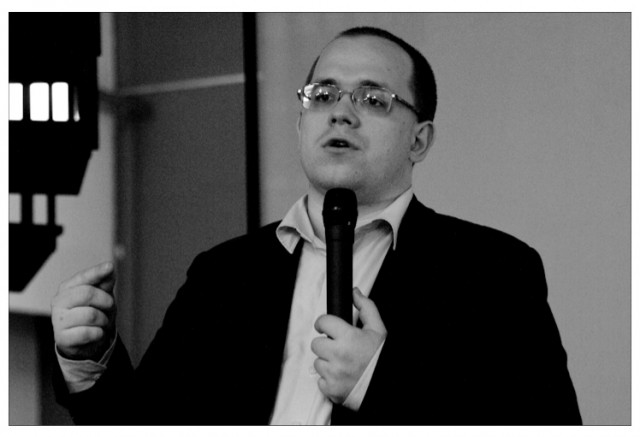
The author considers the fact that dissidents and other activists who utilize the web in these authoritarian countries put themselves at risk because they leave a digital trace. This obviously makes it easier for police to monitor and eventually capture these protesters.
On January 21, at an event organized by Owni [FR] at La Cantine [FR] (a venue dedicated to informatics and technology in Paris) Morozov did not hesitate to say that the lessons authoritarian Arab regimes should take away from the Mediterranean revolts would be to lift censorship on Facebook and let their critics speak. He stated that regimes fear that Tunisia is contagious, and it is better for them to know who the enemies are before falling from power.
Cyberactivism: The “kiss of death”
Though cynical for those who are excited about the Internet revolution in Tunisia, Mozorov is further convinced of his opinions when he considers the ideological approaches of the U.S. State Department. In Hillary Clinton’s speeches on the new freedoms the Internet provides, she fails to acknowledge the “kiss of death” it may represent for bloggers from Washington D.C. to Iran.
Mozorov is not the only one believes the Internet it overrated. Samy Ben Gharbia, a Tunisian cyberactivist exiled to Europe, published an article which begins as follows:
This piece stems thus from a major assumption that U.S official and corporate involvement in the Internet Freedom movement is harmful for that same freedom. I will explain why I consider the new context as extremely dangerous for the digital activism grassroots movement.

There is a distinction between political commentary from Western countries on how the Internet should be wielded, and the citizens worldwide who are concerned about using these technologies. During a seminar on the Internet and Diplomacy at SciencesPo, Michele Markoff gave a speech on the Cold War threats from Russia and China and called for coordination between “friendly” NATO allies. This representative from the Office of Cyber Affairs at the U.S. State Department shocked diplomats at the conference, as the previous British speaker just finished an enthusiastic presentation on his ambassador bloggers and the large number of Twitter users following the Foreign Office.
Cyber wars, cyber Propaganda, and cyber police are obviously linked to the same technology as the video of the demonstrations against Ben Ali. While Mozorov would be quick to reject both of these concepts as one in the same as a precautionary measure, there can’t be doubt that in the case of Tunisia the actions of Mohamed Bouazizi would have been in vain without new media. Due to the Internet, his sacrifice was the spark that set the country on fire.
> Evgeny Mozorov, The Net Delusion : the dark side of Internet freedom - Editions Public Affairs, 432 pages, $27.95.
Article initially published on Rue89
Photo Source: Ophélia Noor, Flickr CC believekevin
Translation: Stefanie Chernow
💬 Discussion
No comments yet. Be the first to comment!