
Since the mid 1990s [FR], artists have used the web as an artistic medium. Websites, search engines, social networks, and virtual realities are used to question our conventional practices and representation of reality. Silicon Maniacs reviews the art of hacking with tools such as Google Maps, Google Earth, and Google Street View.
Electronic cartography is not objective - maps offer a certain representation of reality. It’s a vantage point on a given territory describing the perception of several artists. The easily accessible mapping services from Google, Google Maps, and Google Street View have in effect been subjected to multiple distortions.
Google Maps

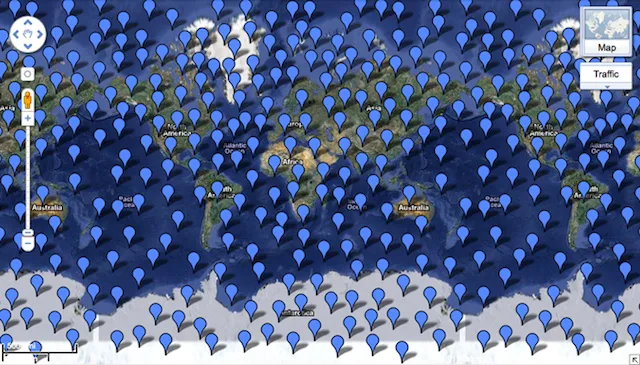
Inspired by the Ripoulin brothers’ collection, Claude Closky used digital media as the basic material for his artwork. On Backward Rain Forecast (2009), he uses the tags on Google Maps to create the perception of an “inverted” rain shower.

On Imaginary Landscape (2008), Sylvie Ungauer creates a visualization of information circulating the web from French sources. The “clouds” are titles of articles, which form around the origin of the content. Moving between continents, these clouds reflect how our perception of the world is forged by news.

Mardi Noir is a graffiti artist located in Rennes. He used Google Maps to pin the geolocation of each of his artworks, creating a treasure hunt on the streets of Rennes, Paris, and London.

Movement of the "UFOs" during the weeks of March 5 to March 12
The Internet artists Microtruc [FR] was created between 2010 and March 2011, around the concept of “virtual UFOs” (Trucs) crossing France. Creating a new UFO every day, each of these “objects” was pinpointed on Google Maps and updated every hour. Users would participate in the tracking of the “UFO,” adding their own interpretation of the adventure. The paths of the “virtual UFOs” and the amusing stories with accompany them can be found on the Truc [FR] website.
Google Earth


Molly Dilworth in turn paints images in the real world to then create virtual works of art. For her project Painting for Satellites, she made 3 giant murals on the roofs of buildings in New York. The mural’s dimensions are formed when they are photographed by Google Maps.

Artist and programmer Clement Valla notes how seemingly logical algorithms can produce absurd results. For his project Postcards from Google Earth, Bridges he aggregates around sixty photographs that illustrate Google Earth’s failures in its first creations of 3D images.
Google Street View

Julien Levesque, a member of Microtruc, reconstructs new panoramas by superimposing fragments of the landscape. The Street View Patchwork is consistent with the images on Google Street View, yet the sections of the artwork correspond to different locations and times. The digital collages form unique landscapes that exist only on the Internet.

Jon Rafman is behind the intriguing project 9 eyes, which refers to the nine camera that are on Google Cars. The Canadian artist spent thousands of hours exploring Google Street Views in search of unusual images. In an Interview by Vice magazine,[FR] he explains his fascination in the unbiased aspect these images capture:
There is something about them that indicates a sense of urgency. I found this to be present as well in street photography during the 19th and early 20th century. With robotic eyes that are supposedly neutral, Street View photography benefits from a spontaneity that will never be perceived and integrated by a human photographer. I saw these images as a neutral – yet privileged – representation of reality.

In Street With A View, artists Robin Hewlett and Ben Kinsley have conversely sought to give character to the neutral and spontaneous aspect of Google Street View. On May 3, 2008, the two artists organized (In collaboration with Google) a series of unusual scenes in the streets of Pittsburgh. In the northern district of the city, users can find a giant chicken, a mad scientist’s laboratory, and a neighborhood parade.
“On the morning of October 13, 2010 I was having as usual coffee at Cafe MÖRDER Berlin Mitte. By coincidence I spotted the Google Streetview car passing on Borsigstrasse. I dropped my spoon, took the door and ran after it,” says Aram Bartholl. His chase after the Google car led to the 15 Seconds Of Fame project, which shows Aram’s self portraits on Google Street View.
The Berlin artist also tries to transpose the virtual world onto the physical world. Another one of his projects aims to reproduce the map’s markers in real life as to identify a “Google Maps location.”
—-
 This article was initially published Silicon Maniacs [FR]
Translation: Stefanie Chernow
💬 Discussion
No comments yet. Be the first to comment!