

Drilling for oil off the coast of French Guiana will not lift the social stagnation afflicting this French overseas department. Permission, granted on June 22, to prospect for oil beneath the ocean floor has been defended by local officials who claim it could revitalise the region, which has been hit by an unemployment rate of more than 20%. However, following statements by the CEO of Shell and a review of the specifics of the operation, there is little hope of more than a few hundred local jobs being created, out of the 19,600 Guianese still searching for employment.
No guarantee
The platform itself, leased by Shell on behalf of a consortium that also includes Statoil and Total, represents the first opportunity for creating jobs. According to Shell, the oil rig Stena Icemax requires two rotating teams of 70 people and about 20 for the onshore extraction phase. Interviewed by the regional newspaper France-Guyane in December 2011, the CEO of Shell France (a subsidiary of the Anglo-Dutch giant) hinted at the possibility of hiring mostly locals.
The president of Shell France has pledged: “All skills being equal, the priority will always be local.” [...] Ad hoc training and infrastructure remain to be established. If this is the case, Shell could implement in Guiana the same policy as in the Philippines, where 75% of jobs at its drilling operation are local.
During a hearing before the French Senate on May 30, 2012, president of Shell France Patrick Romeo clarified hiring procedures in French Guiana, which have been influenced by previous experiences in other locations.
Platform jobs require special qualifications, including the need to speak English. This implies the need for training. Shell has proposed setting up a training program to accompany recruitment, conducted by specialized companies from the oil industry. These companies would commit to gradually recruiting dozens or even hundreds of people, and training them for four to five years in oil-related activities found elsewhere in the world. The trainees could then return to Guiana, with the qualifications needed for when an operation is started there.
One sticking point could be employment conditions in an industry that has a highly competitive cost of labour. ”I’m not sure that the Guianese will agree to work for minimum wage on the platforms that Shell are proposing,” was one industry expert’s opinion.

The 160 jobs directly related to the platform are not expected to come into effect until the operational phase of the project. That phase isn’t due to start, assuming the oil reserves are confirmed, until 2019. Looking ahead, the boss of Shell France mentions 25 jobs already being created and 60 indirect positions related to the exploratory phase. In addition to direct employment, most of the resulting or “induced” jobs relate to “oil field services” – day-to-day procurement and technical maintenance for the platform.
For the underwater imagery which will take place during the exploratory phase, Shell have appointed the French company CGGVeritas, which specialises in geophysical work.
Once the operation has started, Bourbon – the leader in offshore platform services – could take over the management of offshore supplies and maintenance, as they already do for Shell at its extraction sites off the African coast. Contacted by Owni, Bourbon and CGGVeritas were unwilling to discuss their commitments to the oil company. A specialist in the offshore oil industry estimated that for this type of operation at sea and on land “200 people, maximum” would be required.
Add to this the “induced jobs“, which the boss of Shell told the French Senate would match the number of platform jobs created, and by 2019 the drilling operation might reach 500 jobs across the department.

Rescue
Beyond the platform, the prospect of Guiana also refining the crude oil being extracted would make for a very healthy jobs dividend. Except that Guiana has no oil-refining capacity of its own, and France’s capacity in the region has been reduced to the level of local consumption. With half its shares owned by the Total group, the Caribbean Refinery Corporation (known by the French acronym SARA) only has oil depots in Cayenne, the capital. Their refining business is fully established in Martinique though, with a production capacity of 800,000 tons of crude oil per year, most of it routed from European oil fields (particularly in the North Sea). This small refining company is threatened by competition from Venezuela, which produces oil locally at a much lower cost, and to which Guiana itself could turn. Hence the concerns of Serge Larcher, the President of the French Senate’s delegation to the Overseas Territories, and senator from Martinique.
If SARA loses this customer, it could be problematic. SARA is a structure of solidarity between the French Departments of the Americas.

However, any proposal to refine some of the oil within the region must overcome two technical limitations: refining capacity and type of oil. ”The oil extracted in the North Sea is not as considerable as what Shell could extract off the coast of Guiana”, a representative from SARA explained to us. “Our facilities are not necessarily sufficient to refine crude oil that’s too thick. But it all depends on what the company finds.”
But the rescue of SARA is far from being the priority of some elected officials in France, who would prefer the oil be refined on their own soil. Senator Alain Neri:
Why not refine oil from Guiana in Petit-Couronne, which is connected to the port of Le Havre by a pipeline?
Much closer to the extraction site than Le Havre, Brazil – with its semi-public energy giant Petrobras – has considerable refining capacities, described to us by a spokesperson.
Petrobras has 15 refineries in Brazil, with a total capacity of two million barrels of oil per day. [...] Most of the crude refined by Petrobras comes from production off the Atlantic coast of Brazil.
That’s a capacity 100 times greater than SARA’s, coupled with storage sites and expertise on offshore crude not available in France.

Royalties
The biggest potential raised by oil based in Guiana is in sharing the profits. According to France’s mining laws, royalties levied on the value of oil come to 12%. Along with profit taxes, this would increase the levies to 50 or 60% of the price of crude oil extracted from Guianese waters. These tax revenues would be equally divided between the French state and the territory of Guiana, and local officials are still negotiating with Shell on their increase, according to an adviser from the Ministry of Sustainable Development.
In addition to these business activities, the oil company will invest in two main ways to stimulate the local infrastructure, as outlined by Shell France boss Patrick Romeo during his Senate hearing.
We will develop a thorough understanding of the environment, fund theses and take part in ongoing studies. [...] Concerning business at sea, we will offer: support for the fishing industry, a plan for development of maritime operations, help in the formation of a fishermen’s cooperative, research into best practices, etc..
In both cases, no job creation is envisaged, only support for researchers and local fishermen. Many benefits will not be fully realised until 2019, when the operation itself will start. In the best case scenario, there would be the tax revenue from profits (depending on the actual reserves of crude oil), and the work of extraction would create at most 500 platform jobs. Far from the thousand estimated by Mr. Romeo. And not necessarily to the sole benefit of the Guianese people.
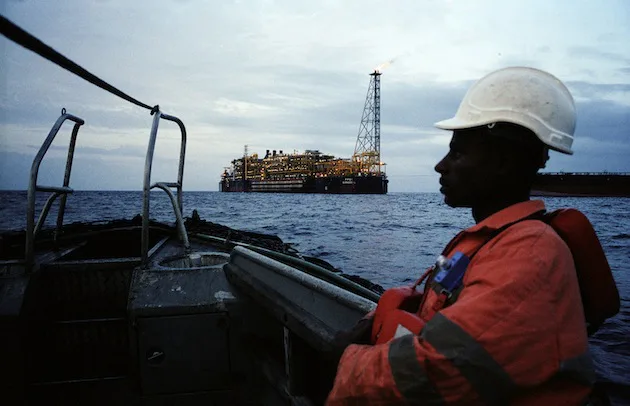
Image credits: Photographs by Helen David © all rights reserved, Argos Collective / Picture Tank. Report prepared in 2005 on a platform off Angola, where the group operates the Total Girassol field at a depth of 1400 m.
💬 Discussion
No comments yet. Be the first to comment!