
![[app] Warning: the fracking risks of shale gas extraction](https://owni.eu/uploads/owni/ascesseur_en-24194d72.webp)
«Sand, water, pressure»: the recipe for shale gas extraction found on Halliburton’s official web site resembles that of a sandpie. Perhaps the original blend wasn’t very different when the procedure was first carried out by the company in 1947, when it was injected to stir the bottom of oil or gas wells in Texas Hugoton’s field to extract everything to the last drop.
Recent improvements in the 80’s and the 90’s pushed hydraulic fracturing to a higher degree of refinement to such as extent that the company has become less transparent about their methods. Questioned by the American Environment Protection Agency, the hydrocarbon giant refused to hand over the recipe of its magic potion; Halliburton is suspected by the sanitary authority to have poisoned the groundwater around certain shale wells using this technique. On Halliburton’s website, only ten ingredients of the ‘potion’ are listed, including different types of sand and water. But, as for Coca Cola, the secret ingredient that makes the difference is missing.
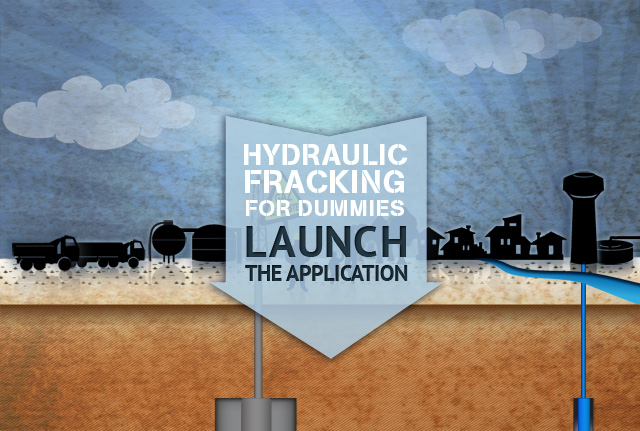
Processing from simple ‘activation systems’ of oil or gas wells, this technology, combined with supple materials which resist intense pressure and with new horizontal drilling systems, made available huge reserves of gas contained in shale coats scattered at 1200, 2500 and even 3000 meters beneath the surface. All over the planet, deposits of thousands and billions of cubic meters of gas offer countries a potential for energetic independence… as well as plenty of contracts for Halliburton and their competitors, Schlumberger or Baker Hughes.
«Out of the wells: CO2, NOx and other greenhouse gases»
The principle is the same for each well: the engineers drill the wells to the bottom, they then place a concrete coffer and begin the vertical drilling of 30 cm diameter to depths of over over 1200 meters before ‘bending’ the drill horizontally in the shale gas coat.
After setting off explosives at the bottom of the well, the engineers inject water, sand and different chemical products that ease the process at an intense pressure: the liquis, propelled at 600 bars (two times the power of a Cobra fire hose), cracks the rock whilst the sand keeps it open so that the gas can escape with half of the water (the rest is still trapped by the rocks). 7 to 15000 cubic meters of water are needed to fracture each rock, however only the half of it gets to the surface and it is precisely on its return that the damage is felt.
Once it has reached the surface, the gas is injected into a divisor which separates the gas from the water that escaped from the well before being pumped into a condenser, a type of huge reservoir of 40000 to 80000 liters. The gas is separated from other components, to let the hydrocarbon vapors can escape: CO2, NOx and other greenhouse gases. That such levels of pollution are dispersed into the air was unknown before the publication of Professor Al Armendariz’s studies of the Civil and Environmental Engineering of Dallas Methodist University.
61% of Illnesses are caused by toxic gas exposure
Let us reveal another secret: the mysterious fluids resulting from the fractures sometimes escape via cracks in the wells, reaching springs and porous rocks from where they seep into groundwater and rise into pipelines, where they blend to make a toxic water. Let’s examine that mystery of the 0,5% of «other» components of water and sand; in Louisiana Dr. Wilma Subra followed a procession of trucks carrying chemical products for the (secret) blend. One of tankers removed the spoiled water so that we could analyse a sample, which turned out to be far more complex than suggested by the ten ingredients listed on Halliburton’s internet site. In her test tubes, she named over 596 chemical substances which are not only acid inhibitors, anticorrosive and thickeners, but have drastic effects on people’s health, e.g. cancer (ethylene) and endocrine problems (ethylene glycol).
Taking the Texan city of Dish as a representative sample, Wilma Subra concluded that 61% of people’s health problems were caused by higher pollution rates than the accepted environmental norms. Exposed to enormous quantities of ozone, sulfur, natural gas and ether many times in a day, people were feeling nauseous, suffering from headaches, vomiting and pulmonary infections: 58% of people surveyed were suffering from sinus problems.
The correlation between hydraulic fracturing and seismic waves still needs to be scientifically formulated: Brian Stump and Chris Hayward, researchers at the Southern Methodist University of Dallas, investigated the Fort Worth site in Texas. The results from the research were cause for concern:
We established a link between seismic waves, the moment and the place of water injection (in the fractured well); we’re missing information pertaining to the subsurface of the area, the porosity and the permeability of the rocks, the natural path that the fluids take, and how these elements could provoke seismic eruption.
The researchers and the gas company agree that the extraction techniques in themselves provoke seismic micro-waves. According to geologist Aurèle Parriaux, doctor in Geology of Engineer at the Polytechnique de Lausanne, these micro-waves can reach «a magnitude of up to 3,4 on Richter scale» so a weak earthquake, though still perceivable. However the real impact of the hydraulic fracture is still to be proven, and thus more research is needed to determine the fractures’ impact on seismic eruption zones.
To accurately establish the consequences of this process, Brian Stump called for a « collaboration between universities, the state of Texas, the local authority, the energy department and eventually, the federal government, to study the issue of seismicity ». Given their unwillingness to reveal the recipe of their ‘magic potion’, it’s hard to believe that the shale gas community will plead guilty to the seismic eruption.
Translation by Claire Hickman.
Photo credits : Flickr CC : Oljeindustriens Landsforening OLF.
💬 Discussion
No comments yet. Be the first to comment!