
On Saturday, January 22, roughly 300 people from Menzel Bouzaiane left on their journey towards Tunis. In each village they passed through, they were joined by volunteers, and their movement grew to the sounds of motorcycles, trucks, and cars. Soon the group was enlarged by trade unionists, journalists, and human rights activists. By nightfall in Regueb, there were more than a thousand people.
On Sunday, much of the rural population had assembled in Tunis. Some left for Kasserine and Gafsa with the same intent of kicking out the Prime Minister from his office. After the the marches, the people defied their curfew and continued to protest with a sit-in.They are now camped peacefully outside the transitional government’s headquarters with the objective to ”bring down the last remnants of the dictatorship. ”
Everything is happening so fast. It took less than two weeks for the collapse of Ben Ali’s regime, which happened with such beautiful but suspicious speed. Is Tunisia ready for this kind of revolution?

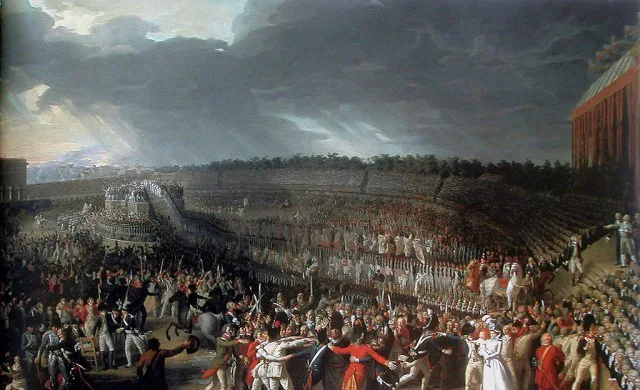
The celebration of the federation, July 14 1790 at the Champ de Mars
Revolutions : bring the people to the capitals
The centrifugal force of the Tunisian Revolution is not really a novelty. From the provinces to the cities, the Tunisian protesters are writing a new chapter in the long history of revolutions in the modern world. Contrary to popular belief, even the French revolution did not start in Paris on July 14 1789 with the raiding of Bastille; it was rooted in the provincial cities’ riots which occurred in the proceeding months. On July 14 of the following year, the thousands of people flocked to Paris to bond over their status as national heroes. They celebrated the federation, which they vowed to protect with a chain of patriots linked from Paris to the provinces.
The name “caravan of liberation” does not have the exact same nature as other revolutions. The Tunisians compare this revolution to the days of gaining their independence in 1956.
The revolutions of the 18th century were often wars of independence against colonial powers, such as in the United States (1775-1783), Geneva (1782), and the Netherlands (1783-1787) . During the French revolution, the rejections of monarchy’s abroad were very much inspired by the revolts against Marie-Antoinette and the King’s flight in June of 1791. Thus an anti-monarchy culture began to form against anyone who could be personified as Marie-Antoinette.
Is the Tunisian revolution a reflection of the revolutions that marked the end of the 18th century? Is it the beginning of a domino-effect of revolutions in the Mediterranean, 200 years after the Atlantic revolutions?
It might not be a straight forward answer, as the context is very different. According to Jean Tulard, implying that 2011 is the “1789 Tunisian Revolution” insinuates a type of neocolonialism.
This revolution belongs to Tunisia
This is a Tunisian revolution, and not at all the second French revolution. A better example would actually be when Tunisia gained its independence from France in 1956. Yet decolonization remains incomplete, as the population still suffers some of the notorious problems from being a former extension of France.
For 50 years, the French government has supported Bouguiba and Ben Ali dictators. So it’s surprising that France’s response to this controversy is so simplistic and creates blindness to the true situation.
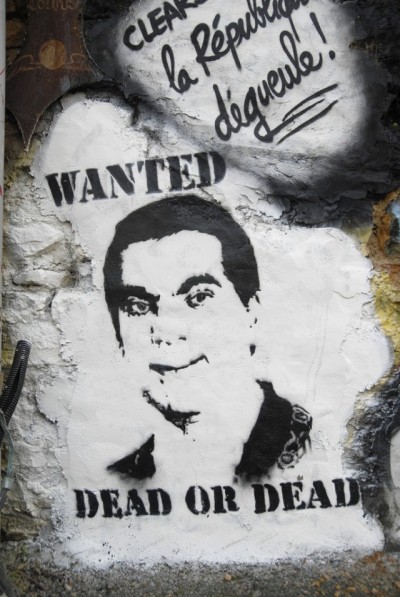
Since 1956, France has has a clear foreign policy towards Tunisia; they only have an interest in having diplomatic ties with the Tunisian government and not its people. This was evident when Michèle Alliot-Marie, Minister of Foreign Affairs, imposed the “expertise” of the French security forces on the Tunisia. Also, when Frederic Mitterrand was the Minister of Culture, he refused to recognize that Ben Ali’s regime was a dictatorship.
This is why the 2011 revolution is a second decolonization. Seen as a war of liberation, the Tunisian revolt is not just a domestic war, but also against France and its residual power to influence events (According to LeMonde, there were rumors of French troops preparing to be deployed to Bizerte).
Thus by refusing to recognize the legitimacy of the Ben Ali, the Tunisian people can truly be free of the post colonial period…providing that they don’t fall into the hands of American influence.
—
Originally published on the Lumières du Siècle
blog
Photo credits: Guebara Graphics [CC-by-nc-sa] via Flickr ; La fête de la Fédération, 14 juillet 1790 au Champ de Mars, Paris by Charles Thévenin, Musée Carnavalet [Public Domain] via Wikimedia Commons ; Graff by the Abode of Chaos [All rights reserved]
💬 Discussion
No comments yet. Be the first to comment!