
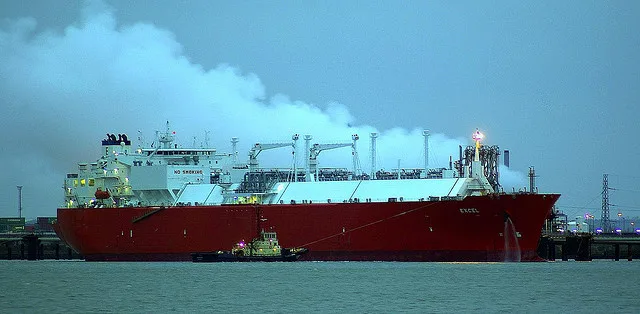
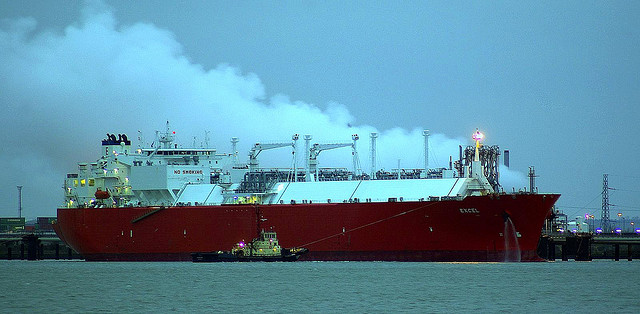
In the bowels of the heavy tanker Marersk Meridian, barrels of liquefied natural gas(LNG) are labeled rather unusally: Made in USA! On November 19th, the brand new hydrocarbon port on the Isle of Grain, which was built in East London with funds from GDF, BP and E.ON, received the first shipment of American natural gas for dozens of years.
Walking on the pipelines of Gazprom
Thanks to gas being extracted from deep layers of rock, the United States has regained its energy independence and are now export its production: this new resource represents 15% of their total gas production. In producing 620 billion cubic meters in 2009, the country has even overtaken the global leader: Russia.
Establishing a foothold in Europe, U.S. producers are literally walking on the pipelines of Gazprom’s, here as in their own kingdom of gas, alongside Qatar, Iran and Saudi Arabia. The new success is above all technical: shale gas is present in almost every country in the world, and at the moment can only be extracted through just one technology, of American origin, hydraulic fracturing.
The industrial ownership of this technology is owned by the companies who specialize in oil extraction such as Halliburton, Schlumberger, etc.. Wherever shale gas is extracted, their engineers are sent, explains Devon, one of the giants of American unconventional natural gas. We have a decade of experience, our first wells were drilled in 2002. Now, large foreign oil companies are turning towards companies such as Chesapeake, hoping for a transfer of expertise through partnerships.
Apart from the situation in the United States, the release of these reserves has caused unexpected consequences in the markets: in winter 2010, stabilised by the new abundance of shale the price of gas remained below that of petrol. A venture in which the Europeans are just embarking.
But there, the technology primacy of the Americans is forcing the locals to share: in the South of France only recently opened for prospecting [FR], Total could replace its partner Devon (who prefers to focus on North America) by Chesapeake, and GDF has placed itself under the wing of the Texan Schuepbach, who prospects new deposits worldwide with the help of the powerful multinational Dale. These concessions fulfill both economic as much as political aims:
One issue for the European market is to restrict its dependence on Russia, Algeria and the Middle East, says Guy Maisonnier, of the French Petroleum Institute. The main idea is to strengthen energy independence. For now, we are at a preliminary stage. What happens next will depend on recovery rates and drilling costs which will be determined by technical constraints.
The Russian gas giant forced to make a deal with Shell
In the rest of Europe, the exploration is becoming standard: Germany, United Kingdom, Northern Italy, Spain, Scandinavian countries, who for the time being, permit prospecting only, pending the evaluation of the potential of deposits already discovered. Shared ambitions have spawned a research program called GASH. With a clear lead, Poland has signed 70 license and carried out the first hydraulic fracturing of a shale gas well in Europe… thanks to Halliburton.
This lack of patience can be explained by the high gas potential found in Poland which could place them just behind Norway and Russia in the league of suppliers of the European Union. An economic coup but also a diplomatic one because it will free them from the dictates of the giant Gazprom, who taking advantage of the winter, has laid down the law in Eastern Europe, when imposing its tariffs.
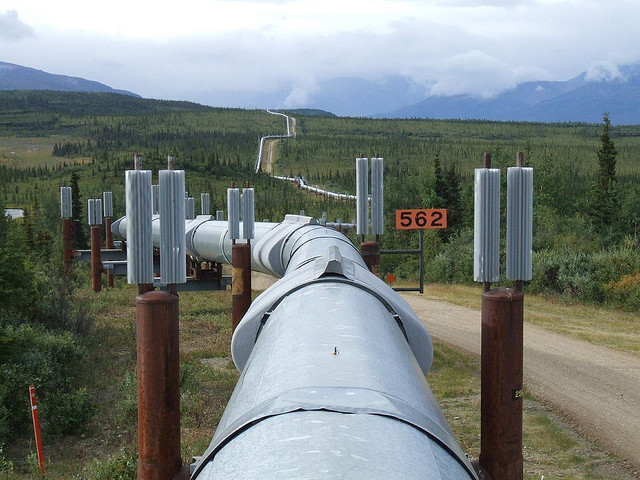
More reasons to irritate Moscow: targeting towards the east the expansion of its hold on the gas market [FR], its investment in ESPO pipeline and liquefied natural gas plant on Sakhaline could be in vain if China, Australia and other Pacific countries were to develop their own gas industry. The Tsar of hydrocarbons has been pushed into a corner, contemplating investing in the American gas companies before signing a cooperation agreement with Shell to compensate for a fall in demand for gas in Europe, from where some barrels have been returned full due to the development of shale gas in North America.
The revolution will not end in Europe: “For the moment, gas has not had a real explosion as at $6 gjoule shale gas remains is too expensive to extract in relation to market prices”, explains Normand Mousseau, who holds the Canada Research Chair in Computational Physics of complex materials, and author of the book “The shale gas revolution“. “However, the more the price rises, the more heavy deposits such as bituminious sands, will become profitable: at $7, liquefied gas from Qatar will enter into competition with Russian and U.S. gas.” Good reason to expect further exciting revolutions.
—
Photo Credits: FlickR CC Jeremy Brooks ; Paul Johnston ; Travis S.
💬 Discussion
No comments yet. Be the first to comment!