

 This article was initially published on Silicon Maniacs [FR].
Owni.fr, Atelier des médias and Silicon Maniacs organized [FR] an event with #jesuismort (I am dead) debates, reflections and experiences concerning immortality and technology. The event took place on February 9, 2011 at La Cantine (FR).
#jesuismort is an event which explores new forms of media that use the web, radio, video, feeds, automation, web applications and social networks. It was organized during Social Media Week in Paris.
The means for potential immortality are numerous: longer life, cloning, mind uploading, or even digitalizing personal archives are all possible techniques. According to the most optimistic predictions, digital and biological forms of immortality should be available this century. Within this discourse, Facebook is already making immortality a more democratic experience.
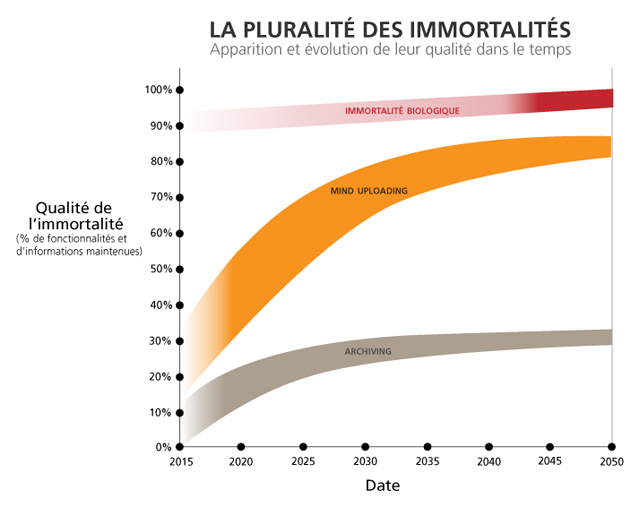
Immortality: digital vs. biological
Immortality is merely the continuation of our information and functionality in time. This objective can be achieved through two strategies: maintaining the current substrate or transferring to a new one. There are strong hopes for the first case, as medicine is becoming more sophisticated. Cambridge researcher Aubrey de Grey forecasts that we could be the first generation to reach the age of 1000 years.
In transferring to a new substrate, immortality is “downgraded” because information and functionality is lost :
- Immortality does not transcribe the complexity of our brains nor our interactions with the world.
- Cloning only transmits genetic information, so the interest in this method is relatively small.
While the transfer results in losing the distinct aspects of our identity, the idea of making a “backup” is gaining popularity. Even though medicine may ensure a longer life, it would not protect us from a simple car accident. Biological and digital immortality are complimentary.
Mind uploading
The transhumanism movement is taking hold of the concept of downloading a personality to a non-biological substrate (mind uploading). The computer would recreate the spirit of the individual by simulating his functions. The advances in neuroscience, computer sciences, and the research of Ray Kurzweil, indicate that artificial intelligence systems will be capable of modeling brain activities in fifteen years.
Sébastien Seung says that similar to the genome, the connectome is a map of the brain’s neural network where all of its synaptic connections are transcribed. Mind uploading is based on the premise that the connectome is the the vehicle for information. Our memories, experiences, and thoughts would be encoded by the neural network structure. In other words, the layout of the connections between neurons is responsible for the encoding of information. To reproduce a human’s consciousness and access immortality, it is sufficient just to map the neural network and model it on a computer.
Technical limitations
Immortalization must undergo a complete survey of the synaptic connections in the brain. For now, the mapping of neurons is the limiting factor. Scanning techniques only account for the structures of the neurons (0.1mm) when in fact it needs to map the structures of the synapses (.001mm).
The second limitation is informatics capabilities: modeling 100 billion neurons and 1014 connections demands enormous computing capabilities. Yet by using Moore’s law, it is predicted by 2018 there will be the end to these informatics constraints. In 2007, the Blue Gene computer modeled one second of brain activity (10,000 neurons and 108 connections) with only 10 seconds of calculations.
Feasibility
The first models will likely be in a primitive form, as it will not account for the ionic interactions or hormones that influence the brain. Yet the absence of these interactions might allow for a more reasonable brain….
Mind uploading (and the immortality that follows) that creates computer simulations of a human brain has numerous economic and scientific benefits:
- Models for drug activities
- Models for neurodegenerative brain disorders
- Models for metal illnesses (depression, schizophrenia, etc.)
- Deeper knowledge of the brain
There is consistent public and private financing for these projects, so it is probable there will be rapid developments.
Using personal archives
Because it is difficult to map the cognitive chain and its 1014 connections, one solution is to reconstruct through learning techniques. Instead of trying to recreate the exact neural network of an individual, inference are made about the logical chain based on reading archives. This will result in an avatar that has identical reactions. It is estimated that what a person hears, sees, and reads during their lifetime should not surpass one terrabyte of storage (according to Microsoft Research) and thus it is technically feasible. Yet it might be more humbling when starting with compiling a person’s activities on social networks and email accounts.
Immortality: A Facebook application
Imagine your Facebook account after 40 years of activities: all your jokes, comments, messages, shared links, etc. It would represent a massive description of your tastes, your lines of reasoning, your interests, your history, your values, etc. After a formal analysis of your account, it is possible to obtain your profile.
The formation of a logical chain to could be used to make a neural network. This type of technology has been used for over 10 years in numerous disciplines (economics, biology, environmental sciences, etc.) as a tool for predictions or recognitions. The artificial neurons have the ability to organize themselves automatically to optimize how they respond to a task. In 2007, I was collaborating in creating a network of neurons, which modeled the effects of a dam against a flood. Learning consisted of establishing values for each connection between neurons by comparing inputs and outputs. In the case of the dam, the input was the upstream flow and the height of the reservoir. The output was the downstream flow.
Through the interactions between the inputs and outputs of the neural network, we gradually got a near perfect simulation of the downstream flow. After coding for 1000 simulations, the learning gave very suitable results; the curves for the simulated and real values were similar, and the connection between neurons was close to accurate. To further refine the network, we accounted for 7000 values.
To simulate an actual human mind is a lot more complicates and requires a much more complex neural network. Yet the concept of comparing inputs and outputs remains the same. In substitution for the river flow, we use semantics.
To summarize:
Semantic analysis + social Internet use + Artificial Intelligence = immortality
Admitted the semantics are the limiting factor. Immortality through Facebook will soon be democratized and affordable given that:
- Social networks could easily be good archive database because they are widespread within populations and reflect our social behavior
- Thanks to the economic stakes in advertising, semantics have made tremendous progress
- Artificial intelligence is rapidly developing
- This technique is not based on any biological constraints, as the reconstruction the neural network is based on gradual training from archives
- The computing power required is less than mind uploading because it doesn’t require a complete connectome
To encourage this type of research, the National Science Foundation gave $500,000 to universities in Orlando and Chicago to “explore how researchers might use artificial intelligence, archiving, and computer imaging to create convincing, digital versions of real people, a possible first step toward virtual immortality.”
The applications of Facebook immortality
Facebook immortality will be a very primitive extension of an deceased individual. Mind uploading holds more promise in terms of creating quality in the artificial consciousness. However, this technology could impose some ethical problems. It is evident that the first Facebook immortality applications will not be named as such for marketing reasons. They will be used only during the lifetime of their users (people mourning friends and family) for psychological reasons. We are referring to active archives, such as second life+ and MyLife…and then after some time for psychological adjustment can we introduce immortality. Thus, it interesting to consider Facebook immortality and its potential misuses.
- The Alain Minc search
Executive boards will be able to create search engines to answer strategic questions based on the archives of geniuses. - Political mapping of an individual
Similar to the previous application, this will also analyze your political stance, and through your digital platform the program will allow you to vote. - Collective political mapping
In continuation to political mapping, the program could aggregate members who share the same digital political profile and could pose automatic guidelines by summing the values of its members. - Modeling democracy
By generalizing the the collect map of an entire electorate of a country, it’s possible to create a model of the acceptability of reforms or legislative proposals. - What would I do? Support in decision making
Based on the same principles as the Alain Minc search, but with more control over who is in the archives. - A more effective online dating service
Analyses the “digital love” between two profiles. - The Tamagotchi Lady Gaga
Cares for a digital friend by keeping them busy with the personality of a celebrity. - A digital paradise (immortality)
Sites like Second Life could evolve digital profiles of deceased people, and friends and family could log in to converse with those who have passed away.
For further reading:
- The series “Living Longer, Better and Maybe Forever” from Big Think (biologically immortality)
- The PowerPoint presentation “The Web Within Us : When Minds and machines Becomes One” by Ray Kurzweil at Google (2009) (technological developments in the context of mind uploading)
- M.L. Caliusco, G. Stegmayer, “Semantic Web Technologies and Artificial Neural Networks for Intelligent Web Knowledge Source Discovery“. Springer-Verlag London Limited. 2010. (notions based in semantics)
Find all the articles in #jesuismort by Silicon Maniacs :
- Weaving the web of death, an interview with Antonio Casilli.
Illustration FlickR CC : minifig
💬 Discussion
No comments yet. Be the first to comment!