
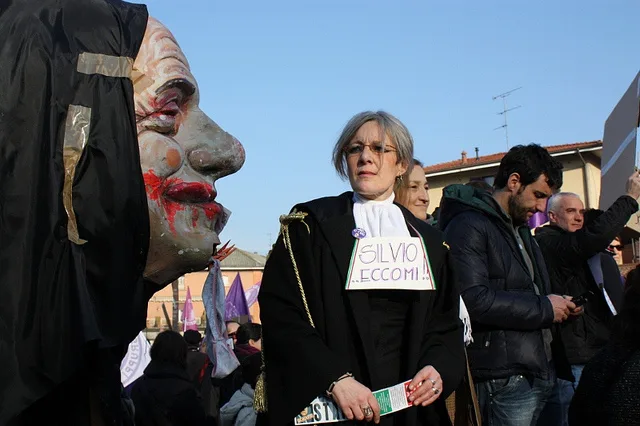
It’s official: Silvio Berlusconi no longer has a cell phone. On February 28, he explained his reasoning to his political party, The People of Freedom:
Be aware that your prime minister no longer has any kind of cell phone because he is subjected to every kind of wiretapping…Everyone considers it an infringement of liberty not to be able to speak freely on the phone. This is why I have stepped backwards in time and no longer use a mobile phone.
He also described himself as “the most persecuted politician in the history of the world.”
At a conference in Milan the day before, he reasserted his convictions that reformed legislation on wiretapping was necessary, qualifying it as a “barbaric customs that must end.” If Berlusconi gets his way, he will put “an end once and for all to privacy violations,” especially for people who are not being prosecuted.
Yet it is worth noting that this sinister device – which he is having a hard time separating from – is the reason he could face a heavy sentence for having sexual relations with minors. The famous “Rubygate” affair is based on a 700 page report, consisting largely on transcripts from telephone and text messages intercepted by the police.
Rubygate
Cristina Di Censo, the judge for the preliminary investigations in the case, confirmed on February 15 that there was “clear evidence” and gave the green light for the President to be tried in regular court (according to the process of an accelerated procedure). The first hearing will take place on April 6, and the verdict could be damaging to a man simultaneously pursued in 3 other cases. So far, he has escaped any conviction despite numerous indictments[FR].
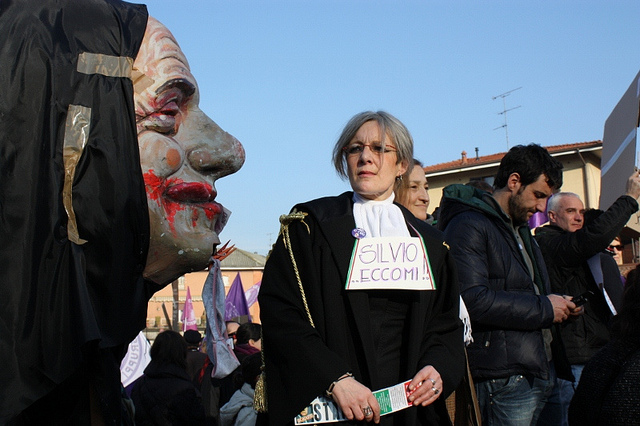
Meanwhile, the Italians have already found amusement in these massive number of extracts from their President’s conversations, published liberally by left-wing newspapers and often relayed to the international press. One group even went so far as to create the search engine Bungle Bungle, (a contraction of “Google” and “bunga bunga“), giving access to all telephone exchanges made public by Rubygate.
Many of these young women present at these “pleasure parties” were also brought into the public sphere through the scandal. The events, organized by Silvio in his luxurious villas (with at least two of the women minors at the time) were wiretapped by the courts. The location of their mobile phones made it possible to know that were participants. Their conversations and texts described sexual orgies, sometimes where Berlusconi was the only male involved. This transcript also highlighted the rivalries that existed between the women, along with the shameless encouragement from their own families.
If the President continues to affirm that he “Never paid for sex with a woman,” the records dating back several years are enough to cause serious doubt. In 2008 and 2009, he had paid intercourse with an escort girl named
, who he lavished with expensive gifts.The numbers battle
It’s clear why Silvio Berlusconi complained about the intercepted phone conversations. Like the Socialist party before him, successive governments repeatedly proposed legislation which restricts the use and disclosure of surveillance – yet none of these movements has ever gone into effect.
The latest bill was approved by the Senate last June, but not without being subjected to some modifications in response to criticisms from the OSCE and the European Parliament. Journalists and other citizens also strongly opposed the new legislation. Yet in the face of so much intense rapprochement, Berlusconi declared that 10 million people could be wire tapped without their knowledge, adding:
This is a serious problem – we are all being spied on.
A month later, the Il Fatto Quotidiano newspaper published “the real statics of interceptions” courtesy of the Ministry of Justice. Less than 40,000 people were wire tapped a year, consisting of 0.7% of the total Italian population (60 million citizens). The article also claimed that 80% of these surveillance activities were related to Mafia crimes. This is not an insignificant number, and Italians understand this investigative system is as effective as it is intrusive.
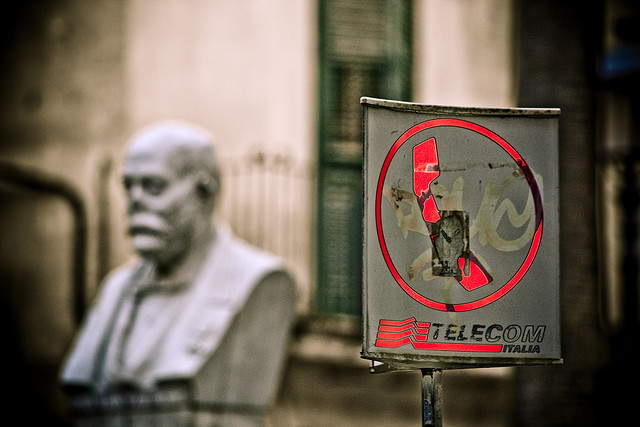
Known as “Mani Pulite“ (“Clean hands”), the extensive operations launched in 1992 by Judge Antonio Di Pietro helped to bring down the corrupt leaders of major political parties: the Christian Democracy (DC) and the Italian Socialist Party (PSI). Wiretapping bought to light the link between the Mafia and politicians, who have shared power for decades.
The shock should have been a turning point for the country, but it was at this moment that Silvio Berlusconi took advantage of the early elections in 1994 and won his first job as a governmental official. He probably was unaware that he would also be subjected to judicial investigations – including those based on the interception of private communications.
Constitutional reform
Since then, his numerous indiscretions were fed regularly to the press in the form of transcripts with different Ministers, employees, and women he frequently visited. It’s these incessant leaks documenting suspected abuses of justice that led Berlusconi to construct the idea that his persecution was by “rouge judge,” with the collusion of the press.
When his constitutional reform bill was adopted on March 10 by the Council of Ministers, Silvio Berlusconi and his Minister of Justice Angelino Alfano said they were ready to present a bill specifically for the regulation of wiretapping telephones. This bill would limit the surveillance of an individual to 75 days, and after that period the judicial system could not resort back to interception techniques. This includes cases where there is “serious evidence of crime” in common law, and in cases containing “sufficient evidence” of organized crime.
Additionally, the reforms would require the prosecution to summit its request for an investigation “in a manner established by law.” Antonio di Pietro, the head of the opposition party Italia dei Valori, summarizes the bill:
The Parliament would decide which crimes judges can investigate…so we can not conduct investigations on all crimes, but only those on which there is a consensus of the Parliament. Guess which side they will take.
Finally, the reform was adopted, and its solicitors became “directly responsible for the acts committed in violation of laws.” Translation: an open telephone conversation used for a conviction could impose substantial damages for those in power. If the prosecution wanted to appeal the acquittal decision it would be close to impossible, because they could no longer use electronic records in the case.
The Mafia takes a hit
The press, the only counteracting force to executives in questionable business affairs and a corrupt legislation, is now threatened. According to Giuseppe Giulietti, a spokesman for Articolo 21 (an association for the freedom of information) the bill on intercepting telephone communications aims to ” introduce censorship and control information to serve the consensus.” The legal text posed creates heavy penalties for the media if they print private transcripts.
Meanwhile, the Italian newspaper never stopped giving the public good reasons to revolt against attempts to constrain judges’ authority. The Ndrangheta, one of the most feared mafia organizations in the world, was nearly destroyed by the police due to tracking a telephone conversation between Giuseppe Commisso (nicknamed “The Master”) and his lieutenant. This one conversation led to 41 arrests.
Fortunately, it’s unlikely that the constitutional reform will be adopted anytime soon. The Parliament would need a two-thirds in each chamber for it to pass, otherwise it would be subjected to a referendum. In this predicament anything is possible, and misinformation is a weapon Berlusconi wields better than anyone – the media magnet “without a fixed mobile phone.”
__
Photo Credits: No Mas, paride de carlo, Sergio Maistrello, Niccolo Caranti
💬 Discussion
No comments yet. Be the first to comment!