
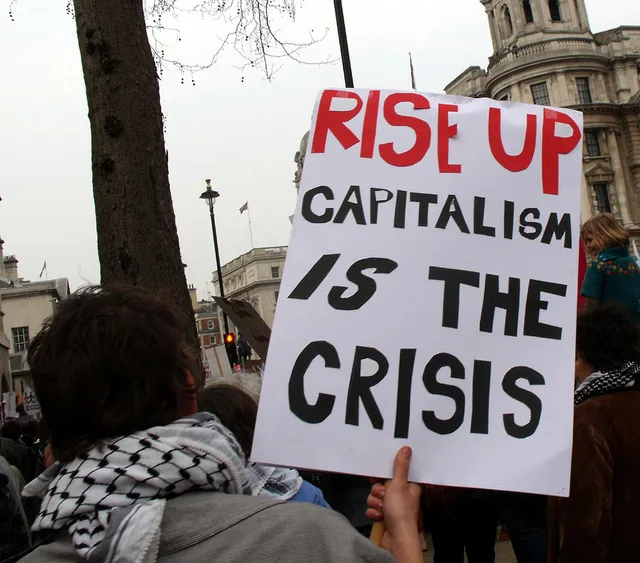
Tim Hardy is a software engineer and a blogger who enjoys quoting Alain Badiou. He is also an all-round activist fighting day and night against the 87 billion pounds budget cuts about to be imposed by the UK government. Hardy’s salt-and-pepper hair and beard hint that his forties are just around the corner – but when you see him distribute leaflets, shout slogans and passionately explain to a cashier the various impacts of the cuts, you can’t help but notice the vibrant, youthful spark in his blue eyes. This man could do activism 24/7 if sleep wasn’t a vital necessity. I met Tim for lunch near his workplace in Bermondsey, South London. During the interview, I felt guilty because while he was thoroughly answering my questions, his chicken and rice noodle soup was getting cold and becoming less and less appetizing. But there was no stopping him. We talked about the cuts, the March 26th demonstration, the role of social media in this mobilization. With the help of some friends, he wants to ensure demonstrators are safe and free to move.
Owni: A demonstration to promote alternatives to budget cuts is going to take place in London on the 26th of March, right?
Tim Hardy: Yes, the TUC - the Trade Union Congress, responsible for organizing the march – has 450 coaches to bus people in, and more people will come by their own means. Also, even though there is an official march endorsed by the TUC, there will be unofficial marches coming from different points in London, joining in on the main one. There are also plans to occupy key areas of the center. The movement ‘Stay there of one day’ plans to occupy Hyde Park for 24 hours and UK Uncut will try to block Oxford St. It is difficult to know how many people we are going to have. The TUC is very pessimistic, I believe, they are estimating 200,000 demonstrators. Most people think it is wildly under what we except. We had a million people for Stop the War [in February 2003] and we want it to be as large as that. There are also other groups, such as disability rights activists like Disabled People Against Cuts (DPAC) many of whom who are too physically impaired to make it to the march. So they are going to do a virtual protest online: it will be a map of the UK where you can place pins, photographs, videos and messages.
O: Since October, the social movement managed to foster a continuous, low-intensity mobilization against the cuts with the help of social media. Almost six months, this is quite impressive…
T.H: Exactly. We reached a point where there are actions every weekend, except the last one where we had a conference. The two weekends previous to that, we closed down every bank in central London [To protest against the cuts, branches were turned into day-care centres, libraries and even community centers, facilities the most affected by cuts]. The focus seems to be moving, at first it was on tax-avoiding corporations such as Vodafone and Boots. Now, attention seems to be shifting towards banks, who are the underlying cause of [the cuts] and who are tax-avoiders as well. The number of people involved has grown weeks after weeks. We went from 1 or 2 actions a day to 40-50 within the UK. And the movement got international: US Uncut, France Uncut, Ontario Uncut… It’s an idea whose time has come and is being spread by the Internet. For a long time, globalized capitalism has used its mobility to avoid paying taxes by relocating. We are firing back at them.
O. Do you think the internationalization of the Uncut movement stems from a new type of activism or is it relayed locally by student unions, anti-globalization groups and political parties?
TH: I’d say it comes out of all those things. UK Uncut has a very tight focus on one particular issue, but it is impossible to limit yourself, in the same way that the student movement started out as being about fees, the fee increases are the symptom of something else – the marketization of further education. It’s the idea that further education has a utilitarian value, you get an education simply to earn more money, therefore the Arts & Humanities are useless. We have seen a 100% cuts in funding the Arts & Humanities because “they have no economic value.” When the legislation on students fees passed in Parliament, the student movement changed and embraced broader ideological arguments. So has UK Uncut. It started being about tax-avoidance, but the more you scratched the more you realized tax-avoidance is part of a far bigger problem. For instance, it is related to the anti-arms trade movement and the peace movement: Barclays bank is the world’s largest investor in the arms trade. It is impossible to deal with one thing without realizing how interconnected those things are.
O: Previous demonstrations in London had to deal with a police tactic know as kettling, where cops surround groups of people and held them “prisoners” for several hours, as on December 9th on Westminster bridge at night with freezing temperatures. You are part of a team that is creating a tool, Sukey, to avoid future kettles. It lets users create an online map of a demonstration, update it live and thus indicate to other users where police forces are located. Can you tell us more about this project?
TH: It’s an application that is like a desktop publishing software, the software lets you control it but there is also an editorial team managing it. So it’s very similar to running a newsroom. We, as the core Sukey team, at the moment are just supporting demonstrations in the UK but we are going to release the software to the world under a GPL 3 license so that anyone can use it for free, modify it. We won’t be managing demonstrations abroad but other people can do it and we can advise those people. We hope to make Sukey strong enough, in terms of security and privacy. Right now, the criteria are strong enough for Europe but they are not strong enough for places like Egypt and Saudi Arabia. We want to change that and make it more robust, so that even if the government take the phone network down, people could have autonomous mesh network so that people can communicate many-to-many within the swarm rather that to rely on a central ISP. We would like Sukey to be used globally or in oppressive regime. But this is further down the road, right now we are focusing on the 26th.

O. It is striking how the anti-cuts movement in the UK has embraced social media and mobile technologies. I would expect left-wing groups to be tinted with elements of neo-luddism or at least be defiant of technological products such as smart phones that are products of the globalization.
TH: There is a huge number of issues around that. Apple products have the most appalling human rights, they also have the most appalling digital right issues. If you talk to digital rights activists, they will hate Apple. Mobile phones are also a tool of alienation and atomization. But we received praises from the extreme-left and anarchists for using those tools of alienation to empower people again. There is a certain pragmatism to it. If you have a certain ideological purity that says “I won’t do this, I won’t use this”, then you are never going to achieve any power. You need some pragmatism, I think. If not, you are going to get left behind. Sukey tries to position itself as not being political but obviously what we are doing is highly political and has a political impact. We get criticized from both sides, it’s a fine line to walk. We also have a no-so-easy relationship with the police, who is not happy about what we are doing. But at the same time we are not breaking the law so they can’t arrest us.
O. I’ve read that the Sukey team is considering including messages from the police in the application if they are respectful of the guidelines, isn’t it?
TH: th of February, they issued a statement saying that they would start using Twitter to warn people of kettles, with a ‘Twitter officer’ in charge of this. [They are also going to use Bluetooth to send messages to demonstrators]. But they did not once mention us. We will talk to the police within certain limits and we will say “you will never have our data”. If the police were to raid the Sukey office and take our computers, they would not find any identifiable data from us. We designed it in such a way so that people who contribute to the application are safe, it is all anonymized and we don’t have data storage. Period. Each demonstration, we start from a blank sheet. If we get raided, the police cannot use that informations to incriminate anyone. However, what we can’t do is, we have no control over the phone companies. The police can go to Orange etc. and request informations. We warn people so they know that, we tell them “your messages are being read”. Some groups criticize us for talking to the police, but you can’t please everyone. Had we completely refused to talk to the police, we would have been closed down by now. We’d rather keep going, and refuse them coming in our offices during demonstrations. For the 26th of March, we will not be the only one watching the police, Indymedia London will have an eye on them, and you could share your video on the recently launched VisionOnTV.
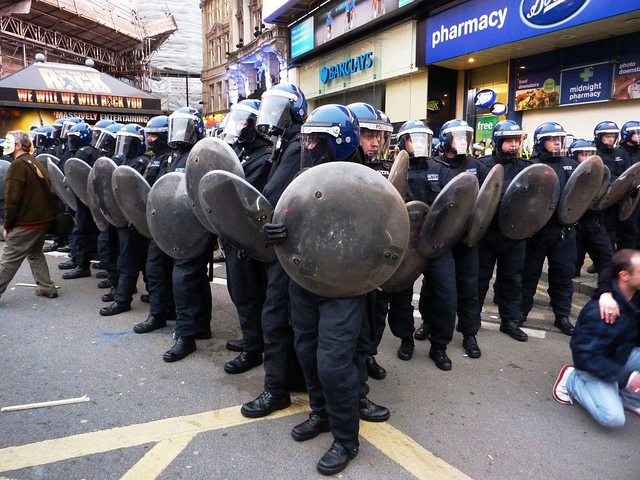
Since mainstream media are not keen on reporting on the demonstrations, the police take this as a green light to use violence. They are already stories planted by the police in newspapers and the BBC warning of “troublemakers” and violence. But reading comments on police blogs and forums like “we are going to kick the shit out of some students this weekend”, you can see their excitement at the prospect of violence. They know they can get away with it because historically they always do. It’s a minority within the police with this mentality, but the problem is they act with impunity because the police close ranks. We have seen it after the death of Ian Tomlinson: the police denied everything and got away with it. [A passer-by walking home, Tomlinson died after being hit in the head with a baton and pushed to the ground by a police officer during the G20 in London in 2009. The police officer caught on CCTV hitting and pushing Tomlinson did not face charges over his death.] They got away with it, but I think the balance is changing and it’s due to technology. Technology is an amazing tool for repression, we are doing the police’s intelligence work when we use technology. It is almost impossible to secure it, in the UK, if you use cryptography and you refuse to give your password to the police, you can go to jail for 5 years. That’s it. Then you may have a virus, a key-logger… Even if you know a lot about computers, it’s almost impossible to secure it. But technology also flattens the field of hierarchy, I’m not saying everybody is equal and there might be some overlap with older media but the price of entry is that much lower. Anyone can start a blog and become influential and if your message is powerful, you will get read.
O: Is that why your started blogging ?
TH: No, my aim in blogging is merely to explore. I’ve blogged for nearly ten years and I deleted all of it last year because I had serious reservations about the value of internet engagement. I decided to start again this year but it’s not ego-blogging. I’m entirely focused on the cuts and the roles of technologies and how they can make society more progressive. I’m not interested in the money, there’s no ads on my blog, I just want to raise the level of the debate. There is a small amount of well-established talking heads when it comes to the debate on social media, and they really miss a lot of obvious points.
O. Such as?
TH: Take Evgeny Morozov, in his book ‘the Net Delusion’, he has a quite nuanced view on the possibility of technology building a stronger civic society but in his interviews or columns, he takes a very narrow view that Internet is useless and just builds repression. Because it drives debate, that’s how media likes it, black and white and it sells books. So sadly, a lot of the debate ends up in intellectually lazy cul-de-sacs. A lot of people argue that online activism is just a pantomime and that it becomes an alternative to actions and short-circuits the impulse of actions. I agree this might be a danger of this happening but that’s not it. If 1000 people read an article and of them, 100 like it on Facebook and one person actually go outside and try to change things, that’s what matter. The rest is irrelevant.
💬 Discussion
No comments yet. Be the first to comment!