
Like any 9-5 worker knows, drinking regularly occurs at parties in the evening, as the beverage makes the hours slide by quicker. Last month, at a social gathering in an apartment overlooking the Villette, a curly-haired nerd with a laugh that indicated his quantity of alcohol consumptions, was kicking back from his #hackathon. It was an initiative organized by la Quadrature du net, the messengers of Internet freedom. In the time frame of a weekend, a handful of programmers, designers, and other Internet philosophers met in a Parisian hackerspace. Their objective was to work night and day on the second version of Political Memory, a collective site that records all the members of the European Parliament’s actions and votes relating to the digital themes discussed in Strasbourg and Brussels.
That nerd sparked my curiosity. The next Saturday I arrived upon an enormous building in the heart of Paris. The mixed ambiance was surreal. At the entry of the building, a young man sold me a cigarette and tried to push other knic-knacks to extract a few more dollars from my wallet. Yet when I entered and climbed the stairs to the fourth floor, I passed into a completely different universe. The floor was several hundred square meters, with cables competing for room on the wall and scattered pieces of processors that were thought to be obsolete. Standing there in the middle of the half empty room, about 15 developers were desperately coding lines (which would have been incomprehensible to the untrained eye). They agreed to refrain from the respite of smoking or drinking, and only shared the few words needed to advance their project.
In the company of all these developers, my attention turned to one in particular: a short and oddly dressed man, thick glasses, hair and beard in all different directions, constantly moving from seat to seat around the room – clearly orchestrating the masterpiece being written. Jérémie Zimmermann is the cofounder of la Quadrature du Net, and is without doubt one of the most animated people I know. While this is the first time I met him, he reminded me of the same league of cyber celebrities regularly in the press. From across the room comes confirmation of the mission of this isolated bubble: to progress, to push forth, to create another version of the tool that so enraged those MEPs bent on limiting Internet freedoms in the first place. Nothing voted in the European Parliament will escape these hacktivists.
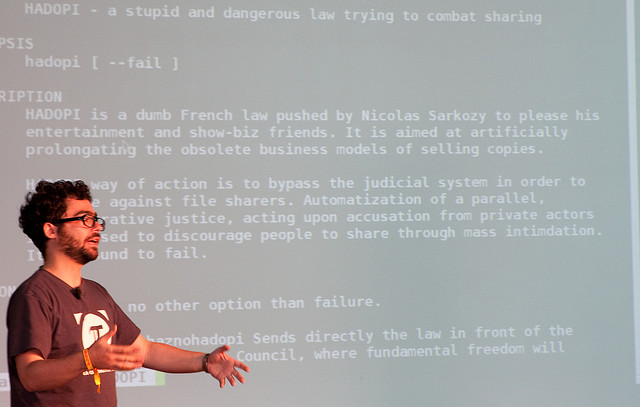
Jérémie Zimmermann in his element, during the Hadopi law debate
Sitting the corner in this office of illegal squatters, I could see Zimmermann was tirelessly involved in this project. On the wiki dedicated to the Political Memory initiative, each MEP has their own profile containing their national Party, their position in Parliament, and their personal website. Their direct telephone numbers to Brussels and Strasbourg are also provided, giving users the ability to instantaneously react to the official measures. Here lies the force behind Political Memory – a section of the site is entirely dedicated to votes highlighted by la Quadrature, and encourages members to become involved.
Taking the Anti-Counterfeiting Trade Agreement (ACTA) for example, the Gallo Report is a proposal on the enforcement of intellectual property rights in the market, and the Bono Report refers to the cultural industry in Europe. Every time there is a report, a directive or resolution – as messy as it is repulsive – concerns far or close to the net, the geeks at la Quadrature are on standby for significant amendments. The organization rates each amendment on its level of importance. After each vote, all the MEPs are assigned a score between 0 and 100. With the combination of the superior coding knowledge and some basic tools such as Search Engine Optimizers, each MEP’s status is ranked high in Google results (Often in forth place just behind their official page, their blog, and Wikipedia site). An ingenious mechanism – simple, bold, and perfectly oiled.
The group is still not satisfied – not because of the work they’ve already achieved, but because of too little media coverage. These ultra-politicized nerds decided to spend time to spruce up the project, notably with symbolic badges “awarded” to Parliament members who voted against the mentality of this geek squad. Reuniting this weekend, these activists are mainly focused on establishing an open source infrastructure. This new version is particularly appealing to other organizations, as there is the possibility to adapt the tool according to users’ interest. Greenpeace will be able to fight similar battles for environmental issues, Reporters Without Boarder for freedom of press, etc.
Beyond the technical prowess, Zimmermann and his entourage contribute to a work that has a bigger purpose. Given the growing number of similar initiatives, political leaders will eventually have no choice but to engage with hacktivists on a range of policies. Similar to WikiLeaks, these guys are redefining the concept of civil activism with a site that captures the words of politicians.
Without the combination of events which drove me to this confidential space, I probably would not have discovered this three-year old initiative. With an honest sense of humility, I believe I am part of a more responsible generation because of these type of projects. Yet the objective to influence the political arena and defend freedom has its own paradoxes. While the conservative right gathers unsurprising marks, the left-wing range between the best and the worst according to the database. The most consistent at the top of the charts are the greens…and the extreme right. Politicians like Bruno Gollnische almost always get the same disappointing results, signaling the political struggle that Zimmerman and la Quadrature were bound to face eventually. A battle of hacktivists vs. the political system. Essentially, these individuals are serving a purpose far more broad than they might realize. Instead of becoming lost in some obscure lobby, they chose their path: Action.
La Quadrature du Net has also implemented a similar system for the national level. Policy Memory allows users to consult the score of their civil representatives on votes within France, such as the Hadopi law. If you are unsatisfied with the status quo, nothing prevents you from calling and voicing your complaint. See the work done by RegardsCitoyens.
—
Photos Credits FlickR CC : Pachango/ verbeeldingskr8 / mksavage / Bold&Blond /
💬 Discussion
No comments yet. Be the first to comment!