
I recently hosted an online conference called “Email is dead: what is the alternative?” (Which you can find here[FR]). It led me to consider the issue and identify concrete elements on a sentiment felt by all: that email became a deadweight in the professional world.
The youth are the masters of communication (especially text messaging)
In the words of new media champion Mark Zuckerberg (turning 27 this year): ” Young people no longer use email, they prefer SMS. They want something more immediate like texting and chats for their conversations.”
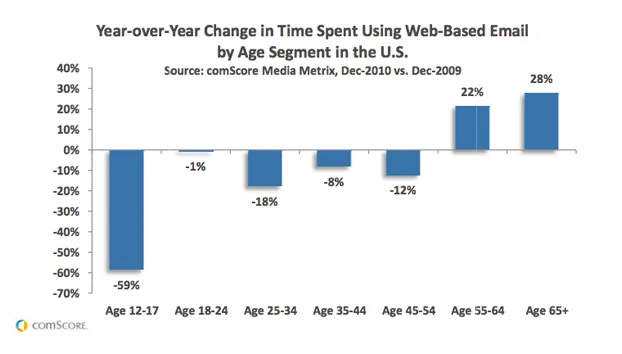
In taking a look at the statistics from comScore, the data seems to correlated with Mark’s perspective:
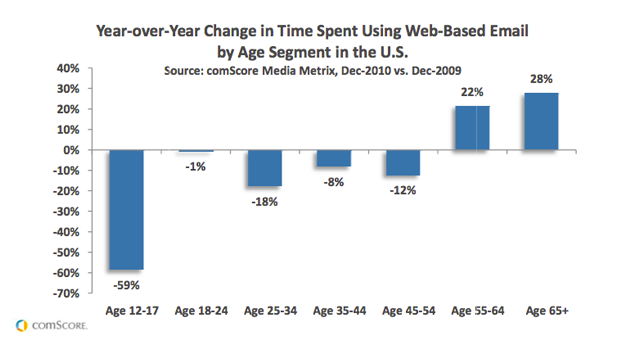
It is nothing groundbreaking…anyone who has a teenager knows that asking him to talk over email is so last century (technically this is true). Nothing compares to an instantaneous electronic message which is now the foundation of interpersonal exchange.
In fact, email is almost exactly like how it sounds: a mere electronic version of traditional paper mail with a mailbox and “carbon copies” (CC). The only innovative feature is the blind carbon copy (BCC) which is a crossover of the classification logic from 1980’s computers.
Communicating faster…and better?
In the last several years, research has been interested in how generation Y introduced these tools into the workplace. What is the real impact of email?
- Will Twitter and other social media tools take the place of email?
- Is email an outdated technology that is only good for corporate communication, or is it still a complementary form of communication?
- Is instantaneous communication just a fad for the youth, or is it signaling deeper changes in our culture?
- Finally, is there something else that can replace email?

Got email?
While email is an excellent tool for interpersonal communication, other tools are emerging onto the scene. While everyone still has the ability to write a 5 page email, no one really wants to. Messages now are reduced in length and are more informal. They adapt to the rhythms of business demands, the importance of the message, and the circumstances for which they are sent. This gives way for other forms of communications like tweets and chats.
The main problem with email is that it was used for everything – even if it was not the best method of communication. Sent to one or more people, its overuse (in assuring no one missed any information) resulted in watering-down its significance. Even though there may be measures to prevent spam, so much of what is received goes directly to the trash.
It sometimes could be more effective if a person got up from his chair and screamed the information into open space, but that would disturb the overall tranquility. Seriously, email is not adaptable to several different demands of communication, such as wide distribution with the intention of interaction. It might as well be an urban legend: email is not made for collaborating or coordinating. Have you ever tried to work on a document without getting confused in the exchanges and made mistakes on the final draft? Have you tried to fix a time for a meeting between several people without having to impose a date because a consensus could not be found?
This is exactly why social professional network provide a significant added-value. In offering search capabilities, coordination, and planning features, the need for email is automatically reduced. You have an announcement? In place of sending it to everyone and their mother, you can post it on the community’s homepage. You need to organize a meeting? Publish the invitation and follow the RSVP responses. If you need to rework a document, make a wiki (a shared word document) and track the revisions of the collective document.
The gateway to social networks
All this should indicate that “more social media = less emails.” According to Nielsen, this is not the case:
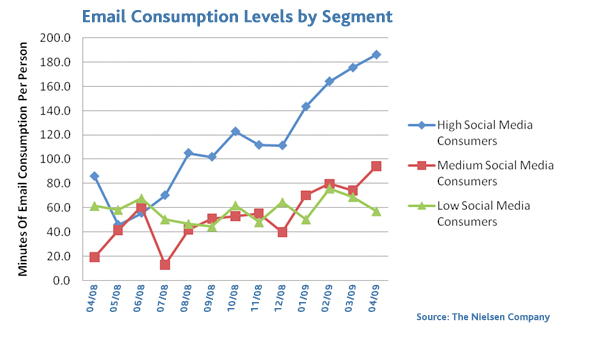
The data above displays the opposite: the more you are a user of social networks, the more email you “consume.” The reason is simple: email addresses are being integrated into social media as a gateway – they serve to transmit notifications, news on the network, and a mode to follow updates (a direct messages on Twitter, a new photo posted on Facebook, and so on). Email induces interactions. The value of information is no longer directly in the email, which is completely disposable, but on the social platform.
These email notifications insure a smooth transition from one world to another. Once the reflex to log onto a social network is spontaneous, the notifications become obsolete. It’s a question of transition and evolution of purpose. For example, some companies have increasingly started to communicate directly through social networks for their public relations directives. Facebook is the new corporate chat channel (although this leads to concerns such as confidentiality and data ownership).
Don’t be fooled: the transition will be long, which is more of a reason to aim to be ahead of the curve. Social networks are tools focused on the user, not on the process. Email will always have a place for certain situation (Validating registration, direct marketing, notifications from social networks) but its value will change. This shift may take months or years, but ultimately there are faster, more efficient and accurate ways of communication on the market.
—
This article was initially published on the bluekiwi blog
Photo Credits: Flickr CC Frank Gruber; Biscarotte
Translation: Stefanie Chernow
💬 Discussion
No comments yet. Be the first to comment!