

Is net neutrality really on Europe’s agenda? It seems unlikely given how the initiative launched on the subject by Neelie Kroes (Vice President of the European Commission and responsible for digital strategy) played out. After its nascence on June 30 2010, it was rejected at the end of last year as well as late March of 2011. The debate to regulate net neutrality will probably be rejected in late April or May, depending on the version.
More than a coincidence of several delays, the information OWNI received reflects a profound disinterest countries have in net neutrality – with the exception of France. The contrast between the two is striking – on one hand, the report by Laure de la Raudière and Corinne Erhel marks not only the desire to protect a “neutral and universal” Internet, but also efforts to initiate education. Conversely, the European Commission concluded there is no need to regulate the networks, since there is too little evidence to prove that net neutrality was violated in Europe. Yet barriers to neutrality do exist, and the Commission’s disregard of the issue is becoming more unacceptable for the cause’s supporters.

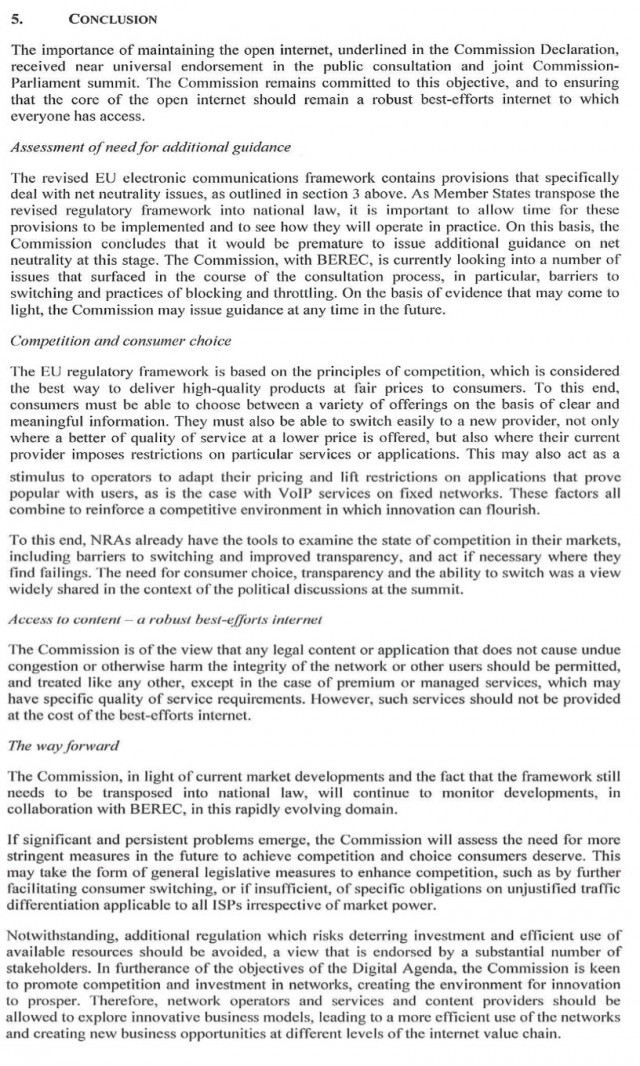
Excerpt from the Commission's provisional findings on net neutrality.
“It would be premature to issue additional guidance on net neutrality at this stage.”
Within French borders, there is an assertion that net neutrality is being violated and thus is a “concrete problem.” Four pillars, broken down into nine propositions, form an integrated set of objectives to hold the European Commission accountable. Pillars 1 and 2: create within the laws of net neutrality an enhanced role for the French telecoms regulator l’Arcep – who can guarantee “Internet quality.” The third pillar includes studying the market’s interconnections and financing solutions for a fair network infrastructure. Finally, a create a counterstrike against Internet blockage when surveillance is considered a priority. Another welcomed development outlined by la Quadrature du Net seeks to protect the interest of users by calling on Europe to do the same in how they approach these different issues.
The war is far from over, given the watered-down findings from the European Commission.
It’s always beneficial for politicians to speak in terms of an “open Internet” because the expression is loaded: those who are not strictly in favor of net neutrality can still appear in a positive light. French MPs who have dared to demand a “universal and neutral” Internet act as a strong signal to the European Commission. In fact their statements are just empty promises.
The Commission’s findings are in line with a wait-and-see approach, as they believe that there are too few violations on neutrality in Europe to launch regulations. The adoption of the third Telecoms Package should be sufficient to brush over the minor differences.
Assessment of the need for additional guidance
The revised EU electronic communications framework contains provisions that specifically deal with net neutrality issues, as outlined in section 3 above. As Member States transpose the revised regulatory framework into national laws, it is important to allow time for these provisions to be implemented and to see how they will operate in practice. On this basis, the Commission concludes that it would be premature to issue additional guidance on net neutrality at this stage. The Commission, with BERREC, is currently looking into a number of issues that surfaced in the course of the consultation process, in particular, barriers to switching and practices of blocking and throttling. On the basis of evidence that may come to light, the Commission may issue guidance at any time in the future.

Mobile Internet is at the heart of the Commission’s first conclusion, in particular the choice of providers. The institution recognizes the difficultly in changing operators, explaining that the shift must be based not just on financial and quality demands, but also when operators “impose restrictions on specific services and applications.” Conversely these barriers are not sufficient to justify action on the Commission’s part, who believe in the power of a self-regulating market.
According to the report, if the consumer can easily transfer to different mobile service providers it could “act as a stimulus to operators to adapt the pricing and lift restrictions on applications that prove popular with users, as is the case with VoIP services on fixed networks. These factors all combine to reinforce a competitive environment in which innovation can flourish.” Clearly, everything is very simple in this new European bubble.
More than 25% of mobile service providers do not offer access to the Internet
Often cited as an example, the VoIP firm Skype has been battling for years with operations to have access to mobile Internet. One of its representatives, Jean-Jacque Sahel, expresses his disappointment:
The situation is not good for corporations concerning IPs. According to Voice over the Net, who organizes these firms, almost a quarter of operators in Europe prohibit VoIP. So to hear that the European Commission said there is not enough evidence – at what point does it deem fit to act? How far will it go? Is it fair to expect that Internet restrictions are so pervasive that it’s just too late to reverse it?
The study analyzes the limitations of mobile Internet in EU’s member countries. “There are sixteen countries which we are sure there are restrictions on VoIP on the Internet in general – twelve of which has detailed documentation,” explains Jean-Jacques Sahel. “There are hundreds of mobile operators in the EU and 28 operating restrictions on VoIP.” More then 25% is not sufficient to move the Commission to action, as they are rooted in their ideology of laissez-faire.
Jean-Jacques Sahel explains it’s not sufficient to merely give users the ability to switch service providers – several other barriers exist. In reality, only a few large companies hang in the balance: “If providers block Google or Facebook, then yes, users will obviously leave. For companies like Bycons and Skype, not so much. Who will change providers just for all those other sites?”
The European Commission’s attitude is so exasperating, and not just for the companies affected. Supporters of net neutrality are disappointed in the weak findings from the Commission. In France, we can only observe the debate’s advances throughout the highest levels of government, and hope that this movement spreads to Brussels. There is still a long way to go, thanks to the confidence the Commission has in the liberal market along with member states being unfamiliar with the issue. Out of 27 countries, only 12 responded to the call for the public consultation on net neutrality launched on June 30, 2010.
At the moment, the “Net Neutrality Communications” is circulating among the various branches of the Commissions, although this does change the foundation of their positions. It has been noted that lobbying on certain operators is particularly effective.
In the report, the French deputies Laure de la Raudière et Corinne Erhel evoked the possibility of another white paper published in May. Recently, Jonathan Todd (Spokesman for the DG Digital Strategy linked to Neelie Kroes) declined to disclose before April 19 when the Net Neutrality Communications would be adopted.
Update: Since the original publishing of this article[FR], the European Commission has released the highly anticipated “Net Neutrality Communications.”
The document below does not differ significantly from the provisional outline OWNI managed to publish earlier. Despite some rewording in an attempt to consider a more than hypothetical future for net neutrality, the European Commission’s final opinion is disappointing as it refuses to go beyond a basic principle which puts consumers in the background.
–
💬 Discussion
No comments yet. Be the first to comment!