
Augmented Reality – that is, the real-time, tridimensional mixing of real and virtual elements, interacting with each other on a display – has been around for a long time in popular culture. From the tough sunglasses-wearing protagonist of John Carpenter’s to the more recent Robert Downey Jr. as Iron Man, we’ve all seen our cinematic heroes interact with this staple feature of sci-fi worlds. And, even though we might not be as familiar with the many ways this technology is currently employed in a variety of fields, from surgery to military operations, we don’t really need to have access to an operating room or a pilot’s cabin to come across it. Common examples of AR can be spotted regularly during football games, when logos or lines appear superimposed to the field as the game progresses normally, or at fairs, where the most tech-savvy brands show off their marketing skills by augmenting minimal leaflets with 3D models activated by a simple webcam.
Serious needs and commercial toys aside, I would like to explore a little more the middle-ground between the institutional and the promotional: the now established figure of the so-called “prosumer”, be it the average iPhone or Android owner or the avant-garde new media artist. In other words, the implications of the potential mass use of Augmented Reality.
With netbooks bringing the laptop to new lows – in terms of price and size – and especially with the explosion of smart phones and tablets, online experiences are more and more consumed on-the-go. That is to say that the already very actual Web – you know, the “virtual” is dead forever – is now increasingly intertwined with real movements and routines. The app revolution has brought mobile devices to a new centrality in social and cultural relations, and AR has been one of the most interesting new territories that resulted from this convergence. Platforms like LayAR or Wikitude, along with open-source libraries like ARToolKit, have made the creation of Augmented Reality applications easier and more accessible, although remaining dependent on proprietary environments and hardware. These signals suggest the technology is breaking through and, in a few years, we can probably expect AR to become a daily routine for most of us. As for now, our mobiles are already pointing us to places of interest via GPS, showing us detailed info about them and requesting us to check-in and out (e.g. FourSquare).

Beyond the commercial aspects, which I am sure will develop further in due time, this new outdoor consumption of hi-tech gadgets has unsurprisingly encouraged several neo-Situationist apps, like WalkSpace or 7scenes, inviting users to experience and share their own local psychogeographies. These apps allow you to create customized tours on a city’s map, tagging the hot spots with personalized media and information that appears on smart phones once the curious flaneurs 2.0 reach them. Since the urban youth across the world increasingly shares the same Internet-powered fascination with city explorations, AR could well become a must-have tool to experience fresh air and rich information environments truly at once. It’s a bit ironic, though, that the Debordian dérive – in the contemporary actualization of his dreadful society of spectacle – is being carried out with help from the most fetishized gadgets around. Psychogeography is about creating your own borders, but, when it comes to smart phones, the choices don’t go much beyond iPhone and Android.
Despite the proprietary infrastructure allowing all of this, it’s a good sign that the possibilities created by AR are also being explored in socially-critical and culturally-constructive ways. Predictably, in fact, the philosophical and aesthetic implications of what best represents the “simulacra” (consensual hallucinations), described by French philosopher Jean Baudrillard, have inspired several artists to intervene on this new ground.
On the same lines of the aforementioned apps, for example, the NAMAland art project by Conor McGarrigle points you to all properties owned by the National Asset Management Agency, a body created by the Irish government in response to the financial crisis and the deflation of the Irish property bubble. As intangible as it is, the crisis becomes an entity that, while remaining ghostly, you can at least pinpoint.
Speaking of ghosts, social issues are also targeted and effectively manifested in Border Monument: Frontera de los Muertos by John Craig Freeman and Mark Skwarek, both members of the Manifest.AR collective. The artists created the 3D model of a “calaca”, a commemorative skeleton figure from the Aztec tradition, and inserted one in several spots around the USA-Mexico border, where remains of dead immigrants had been found. This way the sinister legacy of the social imbalance between the two countries can be expressed through an immaterial monument, only viewable through mobile AR devices like smart phones.
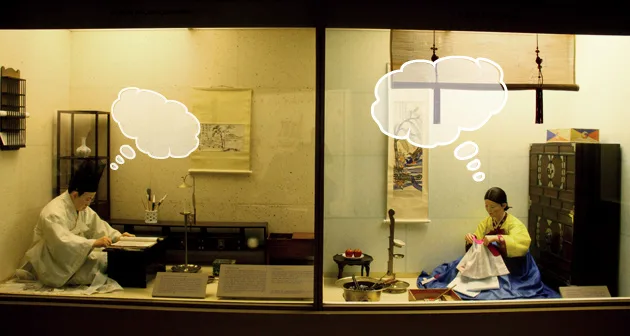
Another project targeting global culture and history is George Bixby’s These Walls Could Talk, an augmented audio tour created as an alternative narration for the dioramas in the Culture Halls of the American Museum of Natural History, in New York. Instead of the static perspective on ever-changing cultures provided by the museum’s original audio-plays, to be listened to while looking at the various dioramas, Bixby’s platform allows people to contribute with new audios and geo-locate them in the institution’s quarters, creating a pluralist and evolving soundtrack to the visit. The standard, historically-accepted depiction of different cultures is thus enriched by a fresher look, potentially challenging its assumptions.
 One last piece I would like to mention is the “Improved Reality” project by Julian Oliver (also author of the amazing puzzle game levelHead) and Damian Stewart, Artvertiser. Presented at Berlin’s Transmediale 2010, the project allows – through a special pair of glasses a la They Live, a smart phone or a laptop’s webcam – to see advertising billboards turn into art. Not only does the software recognize and obscure the ads, but it works as an open platform for public art.
This last connection of AR to advertising is particularly meaningful, especially considering the specific times these projects are happening. Augmented Reality art wedges itself in a special pocket of history, a moment before the experience becomes of mass commercial appeal and in the right time for it to be questioned. Apart from their aesthetic and conceptual value, the ephemerality and the difficult retrievability of the aforementioned pieces well exemplifies the boundaries of the technology itself, something that still isn’t of automatic use. We’re still in time to ask ourselves about the creepy tracking functions that reveal our every move, or experiment with its aesthetic possibilities.
Before we know, though, it might all become banners and ads, or – no big news – another crowd-sourced playground for us to work at. Then, when the technology will truly be part of our lives, AR art will probably evolve to challenge its environments structurally – walled gardens, proprietary hardware and all – rather than aesthetically. So far, it’s mostly either a great Situationist walk or a fascinating monument to a different or hidden history. In terms of art history, I’m curious to see what Manifest.AR will do in occasion of their (uninvited) intervention at the next Venice Biennale, following a similar incursion at MoMA during the Conflux psychogeography festival in New York. If you have an AR-enabled display handy, you should go check it out.
—
Photo Credits: George Bixby, Flickr CC nicolasnova and turkletom
💬 Discussion
No comments yet. Be the first to comment!