
The final death toll was revealed last night, indicating that the battle caused more than 100 deaths according to the Red Cross. The rebels claim the loyalist troops suffered heavy casualties. The leader of the opposition puts the figure at 250 wounded, a number that the government denies.
This story may sound familiar. Better yet, it’s a one-size-fits-all format. Try it yourself and read it again with , , or .
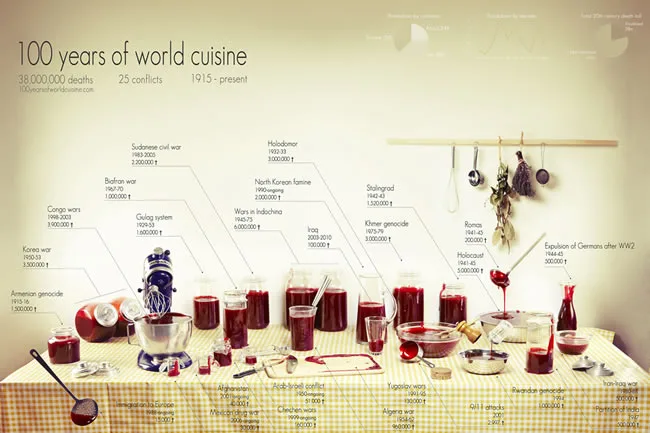
While we tend to judge conflicts by the number of victims, the dispassionate throwing of numbers onto a page invalidates the real sense of proportion. By giving meaning to these figures, the 100 Years of World Cuisine project wanted to contextualize the situation’s gravity. As indicated on the homepage, “This project remains artistic in scope and does not aim [to be scientific]. It sheds another light and (sic) restores meaning.”
The kitchen is the place you least expect to find violence emerge – it is the heart of our homes. In setting the stage here, the photo reinforces the absurdity of war.

Click to enlarge the image
This approach adds an additional perspective to OWNI’s recent article “The war on terror in numbers.”
The scales of war
While working on this projects, we constantly challenged ourselves to justify why we were choosing certain conflicts over others. Why this war and not another?
Far from providing answers, the project aims only to question the relative importance of different conflicts. For example, the comparison between the Israeli-Palestinian conflict and the wars in the Congo is particularly striking. The Israeli-Palestinian conflict – which is regularly featured in newspapers’ headlines – took the lives of a little over 50,000 people. The Congo however resulted in the deaths of more than 3 million people between the late 1990’s and early 2000’s, yet the general public was not versed on its details by the mainstream media.
In the documentary Décryptage [FR], a journalist claimed that there are just as many reporters in Jerusalem as in the entire African continent. While this may not necessarily be true, the above comparison omits any artificial hierarchy of victims – its only on the concrete number of deaths, and possibly the number of deaths per kilometer [FR] (a theory which claims that the media privileges coverage of events closer to its readership).
Conflicts’ treatment seems to be done arbitrarily, leaving the door open for editors and users to decide how much importance should be given to each event.

Counting the victims
The choices made in the photo also highlights the difficulty in counting and defining the parameters of the conflict. Did the Vietnam war take place between 1965 to 1975 as is perceived by the American public? Or did the conflict occur between 1946 to 1975, given that the Vietnamese people endured a conflict with the French before entering into one with the American army? Or, again, could it have begun with Japan’s occupation in 1940?
It’s impossible to objectively state the beginning and end of certain wars. “Establishing peace” often allows room for looting and population exchanges, as shown in the deadly expulsion of Germans after WWII. From 1944 to 1946, more than 500,000 Germans were killed while attempting to flee westward – questioning whether peace was actually achieved.
Counting the victims is an equally impossible task. The context around war often preclude death certificates, and many of those who disappeared leave without a trace. Historians must resort to estimating the number of deaths, which leaves room for error.
In an article, Bruce Sharp explains how victims were counted in the Khmer genocide. The first investigation on the matter was conducted by the government that followed the Pol Pot regime. They went door to door and interviewed Cambodians on the death toll, which they eventually estimated at 3,314,768 victims. Yet some historians also compared the pre-genocide and post-genocide censuses, and they estimated that number of “missing” people was roughly 1.7 million by the end of the conflict. Other interviewed direct survivors and asked them how many times people close to them disappeared, which resulted in roughly 1.5 million victims. Current estimates put the number of deaths at 2 million. Precision is a total fantasy for historians in regarding the number of victims, as they are unable to reduce the margins of error to less than 200,000 victims.
This example highlights the need to take a critical look at catastrophes’ statistics. Considering how numbers are given as “evidence,” without a thorough analysis of the calculation’s origins, only reinforced the cold laconic nature in how the number of victims are reported.
100 Years of World Cuisine is a project by Clara Kayser-Bril, Nicolas Kayser-Bril and Marion Kotlarski.
💬 Discussion
No comments yet. Be the first to comment!