
“Does anyone know anything about what is happening in Egypt or Libya?” wrote journalist Adrian Cantor on 23 May, 2011, in the online edition of the regional Romanian newspaper Informaţia de Alba (Alba News).
“I don’t understand why our media has stopped presenting, at least weekly, a review of the situation in these areas,” Cantor wondered.
Breaking news from Egypt
When the wave of protests broke out in North Africa, the two Romanian all-news private television stations Realitatea TV and Antena 3 decided to send reporters to the zones affected by the civil unrest. They were later joined by the main commercial TV station Pro TV.
The public broadcaster Romanian National Television was among the last television channels in Romania to send a team to Egypt, in spite of the fact that one of its reporters, Adelin Petrisor, has an extensive experience in covering conflict areas. Petrisor is known for his war reporting in the former republic of Yugoslavia, Afghanistan, Irak, and has published several books about his work as a journalist.
In some cases however, the stories that came in from Egypt mainly revolved around the Romanian reporters themselves, as if local human dramas were not considered interesting enough for the viewers.
The news channels seemed eager to display news alerts announcing that “soon our footage team will report from [name of location]” as if the important message was: “We are there, we are the first journalists from Romania to be on the spot”, rather than the actual news about the civil unrest.
Under the title “How much Romanian journalists are suffering” in the Romanian website Vertical News, a critical reader commented on the way Romanian journalists were covering the protests in Egypt.
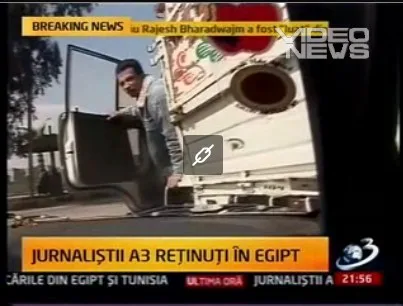
When Romanian correspondents were interrogated as part of a security check by the local Egyptian police, Romanian television channels reported the matter as “Breaking News”.

During the protests in Egypt, on-scene Romanian reporters were interrogated as part of a security check by the local Egyptian police: “Breaking News”?
“What are the first images that come to mind when you think about the protests in Egypt?” asked Denisa Macavei, describing herself as “a reader from Bucharest”.
“Maybe the retention of our journalists by the police in Cairo?” she continued in a sarcastic tone.
“For almost a week I see on TV what is happening with the Romanian journalists. But I don’t find out from them what is really happening in Egypt, what is the situation of the poor people living there. I don’t know what happened with the workers from the Pyramids, how they can buy food or medicine, what happened to the sick and injured people. I don’t know if schools are still open in Cairo and in the rest of the country. I haven’t found out how the resorts, that were usually visited by a lot of Romanian tourists, now look like. I haven’t heard if the water is still drinkable.”
Instead of providing newsworthy information, “the TV programme was interrupted to show the testimonial of a journalist cameraman from Antena 3 who described how his car was stopped by the police and the Romanian team was given juice and cakes,” Macavei complained.
“In spite of having special on-scene correspondents in the middle of the events, our televisions are broadcasting images from CNN. This makes me come to the conclusion that the Romanian story from Egypt has become our reporters’ personal adventures on the spot, and that it is guided only by interest in the sensational”.

Cristian Zarescu, special correspondent for Realitatea TV
Cristian Zarescu, the special correspondent for Realitatea TV, has been repeatedly criticised for his tactless coverage of difficult situations. Before going to the ravaged Chinese province of Sichuan in the aftermath of an earthquake, he declared at the airport that he was “happy to go to China”.
A war? I’m in
Romanian news channels followed the same pattern and kept the same sensationalist focus in their coverage of the war in Libya, emphasising the fact that Romanian correspondents were physically present in or near the conflict area.
Realitatea TV presented reports from its special correspondent based in Tunisia, 60 km away from the Libyan border, as “breaking news” or “news alerts”. The phone reports mainly dealt with the atmosphere in Libya.
On the internet, opinions differed about the way Romanian journalists covered the conflicts. Some readers praised their courage while others deplored that “our journalists go to a conflict area as if they were reporting about an accident on a national road.”
According to a survey conducted by The Romanian Institute for Assessment and Strategy – IRES, 74 percent of Romanians viewed the media coverage of the military intervention in Libya as rather correct and professional, while 15 percent thought the opposite. Ninety percent of the respondents had heard about the conflict. Television came out as the main source for news about the war (84 percent) while 7 percent of the respondents said they had looked for information on the internet.
An earthquake that destroyed two divorces
The earthquake in Japan was another event that led Romanian televisions to turn their attention to the international scene. In that period, the news stations were intensively broadcasting prime time reports about the divorces of two famous Romanian couples, which according to viewers’ ratings, were considered number one news.
After the earthquake, the interest of the audience shifted to the situation in Japan, which was presented in apocalyptic style.
Gandul, one of the main Romanian newspapers, published an email sent by a Romanian citizen living in Japan. “I got angry when I saw Romanian TV stations describing Japan as a nuclear hell”, wrote Cecilia Ioana Manoliu, a PhD student in political studies at the University of Tsukuba.
Manoliu lived 170 kilometers away from the area affected by the earthquake and saw the arrival of many refugees in her city of residence. She was indignant about the Romanian coverage of the situation in Japan.
“People from Romania are queuing and fighting when they receive food for free. Here, people are calm but Romanians are worried and want to buy iodine to protect themselves from the radiation. Japanese people are going to work. Romanians keep discussing on TV if the moon is going to fall from the sky while in Japan people are looking for survivors and have more volunteers than needed. Where are the Hell and the Apocalypse in all of this?” Manoliu asked.
Where is the world?
These journalistic lapses need to be placed within a larger context.
Romanian media outlets usually do not cover foreign policy. As cynical as it might sound, there is a prevailing general presumption that people are not interested in events happening in other parts of the world – because they are too far removed from their daily reality.
Speaking about the protests in Egypt, Mircea Badea, a Romanian TV anchor, declared that he didn’t understand the huge interest of Romanian media in the events.
Mircea Badea is the producer of a press review programme on television and has received several awards from the Association of Romanian TV Professionals.
Internal political fights or the divorce of a famous Romanian couple are presented as breaking news on television while foreign policy coverage is reduced to news about what happened to Knut, the cute polar bear, or Kate Middleton’s new fancy dress.
Daily news programmes on generalist TV stations offer little international news or even not at all. News channels hardly show more interest in the topic.

Adelin Petrisor, war correspondent for Romanian National Television
The public broadcaster tries to keep a balance and broadcasted a higher amount of reports about Libya It also sent a reporter on the spot to cover the death of Osama bin Laden.
It is however often criticised for not doing enough to promote its quality programmes. As a consequence, the audience’s interest and rating figures have dropped dramatically in the past few years.
Both 2010 and 2011 were turbulent years in terms of international events and revealed a Romanian press mostly unprepared to cover conflicts or tragic situations.
Obviously, war correspondents cannot be trained overnight and need more than just the courage to dive heads on into difficult situations and the ability to do keyword research on Google.
The challenge ahead is to raise the interest of the Romanian audience in international issues, whenever the assumption is that there is none. And this will not happen overnight either, especially not with sensationalistic breaking news stories.
The Romanian media’s disregard for foreign policy news and concentration on national affairs look like a form of autism. It is difficult to say whether it is a case of national autism or only journalistic autism.
—-
This post was originally published by the European Journalism Centre
Photo Credits: Flickr CC Cayusa
💬 Discussion
No comments yet. Be the first to comment!