
Editor’s note: The following post was translated from graphism.fr’s ongoing segment “Vendredi c’est graphism” (Friday is Graphism). We do realize it is no longer Friday – it’s actually Monday. We apologize for your Monday blues, and encourage you to stretch your imagination and pretend it’s Friday. If you need assistance, we’ve attached a link to Rebecca Black’s Friday to help get you in the mood. Enjoy
H3ll0 everyone,
Behind every script kiddies design, Helvetica Black Hat, and pixel-perfect cyber-offender, a hacker is potentially hiding! For over three years now, I’ve been trying to spread the word about the benefits in mixing hacking and design, and the interest that designers have in taking part in various forms of hacking.
Without distorting or misusing the word hacking, designers should start implementing “hack” projects such as graphic Trojan horses and sound viruses. Designer: To hack your own projects or those that other designed, you’ll have to relearn everything!
Today, with this special post of “9r@ph!$m Fr!d@y” (Graphism Friday), I will introduce the latest designers and projects that take an interest in hacking. Notably this includes the anatomy of a computer virus, Matthieu Tremblin’s latest works, a short piece on the relationship between design and hacking, an audio hack, and bugged posters… And last but not least, a “WTF” about hacking design and graduation ceremonies
Happy Friday… and happy graphism!

Let’s start with this week’s video, which is all over the web thanks to the computer virus it introduces. This video breaks down the story of how the “Stuxnet” virus was spread. As you might recall, the “Stuxnet” virus was initially designed to attack and destroy the Iranian nuclear power plants and enriched uranium factories.
Directed by Patrick Clair and written by Scott Mitchell for the ABC1 Australian show “Hungry Beast,” this video graphically and elegantly introduces the virus. The source code is still available online for your “entertainment.”

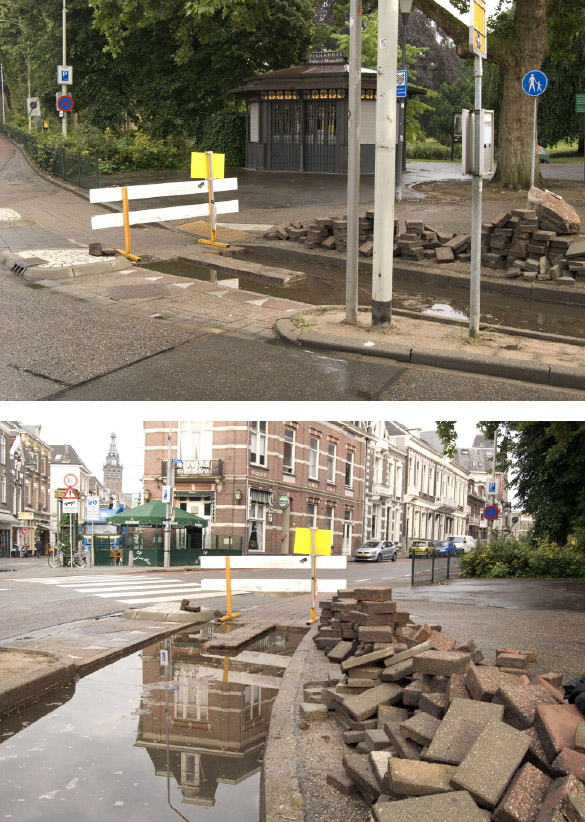
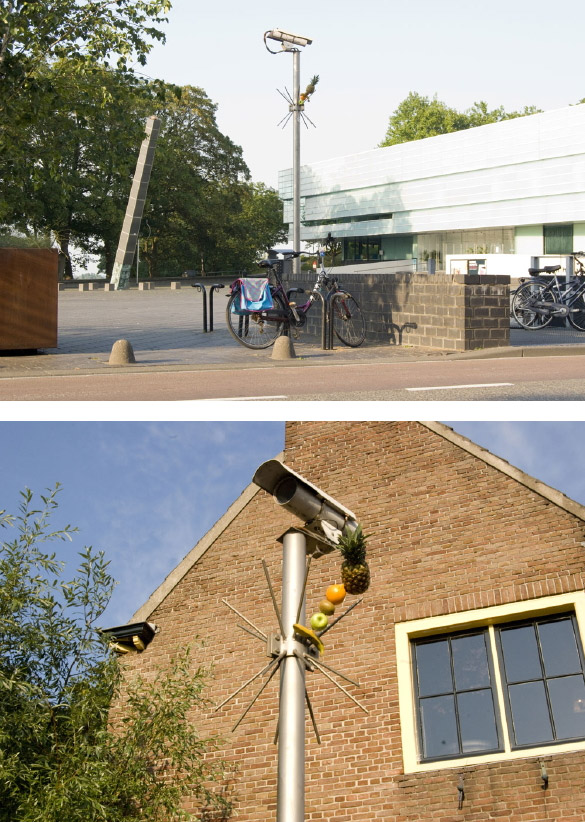
Matthieu Tremblin, a young French man living in Rennes and Arles, also uses hacking design. He finds his inspiration from independent and spontaneous expressions in the urban sphere, and his approach questions legal and symbolic systems.
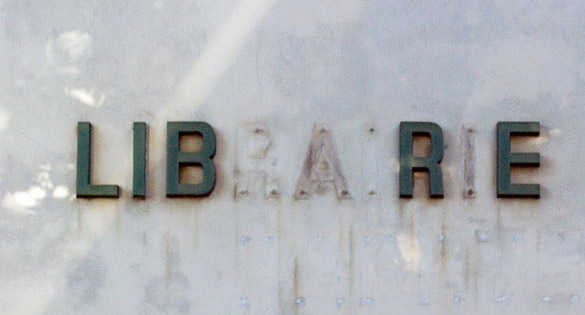
In the works he published recently, Matthieu introduces three interventions in the urban sphere, in particular the Cobble Jetty video (which is a remix of the Spiral Jetty, the famous LandArt work by Robert Smithson). One will also appreciate his fruits brochette and librairie/libre works (a play on word, librairie meaning “bookstore” and “libre” free).
Due to making use of “hacking” in the public sphere, there is now a true form of urban hacking.

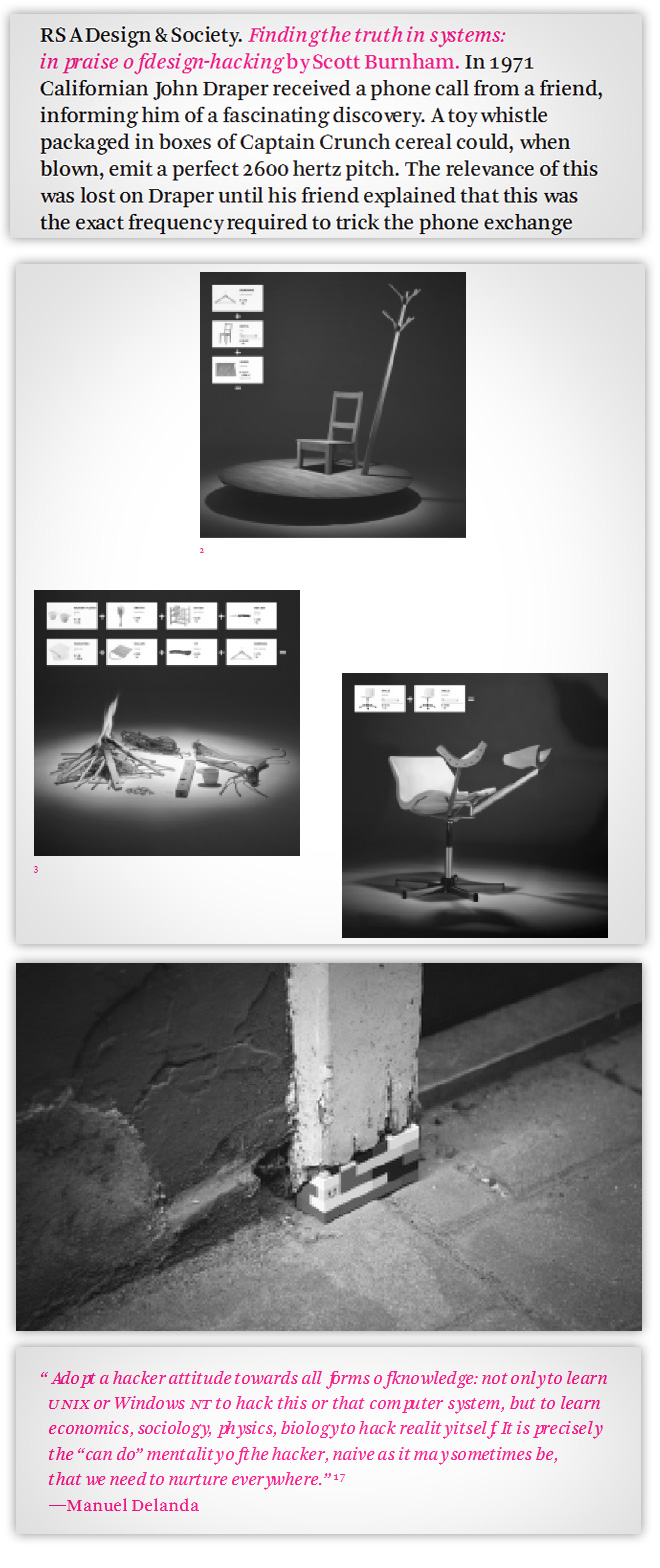
This week was rich in writings regarding the relationship between design and hacking. In this booklet, author Scott Burnham offers an overview of the “hacking phenomenon” associated with design. Scott Burnham poses the question whether it is simply another aspect of postmodernism in design history, or if on a deeper level this trend shows a certain civic resourcefulness that was masked under decades of consumerism.

Alright, let’s move on to the latest GRL project, directly from 54th Avenue in New York. Entitled “L.S.D,” this project is a commercial visual “hack” with an audio experience attempting to make us perceive our environment in a different way.
About the project:
“Research and recent innovations have led to an amazing increase of types and uses of visual displays and screens; indeed, in our predominantly visual culture, they are everywhere. A typical person carries at least one device with a screen, is presented with them in public places, uses them at work and in many leisure activities. They are so ingrained in our everyday acts and habits that we don’t even notice them anymore. L.S.D invites its users to engage in a new perception of their daily environment.”
This hack is therefore composed of:
- Two LDR (light depending resistor) mounted on a suction cup, allowing the sensors to be mounted on any screen surface.
- An analogue synthesizer converts the light input to sound waves. This device can be used in many different configurations and feeds from any light sources. Even if L.S.D can be controlled by any light source, its design is aimed at screen reading/listening.

Let’s get away from this hacking business for five minutes. Let’s talk about computer bugs, including the fabulous Nathalie Pollet posters from the Pam&Jenny studio. This graphic design studio created posters for the “Share/d Heritage” conference, organized by Scam at the Royal Library in Brussels. This conference addressed issues concerning enrichment by digital contemporary artists and preserving cultural heritage online. The processes rely on using hijacking scanner, and the result is very elegant with stretched and staggered shapes… A very nice idea indeed!


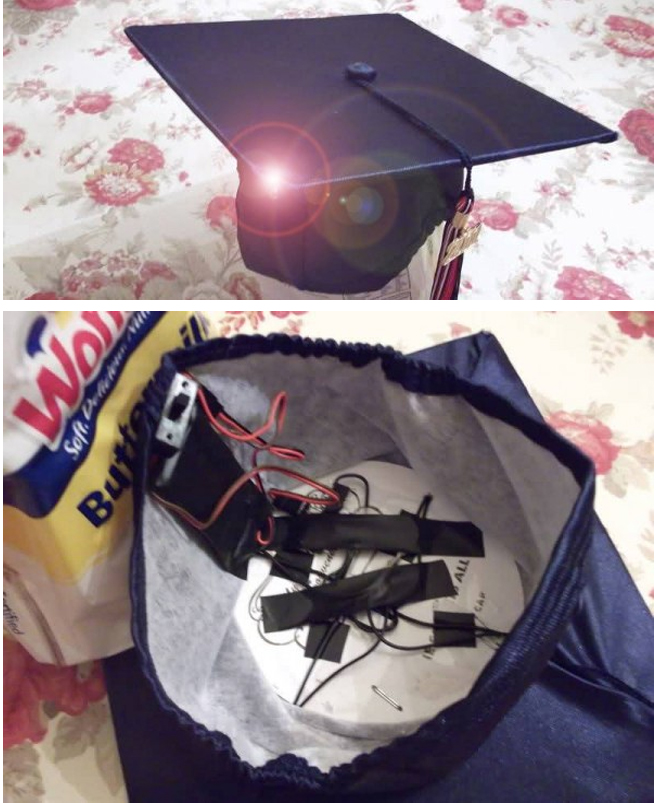
To end this week: a WTF-Hack-Design by a young American graduate from an electronic school. He set up his graduation cap with an infrared LED, so that it would produce a message in Morse code. As you may know, the infrared is invisible – nobody noticed it in the room. But cameras and mobile phones picked up the message.
Does it remind you anything? [FR]

If you want to study this topic further more, check out this book “hack”, or these two documents; the first on design hacking as a generative process, the second on simple and concrete examples of design hacking. Finally, I also had the pleasure to present my project “Hacking Citoyen” on Silicon Maniacs [FR]. Again, it’s all about design hacking!
G30ffr3y
–
This article was originally published on: Graphism.fr
Translation: Stefanie Chernow and Marie Telling
💬 Discussion
No comments yet. Be the first to comment!