
I moved to Amsterdam a couple years ago, with a background in multimedia art and an acquired interest in architecture. It turned out that, if you like both new media and the built environment, the Dutch capital is the perfect place for you. In my time here I’ve been to countless events, from Pecha Kuchas to 2-day conferences, from exhibitions to nuit blanches; most of them were somehow concerned with the intersection of digital networks and public space. The Netherlands is the country with the biggest online/Twitter users ratio, and its tech-savviness is m atched by an historical obsession with urban planning. In other words, public space – both visible and invisible – is taken seriously here.
Before landing at Trouw (the local postindustrial venue that hosted many of the debates I mentioned above) the Cognitive Cities brand was born as a simple blog and later expanded to a 350-person, 2-day event in Berlin, held in February 2011. Divided in two parts – first day conference, second day workshops around the city – CoCities invited “urban planners, designers, technology geeks, environmental experts, public officials, urban gardening enthusiasts and cultural influencers” to take part in a conversation about the future of cities.
Yesterday’s talk in Amsterdam was the first of a series of iterations of the successful format, which in later months will also be exported to New York (October) and London (next January). This time there was no second day, but at the end of the evening co-organizers VURB and Volume launched a call for participants to their next IoT workshop. The 3-day event will most likely take place in the span of the next PICNIC festival and it is meant for “architects, planners, coders and others interested in prototyping applications for a more writeable city.”

As I have written above, I have seen countless presentations in these last two years and I have to say the whole thing is usually more fun and less stressful when designers are talking, rather than academics. They tend to be more visual and usually prefer a big image with maximum two sentences in helvetica slammed on rather than endless bullet lists with minuscule lettering. Made exception for a few slides, CoCities proved me right once again.
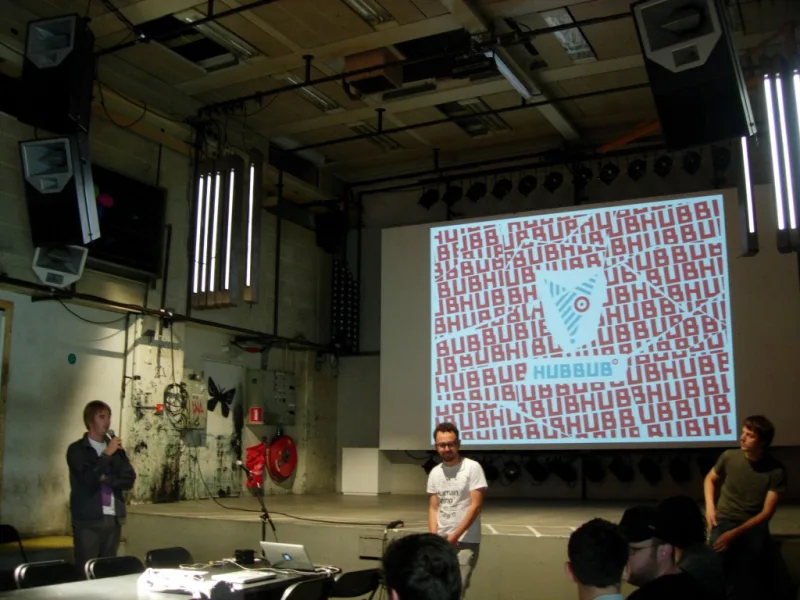
The first speaker was Kars Alfrink, founder of the Utrecht-based Hubbub studio. The designer discussed the importance of play – and game design – in the urban experience, starting from the example of crayon and paper VS pre-packaged toys. He argued a playground fostering creativity from the ground up is much better than a corporate box for limited expression. While the gamification of the city will not necessarily save us, according to Alfrink the real potential lies in the behavioral process of gamers and in the socializing dynamics that activate between them and public space (e.g. playful street art, which repurposes infrastructure, alley cat races, or fantasy city games like the Finnish Shadow Cities. The literacy of the networked city is something that resides in people, not things.
Katalin Gallyas, behind the Amsterdam
Opent project explored several issues related to open data initiatives in the Dutch capital. Her presentation was a bit harder to follow (read: more textual), but it put important concepts on the Cognitive Cities map – for example the initial quote: “Open data is a public good, but only if you can find it”. To make data available it is crucial to engage different actors, like the public itself – through crowd-sourcing – and institutions, like universities. Being a part of the Open Cities network helped a lot to overcome the initial lack of support and raise increasing attention among both politicians and developers/hackers.
The third speaker was VURB’s own James Burke, who tackled the issue of vacant space and the best ways to make use of it. An immediate idea is squatting of course (1 billion people in the world already do it), but unfortunately the practice has recently been made illegal in the Netherlands. Other ideas are converting the abandoned areas in arable land (as seen in Detroit), sharing spaces for co-working or communal activities (e.g. praying), or recycling those spaces only temporarily, like with Berlin’s pop-up restaurants. A future challenge and an interest of VURB’s is the mediation between those in need of space and those who own it (urban incubators, housing companies, governments), enhanced by physical and digital networking.
On a more theoretical note, Volume Magazine’s Edwin Gardner outlined the techno-utopian scenario of the Algorithmic City. In the first part of his presentation the design researcher pointed out how, in architecture, algorithms are today mostly used to create quirky shapes and do not address real planning problems. He then proceeded to outline a history of the architectural use of algorithms, from System Dynamics founder Jay W. Forrester to the much quoted Christopher Alexander, via Will Wright, father of the popular video game Sim City. Finally, he proposed the institution of a building code, algorithmic master-planning, and algorithmic zoning. The first would work as “an open standard, object-oriented programming platform with an ecosystem of API’s and apps empowering civilians and city authorities, amateurs and professionals”, an “interface between us and the built environment.” The second instead would be a departure from “shock-and-awe urbanism” towards “incremental urban growth”, with “room for smaller parties and individuals to participate in real estate development and the making of their city.” Finally, algorithmic zoning would be dynamic and “respond to local market demands and not the global financial market.” I found these last three propositions extremely interesting, albeit more for their utopian courage than their technocentrism.
The CoCities evening ended with a presentation by Vincent Schippers, Alexander Zeh and Caro van Dijk, who eventually addressed the audience launching the IoT workshop I mentioned above.
Overall, the diverse speeches all made something very clear: public space is still definitely about analog humans and built environments, but it can also learn something from the openness of digital languages and networks.
—
Photo & Video Credits: Cognitive Cities
💬 Discussion
No comments yet. Be the first to comment!