
At the end of June, Creative Commons International published a fascinating book - The Power of Open – which tells the stories of more than thirty different creators from all corners of the globe who achieved success in sharing their innovative projects using Creative Commons licensing.
The Power of Open. CC-BY.
It’s a pleasure to see the variety of applications used under this licensing, such as films, music, publishing, journalism, education, design, and more. This open infrastructure allows for the exploration of new ways to create, using all that the Internet has to offer.
It’s important that this book is diffused in France, where Creative Commons licenses are still relatively unknown. Last May during the eG8 conference in Paris, the Minister of Culture Frédéric Mitterand explicitly refused to speak to the “father” of Creative Commons licensing, Lawrence Lessig. But these attempts to disregard CC are in vain, because the use of Creative Commons licensing continues to grow at an impressive rate (as the graph below illustrates). Almost 500 million works have been licensed under CC since 2003. Even in Beaumarchais’ domains (and Hadopi…), it is no longer possible to ignore a phenomenon that buzzes at such an amplitude.
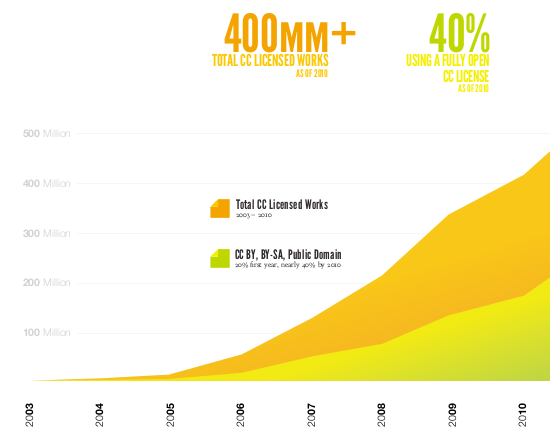
Number of works licensed under Creative Commons since 2003. CC-BY
Even though The Power of Open does rehash the stories of pilot projects (the now famous Ted Talks conferences, Al Jazeera’s Creative Commons Repository or the open archive of the PLoS – Public Library of Science), it doesn’t fail to offer a brilliant panorama of the numerous lesser known initiatives, which are just as remarkable and instructive.
Having hastily devoured the text, I would like to share with you a few of my thoughts on the advantages of using Creative Commons licenses.
Save on inferred costs of copyrights
Everybody keeps on saying that author’s rights are essential to encourage, but they never tell you about how expensive inferred transaction costs can become when taking the “All Rights Reserved” approach. Any use of a work that requires a prior authorization also requires contracts that must be prepared and signed, attorneys to pay, research to be made on any queries made about any specific rights, the list goes on.
In some cases, these management costs are simply too much to bear and strangle a project before it can begin to prosper. This is what happened to Pratham Books, an Indian publisher of childrens’ books:
Being a small publishing house, we don’t have the capacity to personalize licensing each time an interested party wishes to use our content. Creative Commons licensing has allowed us to form agreements with numerous partners which has taken the weight of judicial negotiations off of our shoulders and the loss of time and money that such negotiations required with it [...] In a small company like ours, time is extremely important. In our case, Creative Commons licensing has helped us economize on time, money, and energy.
These transaction costs are also one of the reason that ex-singer and bassist for the group Tears for Fears, Curt Smith, chose to use Creative Commons licensing for his solo career. He describes how he was “overwhelmed by requests to reuse Tears for Fear songs.” With Creative Commons, by authorizing in advance the non-commercial use, allowed him to concentrate on what he loves: making music. Creative Commons licensing is also an opportunity for him to start collaborative projects with people met on social networks like Twitter and Facebook (The Social Media Project).
The designer Nina Paley explains that she decided to use free licensing when we realized that it would be virtually impossible to settle all of the legal questions that would arise while producing her first film Sita Sings The Blues. It is now distributed for free under CC and is a huge success.
Same thing for Melinda Lee, previous judicial affairs manager at MTV, who observed that so many opportunities were missed by the channel because it couldn’t negotiate rights for certain content fast enough. She decided to start her own project, Uncensored Interview, a website produces celebrity interviews, which she has in part licensed CC-BY so that others, fans as well as other companies, can take advantage of them.
Creatives Commons is becoming, little by little, a “legal standard” by allowing project creators and managers to dodge large investments required to implement a legal framework. This is how the Open University was able to save so much money in developing its open pedagogical platform and content, OpenLearn:
To begin with, we had budgeted 100,000£ for legal fees to establish viable licensing for OpenLearn. However, we were able to economize this money because we adopted CC [...] Using a well-known license helped us to get others involved. We were able to explain the advantages of these independent CC licenses and to avoid asking our partners to develop and adopt specific internal licenses to work with us.
Playing the dissemination card
Creative Commons are in touch with the Internet, because they authorize the reproduction and re-presentation of content, allowing them to circulate on the web where classical copyrights would have tied such content up.
Many of the projects presented show that it is possible and even more advantageous to diffuse content rather try to protect it, especially in reference to online journalism.
The American public journalism website Pro Publica (similar to OWNI or Agora Vox) has also deliberately chosen to allow the reproduction of its content on the internet so as to increase its visibility and to favor the circulation of information. The terms of service of the website proclaim, in bold face, “Steal Our Stories!” Thanks to CC-BY-NC-ND licensing, the website controls the dissemination of its content (no commercial use, no modification). And it works – Pro Publica was the first “pure player” news webste to win a Pulitzer prize in 2010 for its investigations into the consequences of Hurricane Katrina.
The Qatari channel Al Jazeera chose the same strategy in placing its video reports under CC-BY licenses in the Creative Commons Repository. The impact of the content’s visibility is extraordinary, especially considering the 723% increase in views after the uploading of images of the Egyption Revolution and countless cross-posts. Al Jazeera is also one of the leading suppliers of content for YouTube Video Editor, which makes it much easier for Internet users to remix videos.
The Global Voices platform, which specializes in cross-posting local and citizen journalist blog articles, uses a different aspect of Creative Commons licensing to help disseminate information – they make translating easier. Even though translation is a legally considered an adaptation of a work, therefore expressly forbidden by principle, the articles published on Global Voices can be quickly translated into at least a dozen different languages by a team of volunteers on the platform. The benefit of this is obvious as the audience becomes amplified. This method allowed Global Voices to be on top of covering events such as the Tunisian Revolution and the earthquakes in Japan. Its articles were even sourced by traditional media outlets such as the New York Times and Reuters.

—
Article originally published on :: S.I.Lex ::
Flickr CC  karindalziel
Update: 11/07 at 22h15, Lawrence Lessig was, in fact, present at the eG8 conference in Paris, according to reader commentaries.
💬 Discussion
No comments yet. Be the first to comment!