
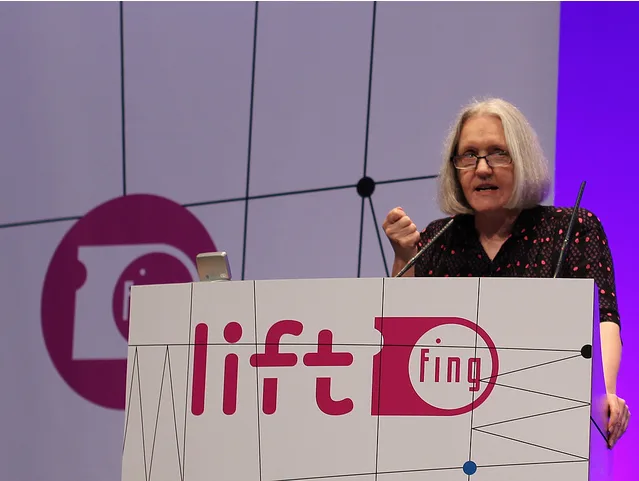
For American sociologist and economist Saskia Sassen, who introduced the 3rd edition of the Lift conference last week in Marseilles, cities have become a strategic space for any and all technological applications. To what extent do the technologies produced and used in urban space change that city? “At a moment where everybody is asking themselves how to use cities, and diffuse services in urban space, the question of knowing whether technologies urbanize a city or not seems important to me.”
Cities need to be hacked
A certain technology gives technological capacities that go beyond the technology itself. When big businesses use technology, it does so in a different way than the average citizen. It starts off differently. Its objectives are different – even if the tools are technically the same. The technology functions in an increasingly vast space, and that space never gets smaller.
Cities are a complex, anarchical place. Yet the use of technology within an infrastructure allows that infrastructure to function – not necessarily the city in its entirety. “The question is therefore to look at how we adapt or try to adapt the technology to the city as a whole.”
Saskia Sassen on stage at Lift 2011 in France.
“It’s indispensable to see that a city isn’t simply the sum of its parts. A city is where people, cultures, and subcultures exist and thrive. This is how cities are able to adapt, react, and continue to exist like Rome, Marseille, and Istanbul have done. Every city reacts differently.”
We have to start understanding urbanism differently. What is an urbanized oil rig? What is a city with dead urban spaces? Is a city merely a bunch of skyscrapers next to each other? “Our cities are strange. They are living organisms that mix with and continue to respond to the what we do to them,” explains Saskia Sassen.
Can we rethink how we approach urban space? Can urbanism be open source? How should we think about cities and how they’re hacked? Can a city be hacked? Do cities feel? When is a city too intelligent, too sensitive[FR]? When a bench ejects the person trying to sleep on it, or when a trash can spits out what you just put it in because you’re supposed to recycle (like the artists JooYoun Paek and David Jimison proposed at the Toward the Sentient City expo in New York in 2009)? How does a city speak?
Saskia Sassen told the audience that in the 1980s, Riverside park in New York was known for being dangerous – to the point where people who walked their dogs in the area brought their dogs for protection. By walking their dogs, little by little, they took back the park. The surge of dogs led to the delinquents’ departure. Today, the park is a magnificent place and the property around it increased in value. “Our practices are kinds of programs that we can connect with others’ practices and programs.”
“When we talk about smart cities, the problem is we think about technical systems that deurbanize the city,” explains the sociologist, mentioning the Sondgo business quarter in Séoul, and Masdar City in Abu Dhabi (which she previously explained in an article for McKinsey Digital).
The technologies adapt themselves to the each building, but this deurbanizes the larger urban space of the city. Intelligent systems incorporated into the cities’ open and expanding systems are, in fact, closed systems. How can and should cities’ other systems interact with such a closed system? How do we get around their rigidity? How do we hack them? Should we?
Intelligent or “smart” cities are currently operating in a closed system with limited possibilities and potential. The technologies used aren’t visible. “Yet, to be interactive, to integrate the diversity (and thus the advantage) of cities, they should be visible, and accessible to those who encounter and use them.” The smart city relies too heavily on technological obsolescence that risks rendering the city incapable of adapting and reacting….
“We need to work on urbanizing technologies rather than developing technologies that deurbanize our cities,” says Saskia Sassen. Technologies used in cities need to be adaptable. Cities need to be able to be hacked! If not, our ability to adapt – which has proven its utility over the course of the centuries – will be diminished if not die.
Dangerous developments in smart cities
American writer and designer Adam Greenfield, author of Everyware and head of Urbanscale since 2010, talked about civil responsibilities in the networked city.
“When we use the term ‘networked city,’ we generally imagine something futuristic,” explains the designer. In IBM and Cisco brochures, the concept is thrown around in a way that makes you think it isn’t completely realized. Yet, the networked city is already here (Greenfield explains the idea, name, and use of this expression is influenced by the French Marxist sociologist Henri Lefebvre, who died before the rise of the Internet). The city is a place where the population is implicated and essential, especially when we think about the very sophisticated little computers they have in their pockets….

Adam Greenfield on the théâtre du Pharo's stage in Marseille.
In today’s cities, we are surrounded by objects and spaces that have their own digital identities. Urban spaces are increasingly characterized by objects that can do things, like Tom Armitage’s Tower Bridge in London that warns commuters via Twitter when it’s going to be raised. We are witnessing new forms of surveillance developing, not only by cameras and microphones, but also by more subtle means. Tens of millions of people encounter these technologies everyday and we need to learn to evaluate their risks.
To better understand what problems may be created, Adam Greenfield developed a list of effects, from least offensive to most consequential.
The first example is a sensor from Finland. As you may know, Finland plunges into darkness for a large part of the year. Therefore, cars are more dangerous for pedestrians – especially for children and elderly. Sensors are placed on roads, and alerts vehicles if pedestrians are present. The system saves lives and has been met with glowing Finnish approbation. Even if it doesn’t archive any data, the system still collects data about citizens without their knowledge.
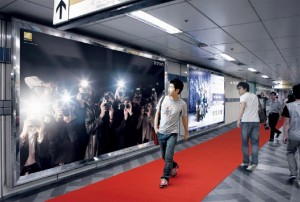
This Korean billboard is more annoying. The ad portrays photographers, and a red carpet was laid out in front of the poster. When someone walks by, the “photographers” take pictures and illuminate the area with a series of flashes. The idea is to give people the impression that they’re a movie star. But people weren’t exactly pleased with the flashes – they were more surprised and annoyed. The operation isn’t dangerous or worrying, but it shows a certain lack of respect and represents a nuisance. It is therefore a good example to show the degree of possible pernicious effects.
Much more problematic is this Japanese machine that tries to analyze your face to determine your age and gender, and to propose drinks that should correspond to your taste. “Such a machine,” explains Adam Greenfield, “tends to discriminate and pigeonhole people into set stereotypes and categories. It’s the opposite of what we want from a city, which is embrace and increase diversity.”
This billboard created by a French company is even more troubling. It identifies your age, sex, and your ethnicity and tries to allure your attention by showing ads that correspond to your profile. Such technologies, says Greenfield, are so menacing that he would like to ask the Mayor of New York to put a stop to it as quickly as possible to limit an explosion of support for these ads (like the New York Times called for a few years ago).
All of these examples, while ranging in their degree of harmfulness, are at least easy to analyze. How do we evaluate problems caused not by an object or system, but by interactions of different systems in public space?
For example, in Wellington, New Zealand, a video surveillance system was introduced to monitor car accidents. The populace was asked how they felt about the technology, and overall they approved of its installation. Later on, the system was updated with facial recognition technology – and the citizens weren’t consulted for the simple software update.
How do you predict developments like this one? For Greenfield, the global openness of public space data is a democratic necessity. Such an openness would predict developments and prevent undesirable ones. This type of information needs to be available to everyone, not just to those who can pay for it. According to Greenfield, despite the possible risks of open data the benefits are well worth the inconveniences.
Bridge the gap between developers and users
“Architects and urban developers don’t thoroughly consider the uses of what they build. The cities they create aren’t anchored in reality,” states Alain Renk, who heads Renk & Partner/UFO (urban fabric organization). In Paris, for example, everyone knows about the physical and political debacle that the périphérique represents. And yet it doesn’t truly represent the edges of the city or the lives of Parisians. Are the long construction times a reality, or just a way to give those who live in cities enough hope to stick around? Can we build cities differently, with materials more adaptable than concrete, similar to Mexican buildings? Can we build tools that allow the inhabitants to build their own cities? So that they share in assessments and decisions?
These are questions that Alain Renk is asking. He advocates a radical response to the standardization of urban environments by big construction companies that host the interests of big advertisement and service businesses. Can a global city “Still be a place where people can develop projects that aren’t robotic and formatted?” asks the urbanist.
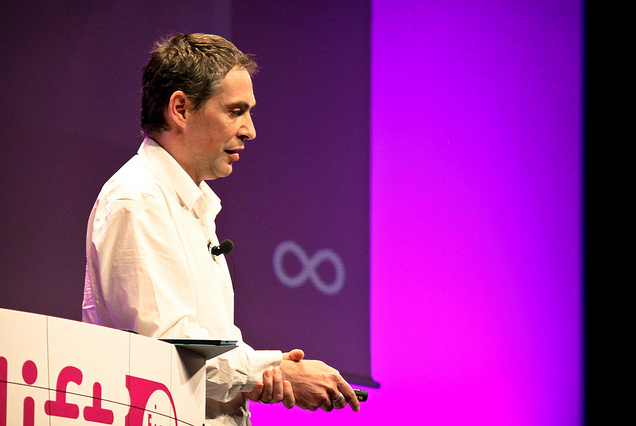
Alain Renk.
According to Renk, it’s lamentable that we continue to design and construct urban environment like we did before the Internet. We now live in a new kind of world, that is physical and digital at the same time. “A city’s inhabitants are the recipients of what is constructed for them.” The balance of power between contractors and users isn’t as equal as we’d like to believe. Architects and city planners are becoming disconnected and arrogant. They seem to be building walls just to keep urbanites at a distance. Yet, connected urbanites know more about their cities than those who invent and organize them, says Alain Renk.
This reflection led him to develop his prototype for the latest Futur en Seine, which he calls Cities without Limits [FR] (video). This project in augmented reality would allow inhabitants to change the look of their neighborhood. The project, installed in three different parts of Paris, collects data on how inhabitants modify their urban environment to their needs. Each user can then look at the options that stem from their manipulations, “The world we live in needs to be used radically.”
Making of: Unlimited Cities / Villes sans limite from Unlimited Cities on Vimeo.
“From where we are now, does the future even matter? With the Internet, won’t everything be interchangeable?” asks Laurent Haug, host of the session. “A city has to provide places to work, to meet people, to circulate. It has to have a certain uniformity,” says Alain Renk. ”It has to alternate between places where there’s everything … and places where there’s nothing.”
—
Article initially published on InternetActu
Photos Pierre Metivier (Saskia Sassen et Adam Greenfield) and Swannyyy (Alain Renk).
Image CC Flickr 

 tarentula_in
💬 Discussion
No comments yet. Be the first to comment!