

The following article published in the excellent e-book Perspectives on monitoring (on the moderator’s blog), brings together digital specialists (including myself). The article gave me the opportunity to reflect on the evolution of digital monitoring. Please excuse the length, this article was meant to be read on paper or a tablet.
“Touff from the Gorzg tribe climbed on top of a hill. It’s was three days since his tribe or himself had something to eat. Each morning, the hunters courageously left to explore the region, but each evening they returned empty-handed and dragged their feet back to their starving women and children. Touff decided to change their strategy. Standing at the highest point of his land, he observed the horizon. Suddenly, he saw vultures making circles in the air. He ran to the area over which the bird circled, and discovered the corpse of a young gazelle. He scared away the vultures with gestures and cries. He picked up the animal – tonight, his tribe will not go hungry.”
– Natural history of the Zhurg, tome 4
Humans possess an extraordinary curiosity and an impressive ability to adapt. More than other animals, these two qualities (along with opposable thumbs) allowed our species to survive and develop on the planet. His curiosity allowed him to stand up and to see farther. Seeing father, he was able to identify predators and prey. This lesson is engraved in our genes.
Information = survival
This primordial lesson has stayed with Homo sapiens for thousands of years. The biggest civilizations circulate information and knowledge, while dictatorships and autocracies try to contain it. Information has also become a symbol of wealth. Information is power. Information is freedom.
Now, civilization are confronted with a new domain: digital territory. Humans had to transform themselves and adapt to the Internet. Our species is now transforming, and this process isn’t finished.
A question of adaptation

Man transformed at the same time that the Internet invaded. Little by little, he found himself drowning in the flood of information. On the Internet, everything is information – be it text, images, video or the aggregate forms that these different elements can create.
Over time, man has invented strategies for coping with his digital environment. These strategies range from selecting his home page, installing spam filters, and bookmark management. A progressive adaptation that is accompanied by the construction of mental strategies, which are oftentimes unconscious.
The need to search, to monitor (the active or inactive reconnaissance of information on the Internet) plays an important role in the development of new products that allow us to immerse ourselves in digital territory.
Today, everyone is monitoring the Internet – on LinkedIn, Facebook, and Foursquare. Whether you are scanning statuses or your friends’ geolocations, you are watching. To google something has become a natural act. We no longer associate the notion of egocentrism that underlies this relatively new behavior because it is considered watching, and therefore normal adaptation to the digital environment.
Monitoring has crept its way into our daily lives, but how far will it go?
The companies started it all
Companies were the first to understand (at the beginning of the 21st century) that it was indispensable to permanently have an understanding of the Internet. The term monitor (e-monitor, digital monitor, data-monitoring) began its tour-de-force at the beginning of the 21st century, following the progress of companies and brands implanting themselves on the Internet. In the beginning they only monitored certain sectors, but little by little, companies started to monitor everything from crisis management to their communications and marketing.
Ten years later, monitoring has become an obligation for companies and brands that want to develop – regardless of their size – from a bakery to a multinational corporation. These companies understand that such monitoring doesn’t necessarily mean externalizing an operation, but that it is often more economical to create a new position dedicating to such activities within their company. Monitoring is recognized as one of the axes of development in an enterprise (improvement of products and services, after sale service, e-reputation, innovation outlet).
For enterprises and individuals, monitoring is an acquired behavior that shows no signs of slowing down.
A future of data everywhere, all the time
Whether it be companies or individuals, permanent e-monitoring is only the latest adaptation to the new information era. Even if they’re not talking about it on TV, we are definitely in the midst of the third industrial revolution (or even the informational revolution). This is the result of our passage from a commercially and industrially dominated culture to one that is centered around the sale, exchange, and sharing of information.
Information has therefore become the dominant value on the Internet. Yet outside this behavioral adaptation, we will physically adapt to the information era.
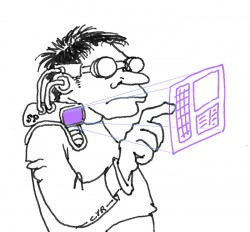
We already use cyber-extensions to access and exchange information. No, not cyber implants connection to your cerebral cortex, but rather a smartphone or a GPS in your car (“We are all cyborgs!”) These are the tools – the physical extensions – that already exist and allow us to transform virtual information into physical data.
Monitor what? A new type of data
In a few years, there will be information everywhere, all the time. It’s a development easy to anticipate, when the open data and link data initiatives shown their utility (thanks to Tim Berners Lee). The Internet has become a meaningful entity (XML, RDF or Resource Description Framework) that defines metadata or WOL (web ontology language).
This data is omnipresent (to see a few more dangerous aspects, check out “Data marketing against humanity – the Robot war is coming!”). However, we’ve already started to organize data according to its proximity to ourselves:
- Intimate data: what enters into the private sphere? Who’s talking about us? Who’s researching us? What information is visible in digital territories? Is the image we create of ourselves on the Internet satisfactory? Certain services will allow us to retrieve the opinions other people hold about us that are published on the Internet (Paranoiacs will love www.whatiswrongwith.me)
- Data about our intimate and passionate relationships, including close friends and family. But also the people that we may hate – soon we will all naturally stalk our haters (if you don’t do it already). This kind of data could include geographic location, status updates, birthdays, events that they attend, or even their personal and professional relationships.
- Data about our interests, passions (sports, games, music, media, etc.), and beliefs (political, social, religious). Who won the Superbowl? What did a certain politician say today? When is your favorite singer playing in a local concert?
- Our physical environment: the weather, times for a certain movie or show, locations that might interest you, etc.
- Places that your family and friends visit frequently (restaurants, cities, high schools, regions), other social connections (friends from school, bosses…), information about when those spheres cross and how (associations, clubs, unions…)
- Finally, places that are far away: is something important happening in the world? What is its impact?
2012: Homo digitalus is coming…
To handle all of this constantly updated information, we will have to invent new interfaces, cyber-extensions capable of manipulating, treating, and exchanging data in real time.
Monitoring is here to stay. Without data, you’re done for. You’ll never be able to integrate yourself in a hyper-connected society. It’s the new species Homo digitalus – the wired well-connected man. We won’t ask ourselves why we monitor, but how to monitor as effectively as possible, and how to obtain the most recent information.
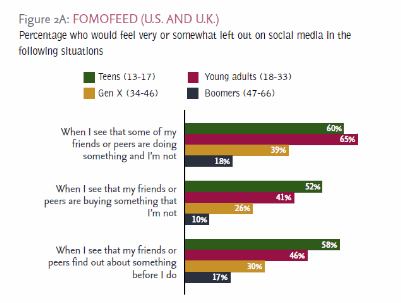
With these risks and challenges, society will change. The transformation has already begun. The infamous FOMO (fear of missing out), reserved for the hyper-connected and hyper-social, will become a world wide fear. Certain hyper-connected people (young or not) can’t be without their phone without feeling lost and without a social life (without information we are nothing?). According to companies, those that search, manage, and pass on information are already the most powerful on the planet (Google, Microsoft, Apple, and Facebook).
So, the human race is going to change, whether we like it or not. We will become detectives, filtering and creating information.
Why not get a head start?
—
Originally published on le blog de Cyroul under the title “Demain tous veilleurs: la veille comme art de vivre du futur.”
Image CC Flickr 
 sntgmdm ; floodllama,
  M i x y, Cyroul and ConversationAgent
💬 Discussion
No comments yet. Be the first to comment!