
The open data movement has begun. The premise of open data was first evoked by Michael Cross’ campaigning in 2006. The United States took the first steps with the arrival of Barack Obama in the White House, launching data.gov only six months into his term. The British portal data.gov.uk went online a year later.
The iFRAP foundation has recently taken interest in data publishing, focusing on establishing “[governments’] legal or customary propensity to diffuse, without the express particular request of their civilities, of useful administrative information as a means of increasing transparency.” Which is where the distinction between “open data” and “open government” originates.
Open data is defined as: “publishing on websites dedicated to data sets (…) in formats easily reappropriated and reused free of cost by the public (civil societies, businesses).” Open government is then: “An administrations capacity to spontaneously and directly render a certain amount of information public, no solicitation required. A proactive disclosure policy.” Basically, half de facto state, half open and dynamic publication. Samuel-Frédéric Servière, the author of the study summarizes:
E-democracy from the citizen’s point of view means open data – e-democracy from the government’s point of view means open government.
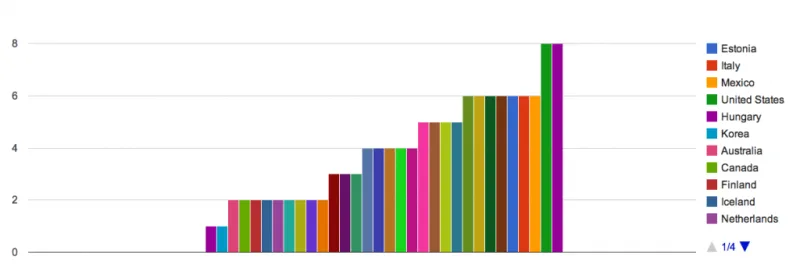
The iFRAP foundation, specializing in public policy and reforms, created a ranking. OWNI used the same data (provided by the OCDE) to visualize the extent state governments are transparent. Two variables are measured: the legal framework which the data is published, and the means used to publish them. The OCDE bases its analysis on 12 types of data:
- All budget documents
- Annual ministers’ reports, including their bank accounts
- Audit reports
- All reports on public policy
- Commercial contracts above an established threshold
- A list of civil servants and their salaries
- Information describing how data is recorded, data set content, and its use
- Information on internal procedures, manuals, and guidelines
- Descriptions of the structure and procedures of State institutions
- Annual report on Freedom of Information legislation
- Freedom of Information procedural information
Legend: The number that appears next to each country is a coefficient the is derived from 12 data categories concerning the legal framework of publication.
- Dark red (4): The majority of data must be published under penalty of the law. (ex: Russia, Spain, Estonia)
- Orange (3): The majority of data is published by custom, without a set legal framework (ex: Brazil, Sweden)
- Light Orange (2): As much data is published by law as is published customarily (ex: Australia)
- Yellow (1): As much data is published by custom as is not published at all.
- Light yellow (0) : The majority of data is not published.
Hungary, Turkey, and Portugal are not the usual champions of open data, and certainly not the first countries we think of when the phrase “open government” is evoked. The same goes for Russia. Yet just because there are rules, doesn’t mean they’re always followed … However, the laws do form a legitimate transparency policy framework. Among the 12 data categories used by the OCDE, eleven were subject to binding legislation in Hungry. This kind of strict legislation is typical of “ ‘young’ countries who are in transition and who value transparency in government as a way to fight corruption, who may be recently emancipated (…) and who are therefore particularly receptive to Internet technologies,” according to iFRAP analyses.
Customary practice
The lack of strict legislation isn’t synonymous with a lack of action as certain Anglo-Saxon examples reveal. In Great Britain, customary practices dominate proven by signs of a democratic maturity in line with traditions of Common Law and customary unwritten law.

It’s rather unexpected that Luxemburg and Poland are the countries that publish the least (8 unpublished data sets). According to Samuel-Frédéric Servière, certain data is sometimes easily accessible without being published.
In Sweden, civil servants’ wages aren’t available online, but can easily be obtained by telephone. Transparency is a part of their tradition.
A tradition and habits that are not always compatible with dominant open data practices and processes in certain other countries, which lead to Sweden’s call to order for “non-application of the 2003 European directive regarding public access to information.”
Legend: the number that appears next to each country corresponds to a coefficient derived from data availability.
- Green (1): The majority of studied documents are published on a central portal (Russia, Switzerland)
- Blue-green (2): The majority of studied documents were published on Minister or Government agency websites (France, Brazil, Canada)
- Blue (3) The majority of studied documents are published on independent websites (Australia)
- Gray (4): As many documents are published on a central portal as are published on Minister or Government agency websites (Sweden, Slovenia)
- Light Yellow (5) As many documents are published on Minister and Government agency websites as are published on independent websites (Spain)
- Yellow (6): Documents are published equally among central portals, Minister and Government agency websites, and independent websites (Ukraine).
Another important difference to note is the availability of data online. In the large majority of cases, it’s the Minister and Government agency websites that provide the most data. Sweden is an exception; public data is just as available on a central portal as on Ministers’ websites which expresses the de facto accessibility of data. Redundant data publications prove that the data is reliable.

Substantial gaps exist between different countries’ published data. Only 5.5% do not publish reports related to their budget, institutions, and respective procedural documents, while 64% of governments do not publish a list of civil servants and their salaries. Those who do offer this kind of data tend to be fighting corruption, such as Mexico and Italy.
In short, the three largest categories of “open governments” are: countries fighting corruption, post-authoritarian regimes who erect legislative barriers to promote open data, and countries who publish data due to tradition or conviction.
Photo credits FlickR CC by-nc-nd Wallig
💬 Discussion
No comments yet. Be the first to comment!