
Behind closed doors, top French service providers are planning to put a stop to unlimited Internet. ”Yes, there are some packages which we could discontinue” confirms forthright Orange spokesman Jean-Marie Culpin, interviewed by OWNI. If enacted, the situation would be unprecedented for French households, which have grown accustomed to packages offering one of the most competitive Internet accesses in the world. Confirmed by some operators, this strategy was agreed upon collectively within the French Telecom Federation (Fédération Française des Telecoms, FFT).
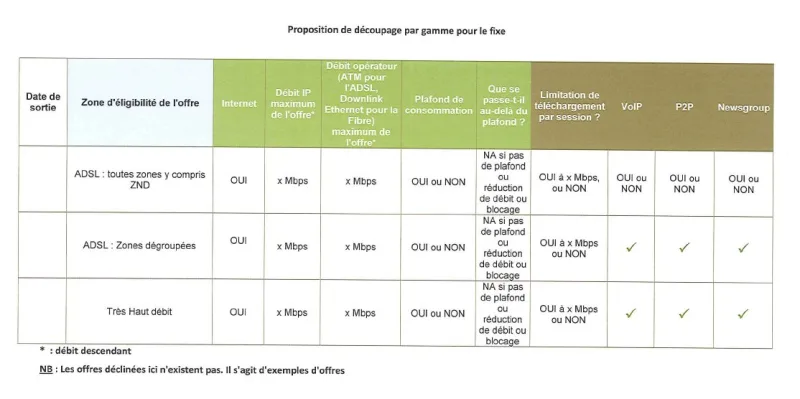
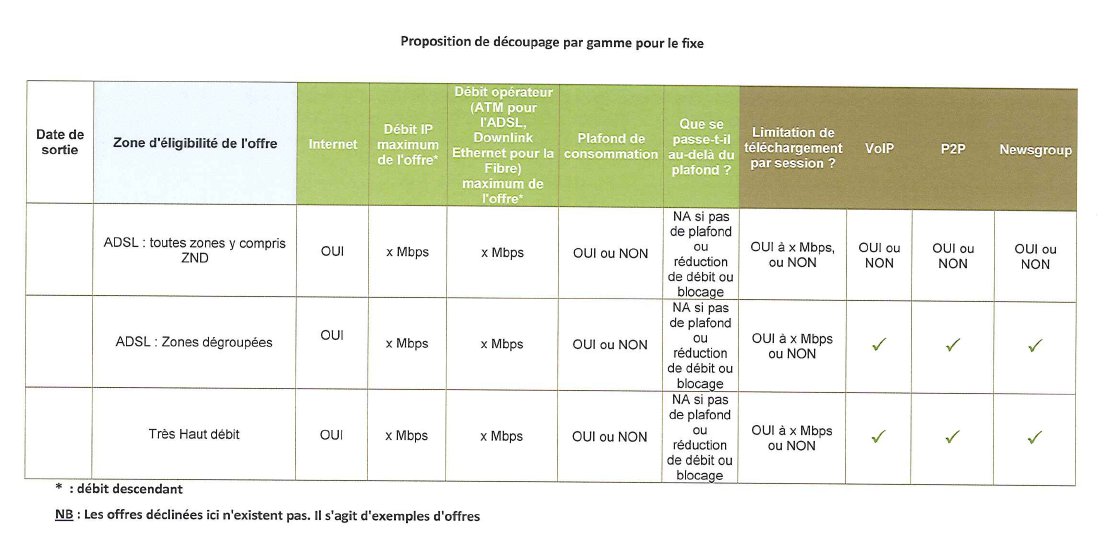
OWNI got hold of one of the organization’s documents outlining the intentions to introduce new packages with “maximum IP speed” and “consumption limits.” All of this “for landlines” (see below).
The process, already put into place for mobile phones, has so far been successful. French service providers, like their European and American counterparts, truncated smartphone navigation for multiple applications: peer-to-peer, VoIP and so on, so much so that SFR, Orange and Bouygues, have been accused of undermining network neutrality. (Remember: the principle of net neutrality is that anyone can view or send any content no matter their status or their location in the world [check out our articles on the subject]). Their advertising of “unlimited internet” packages was barely challenged. And despite the misleading slogan, users didn’t seem to turn away and neither national nor European governments lifted a finger. Why slow down when they’re on such a roll?
Smartphone “consumption ceilings” now for everyone
On July 21, this was the FFT’s response to the ARCEP (Regulatory Authority for Electronic Communications and Postal Services) advice on network neutrality. According to a Federation spokesperson, the service providers were invited to make proposals for their sector, while consulting with consumer groups and other non-member service providers, such as Free.
Entitled “Transparency of information consumer”, the paper presents three directives to “better communicate with consumers on the traffic management practices and types of offers” (p.1):
First, they [the service providers] rewrote common definitions for key terms used in describing the offers.
Second, they present network management characteristics and provide useful information for each range of offers. Suggestions included a summary of permitted, limited, or blocked uses in their Internet access contract offers.
Third, they provide intel about elements affecting connection quality, as well as advice on potential problems.
These summarizing tables outline the limited household internet packages.
We can then read the FFT’s ‘proposed cuts for households’ on the last page (see below). The tables describe three offers, which do not currently exist on the market, but are possible. They propose ”x Mbps” (megabits per second) of “maximum IP speed” subscription. A “consumption limit” beyond which the operator aims to ”reduce the flow” if not downright “block” it.
Three other entries for “VoIP”, “P2P” and “Newsgroup” – services usually excluded from navigation on mobile device – are included in the table with a brief “yes or no” option, hinting at the possibility to eliminate them from proposed offers, at the discretion of the service providers.
“Speed reduction beyond a threshold of data consumption”
French telecom agencies are justifying this move with the same excuse they used for cell phones: in their opinion, saturated networks require “traffic management.”
Mobile networks are characterized by more constrained capacities which can be explained by frequency rarity and resource sharing in access networks. These technical factors explain the existence of specific restrictions and/or limitations for cell phones.
(II. Gestion de trafic, p. 3)
Problem: these “restrictions” are no longer confined to cell phones. Various documents implicitly admit the extension of such restrictions to landlines. Like on page 2:
Among likely traffic management solutions to be used by service providers, we find speed reduction past a certain threshold of consumed data. Cell phone service providers have most often used this practice to ensure continuity of service for all users, despite the extraordinary growth of mobile Internet use and without financially penalizing the heavy users. Indeed, beyond contractually defined fair use, the flow is adjusted, to avoid overcharging.
(II. Gestion de trafic, p. 2)
“Service providers think they’re invincible”
From the FFT’s perspective, if the validity of these proposals is confirmed, they must be proved to be the “fruit of a collaboration.” ”Consumer groups agree: the document was developed with them,” said a spokesman.
“Wrong!” retorted the UFC-Que Choisir, which describes the incursion of service providers on household connections “unacceptable”. For Edouard Barreiro, digital expert in the association, ”the service providers have manipulated many of those elected as representatives of consumers. But this decision is still unacceptable. Limits on household Internet connections has no economic justification, he continues. Household connection costs do not vary with the consumption of users, and when they do it’s for a negligible amount. Service providers are trying to extort money from both sides: content providers like Google and then consumers. They think they’re invincible. ”
On the regulator’s side, the document is unknown among the ranks; impossible to obtain any information about the response that Arcep would give if limited Internet packages emerged despite everything. The possibility is described as “bizarre”, “as much as resources are finite for cell phones… it’s the same for household connections …” OWNI was confirmed by phone. It is true that the saturation of the wired network is not established (on this subject, see the explanation [fr] of Benjamin Bayart, President of NDR, a French ISP association). Questioned on this point, the noticeably embarrassed spokesman for the FFT admits that the argument is more valid for cell phone networks, whose coverage depends on the number of antennas.
If Orange is hiding the implementation of the new strategy, at least they’re conceding that the pill will be hard to swallow for consumers. ”For household connections, it is more difficult because it is not a phase of new equipment, such as with smartphones for mobile connections,” said spokesman Jean-Marie Culpin group. ”Yes,there are some packages on which we could put the thresholds.” He added: “If they’re only for that 1% of people who download movies all day, then I think that’s a possibility. It would be unacceptable if it affects more of our clientele.”
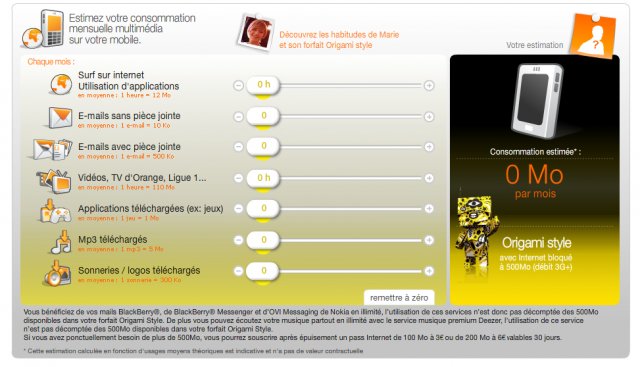
Orange proposes tracking your internet use. The Origami style package blocks all navigation past 500 Mo.
Towards a limited internet, everywhere for everyone
What would a limited household internet connection France look like, concretely speaking?
Let’s look at cell phones first. In the world of mobile phones, the move has already been made. Depassing the 500 mega bytes (MB) or 2 gigas (GB) threshold, depending on the package, a consumer’s connection is slowed or completely blocked. The service provider then proposes that he buy more octets. ”Service providers are doing the same things: we need to diversify our offers, creating more thresholds. There is no reason to pay for 2 GB if you only use 200 MB”, said Jean-Marie Culpin, who shares Bouygues’ views. ”We must adapt to reality of demands” declared ZDNet Vice President Frederic Ruciak. In other words, set up ”models based on the speed and amount of use”.
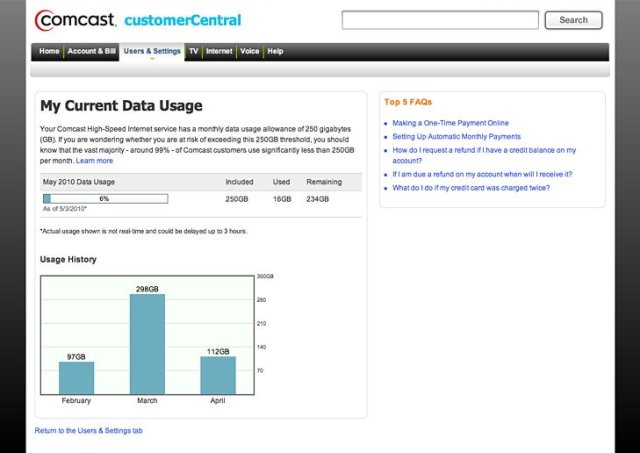
And what about Great Britian? Or the United States? These two countries’ package deals were reviewed by the FFT before making their proposals. As stated by the representative of Orange: “U.S. tariffs are the dream of all service providers”. The firm admits to having looked over cable operators like Time Warner, Comcast and even AT & T and Verizon, which offer a capped connection, usually at 250 GB per month. Users are encouraged to keep an eye on their consumption, using a counter. And beyond ”fair use” fixed contract, wave goodbye to the internet (here and here are testimonies of two Comcast subscribers whose connection was cut). For France, this would be a regression. Back to when each subscriber had to conscientiously count every minute of connection.
Where does Free fit in?
Installing counters on modems promises to be a tricky business, not to mention the difficult in justifying it in technical and economic terms. Such a change would stir things up for the French, who are used to triple-play (cable TV, telephone, internet) packages and low prices. Notwithstanding the position of Free, a veritable variable in the service provider equation. Free had the providers’ scrambling with the launch of its ADSL offer in 2002. Seen as a kind of white knight of telecom, their reaction will be crucial. Because implementing limited household Internet connections and not assuring your concurrents will do the same would be shooting yourself in the foot … Free claims to have “plenty of reservations on the relevance of such a proposal” that would ”counter to the fundamentals” of household modems. Concluding: “it’s hard to see what the point is.”
Illustrations : CC FlickR zigazou and screenshots.
💬 Discussion
No comments yet. Be the first to comment!