
“Over there, I never go there, there’re only Muslims. Me, my country, is Croatia.”
“Over there,” that’s East-Mostar (Bosnia-Herzegovina). Once a year, Silvio Bubalo must however betray his morals and cross the Neretva river in order to attend the Zrinjski match, the Croatian community’s football club. In Mostar, in the stadium as in the city, each community marks their territory and ascribes their identity in it.
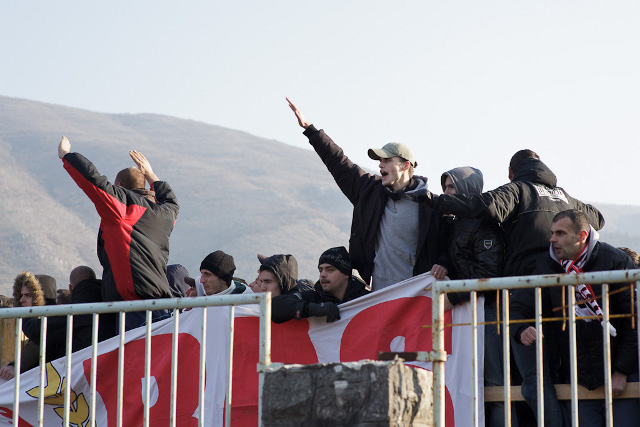
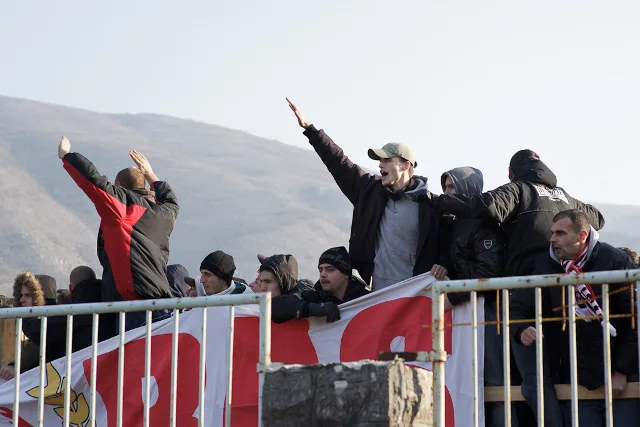
Football matches between the Bosnian FK Velez team and the Croatian Zrinjski team are often a stage for nationalist demonstrations.
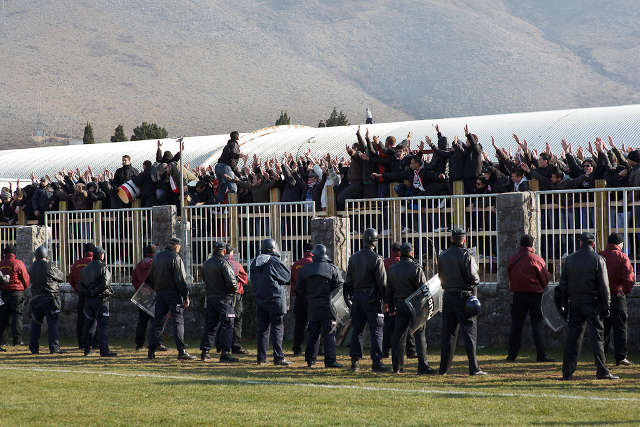
Each year, at the end of February, 500 ultra Croatians take the brief trip to the Bosnian camp. Stuffed into buses and vans right after the kickoff. Supervised by riot police. Parked on a wooden platform built outside the walls, they readily multiply their provocations: Croatian flags and flags of the Vatican are unfolded; fascist salutes are addressed to rival fans. In return, the locals whistle and boo for good measure. It’s now a convention.
The truce is broken at each match.
“The difference between us and the Zrinjski, who never cross the river, is that we know how to swim,” jokes Gaga, a Velez fan. Before getting more serious. ”I would never walk over there with my red scarf and white jersey, it’s too dangerous.” Then fatalistic: “Most of the time, life in Mostar is quiet and normal, but each football game ruins everything. Nationalism and the past resurface.”
This year, no incidents and no clashes between rival supporters were reported. Perhaps because of the massive deployment of security forces: more than 500 men in the city the day before the match. But the atmosphere is tense. Swastikas and Ustashi symbols (Croatian fascist and nationalist movement) have appeared on some monuments in Mostar. Particularly on the graves of the cemetery where the conflict began in the 1990s, which combines the graves of soldiers from both sides. The work of a few fanatics, no doubt. For the people, they are almost part of the decor. But there is more than just folklore.
“It often happens before matches, elections or negotiations,” said Robert Jandric, who handles the Abrasevic Cultural Centre, one of the only places where young people from both communities can meet. Last February, in fact, negotiations were deadlocked: Bosnia was without a government for more than five months, the political parties failed to reach an agreement, which is to say divide the power. Each community tried to clinch key positions and gain as much power as possible.
The split hasn’t been easy. Since the Dayton treaties that ended the war in 1995, the country has been divided into two camps: the Bosnian Serb Republic on one side, the Muslim-Croat Federation on the other. And without an agreement between these two entities, a federal government is just impossible. In Mostar, the situation is even more complex.”Mostar is the last multi-ethnic city of Herzegovina (Southern region of the country) precisely because it is divided,” says the writer Veselin Gattalo. ”And the Bulevar, with houses still in ruins, is ground zero.”
A boundary unfurls in the middle of a city.
The main artery of the city, the former frontline of the war that tore the city apart between 1992 and 1994, now effectively acts as a border. Not a store in sight, except a gas station. The few passersby do not linger, there’s nothing to do there and they fear groups of disaffected youth who squat buildings that were never rebuilt. ”The town is physically divided into two,” insists Robert Jandric. “When you see it, you do not want to live here. ”
Destroyed during the war and rebuilt with great pains by the World Bank, the new Old Bridge over the Neretva has not brought the city’s two communities any closer together. ”Instead, the Stari-Most has become the symbol of the Eastern portion of the city,” laments Gattalo. It’s not the only monument to be polarized since the return of peace. On one hand, a bell tower a hundred feet tall, attached to a Franciscan convent, dominates the city center. And there’s Mount Hum, where the guns of the Croatian army were placed that destroyed the Old Bridge. On the other, minarets are multiplying. Each community is vying to show its dominance over its part of the city.
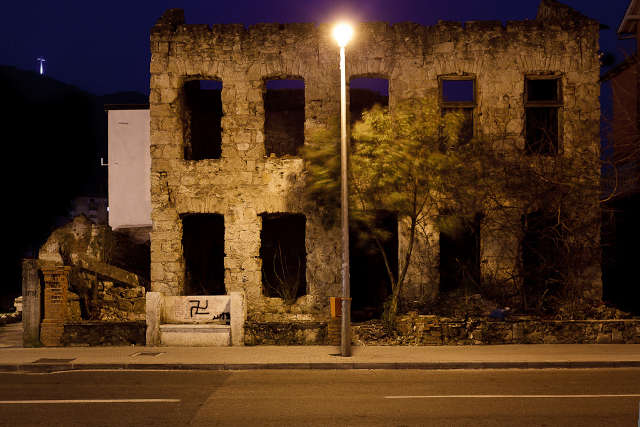
In the center of the city, the Bulevar cuts the city in half.
This division is reinforced by the institutions. Although the pressure of the international community led to the establishment of one police and one municipality, this unity is just a facade. Without agreement between its communities, the city remained without a mayor for fourteen months after the 2008 elections. To break the impasse, the City Council extended the outgoing elected official. Above all, many jurisdictions continue to lead a double life. In the East, the mail is sent by mail from Bosnia and Herzegovina while to the west, it passes through the neighboring Croatia.
Similarly, the water company is run by two parallel services. Nothing seems to promote unity, “If I was going to be treated in the hospital in the West, much more modern, I would not be refunded because we do not have the same health and reimbursement system as the Croatians” laments Amela, a 28 year old Bosnian.
“Here you are first Bosnian, Croatian or Serb before being a countryman (a distinction is made between the Bosnian-Herzegovinians, all citizens of BiH and the Bosnian sub-community.),” Warns the young woman. But she wants to believe that the situation will improve. “When I came back to Mostar after the war, I had to pass two checkpoints in order to visit my father’s grave. Today, there’s nothing more normal than to go window shopping at the mall in the West! ”
“It’s a war over territory, not religion.”
In the heart of the Croatian neighborhood, less ravaged by the war, is the Rondo quarter with its hip cafes and clothing stores. For Amela, born in the multiethnic Mostar of Tito, the boundary is elsewhere.
“The real Mostarians, those who lived here before the conflict, continue to live in one city. Whether Catholic, Orthodox or Muslim. The Croats from the rest of Bosnia who took refuge here after the war want the division. They believe that West Mostar is theirs alone. “All eyes are on Zagreb, which funded part of their installation and gave them passports. They still dream of a Greater Croatia. Or at the very least to live in the capital of an autonomous federation within Bosnia. ”It’s a war over territory, not religion,” adds Amela.
The city’s divide is more subtle now, rooted in the minds of many Mostarians. In each camp, prejudices die hard. Including the younger generations. ”I am stared at,” said a Croatian high school student who says, however, he rarely goes to the East. ”It’s like there are two different cities,” his twenty year-old pupil adds. ”I’m too young to have experienced war, but we must acknowledge that it occurred.” That means not fraternizing with the former enemy.
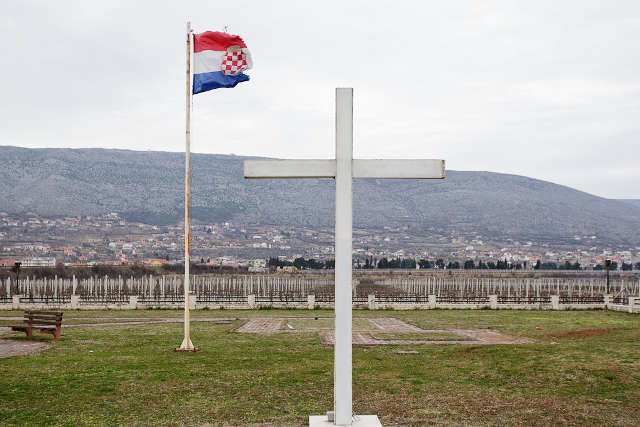
33 year-old Robert Jandric of the cultural center isn’t optimistic. “It was better in the years following the war. At least there was hope, young people still remembered the old system where everyone lived together peacefully. Today, those who live in nationalist families are helped by their parents.”
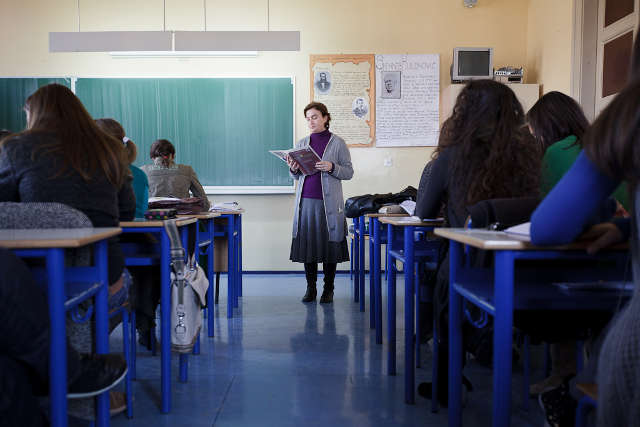
An observation shared by Gordana, French professor at the city’s high school. Meeting her students for the first time, she invites them to choose the person they would like to immortalised into a statue in the city. Prudent, a girl, mentions a starlet, and a friend surprises everyone with Leonardo da Vinci - without knowing why. But most students fall back on Tito or Alija Izetbegovic, the first president of Bosnia and Herzegovina. ”You see, they’re almost always talking politics. It is not normal, they should have more light-hearted concerns and other role models for their age,” she slips a bit resigned. She hesitates, chooses her words carefully and then heaves a sigh: “They are indoctrinated.”
A divide in history lessons and in ballot boxes.
This invisible boundary doesn’t bother many political parties on either side, who play off the divide to stir up voters and to stay in power. ”Each side is afraid of being outvoted when that part of the city dominates the other,” explains Osvit, after having returned home in recent months. “So they always vote for a representative of their community and not someone who would defend the general interest. ”
Status quo assured: the SDA, the Bosnian side, and the HDZ in the Croatian part, two nationalist parties, have been in power for twenty years. Each has their part of the city, their private preserve. “The SDA and the HDZ divide Mostar,” said VESO Vegar, spokesman of a just as nationalistic Croatian party competitor. “Their goal is to have a monopoly on their territory.” And because counting the population could jeopardize the fragile balance of power, no census has been taken in Bosnia since 1991.
Even Radmila Komadina, spokesman for the municipality, and HDZ sympathizer, confirmed that many politicians compete for airtime to get a bigger piece of the pie. The economy pie, that is. With 2000 employees, Aluminij is the largest employer in the city. It is also the largest Zrinjski sponsor and funds the Croatian cultural center and an art gallery. ”But to get in, you have to be an HDZ supporter,” said Vegar. ”Blackmail at its finest,” according to Robert Jandric. This is confirmed by other inhabitants, but not the company, who rests tight-lipped and closed to any visitors. Result: 90% of employees are Croatian. A godsend in a city that has 40% unemployment, but only 20% in the West.
The economic development of the Croatian side ends up dividing Mostar even more. “Why is it that we would go to the other side?” asks Ivo, a Croatian student. “We have everything we need right here [in the West].” A simple statement of fact for Ivo and his comrades who stroll along a commercial street on a Sunday evening.
With the exception of shopping centers, Bosnians and Croatians rarely cross paths. Especially since segregation rules from kindergarten to university. Only Mostar High stands out. In the heart of the “Bulevar” district, this general high school in this city of 100,000 inhabitants is the only one to accommodate 650 youth from all communities. ”Here everyone can meet and make friends. This first step is the way forward for all of Bosnia-Herzegovina,” the director, Bakir Krpo, proudly stated.
The model has its limitations, however. As soon as the bell rings, Croatians and Bosnians returning to separate classes. The fault is most evident in history classes, Croatians follow a program established in Zagreb [capital of Croatia], Bosnians a program established in Sarajevo [the capital of Bosnia and Herzegovina]. Result: “Only the Bosnians consider this country as their own,” says the headmaster. Reconciliation promises to be long. On February 14, the anniversary of the liberation of Mostar, no commemoration was held. On neither side of the Bolevar.
—
Photos Joseph Melin
💬 Discussion
No comments yet. Be the first to comment!