
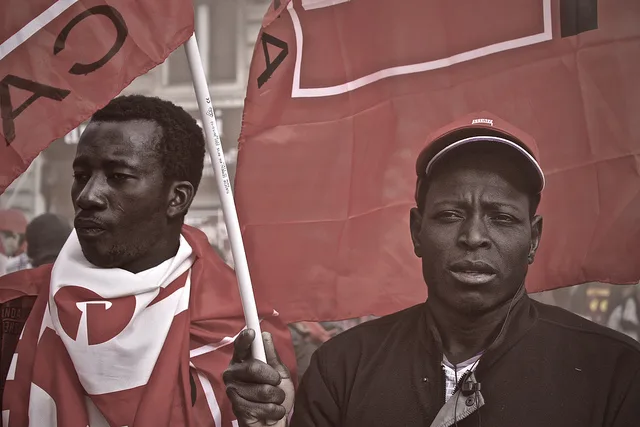
Mahmoud was just 23 years old when he was rushed to the hospital. He complained of strong chest pains and his skin was turning purple: all symptoms of incipient frostbite. A doctor provided him with the essential care and kept him under observation, and when he was certain that Mahmoud was out of danger he signed him out of the hospital. But what is a standard procedure for all other patients proved to be a mistake.
The man in question, Mahmoud, is in fact an Egyptian-born immigrant. Before ending up in one of the beds of the San Paolo hospital in Milan, he spent more than twenty days waiting on an old smokestack in Via Imbonati along with other immigrants who were protesting. He claimed his residence permit, and paid €500 for it. No one told him that he didn’t qualify for amnesty, or that it was reserved exclusively for domestic workers and caretakers. Mahmoud resisted the fever, the rain and the frost, but eventually he left the smokestack and was admitted to the hospital.
Because he doesn’t have a permit, the doctor who took care of Mahmoud now risks being investigated for treating him without alerting the authorities.
Since 2009, clandestine immigration in Italy is a punishable offence.

Half ghosts: Invisible workers, invisible citizens
These are the immigrants of Italy. Cheap labour when it comes to business, invisible ghosts when it comes to rights. Five million ghosts who work in factories, pick oranges, look after Italian grandparents and, in many cases create businesses that employ youth.
The latest Caritas dossier on immigration in Italy shows that nearly 5 million foreign nationals can be found on Italian soil; they represent 10% of employees and contribute to 11% of our GDP. Each year, they pay almost €11 billion in taxes and social security contributions and in exchange they benefit from less than €10 billion in welfare services. The Italian state earns at least €1 billion thanks to immigrants.
Even if individual immigrants are formally integrated into the job market, they often face ‘social apartheid’. It’s difficult to get a residence permit and, conversely, it’s extremely easy to lose one.
The repatriation is a trip to hell, and it often involves going through the dreaded torment of the Identification and Expulsion Centres. Obtaining citizenship is a bureaucratic nightmare. Even the children of those who have worked in Italy for decades are often condemned to statelessness. Given the living conditions of its “permanent residents,” these centers are often likened to concentration camps. The comparison is not as perverse as it may seem.
So it does not come as a surprise when someone, after paying €500 just to join the ranks of amnesty fraudsters, joins a protest and suffers the elements to demonstrate on a tower. It is also not surprising that this person is also too afraid to ask for medical treatment.

The Internet, the latest free tool to gain visibility
What can a ghost of the societal system do to obtain visibility? Very little. They can rely on political parties, who may use them as a totem just in time for the elections. They can climb on a crane or a smokestack, risking their life and incarceration. They can take to the streets, as in Rosarno, and become the mafia’s scapegoat.
Or, they can set up a website.
“The Internet allows information to be disseminated in real time, avoiding travel and reducing costs. It is therefore a means to reach the poorest,” says Karim Metref, an Algerian immigrant and digital activist. “Movements run by migrants often lack resources, and they need to communicate, share, and organize themselves without spending too much. That is one reason why they’re increasingly turning to the web.”
There are plenty of premises for the Internet to become a primary tool for the claims of alien citizens. Moneygram, a company specializing in money transfers and migrant banking, conducted a survey using a sample of 2000 Italian immigrants between the ages of 18 and 70. According to their results, 70.4% of immigrants usually surf the Internet, and 65% do so directly from their home. These figures are in line with the general European trend, though what is striking is the figure is significantly higher than the 51% of Italians as a whole who claim to surf the Net (Source: Istat), and the 68% of Italians who say they have a connection at home at all (source: Audiweb). Especially considering the age range of an immigrant population that is largely under 30, this means that on average immigrants use the Internet considerably more than the average Italian citizen.
Moreover the language – which had often prevented extended dialogue across the various immigrant communities – is a barrier which is beginning to break down: in fact, a recent report from Censis indicated that 85% of foreigners have acquired sufficient knowledge of Italian.
Italy still lacks a platform genuinely capable of concentrating the forces of these half-ghosts. “They know how to use the Internet for personal reasons (to communicate, read their national press) but not to network and produce content,” Karim explains. To date, the use of the Internet by foreigners has been more passive than active.

Italians’ monopoly on immigrants’ websites
Except for a few that are connected with political parties or trade unions, the majority among the vast number of websites that tackle the vindication of foreigners’ rights are actually run entirely by Italians. The same goes for social networking sites like Facebook, where one of the most popular pages, the ‘Solidarity for the immigrants of Rosarno’ group (40,080 members) is entirely administered by native Italians.
Often these sites are motivated by a sincere desire to help, with the intention of up-to-date and in-depth content which is unavailable elsewhere. But despite being a useful collective resource, in practicality the sites leave much to be desired. Many of the portals are not translated into any language other than English, and the traffic they receive is mostly weak, hindering their longevity: in the past five years many have shut down or have been left to stagnate. The same official pages provided by the relevant governmental departments offer no alternative: despite having funding from the public purse, they suffer the same fate, and often contain incomplete or outright misleading information.
It’s worth noting that sites created and managed by foreigners exist, but they rarely tend to have an all-encompassing ambition and instead are aimed at specific communities. Ako Ay Pilipino, or sites such as Gazeta Ukrainska, are designed to be viewed only by members of specific ethnic communities and as such they can hardly be regarded as instruments of “integration.” This is proven by the fact that most of the time the contents are not even translated into Italian.
The presence of these non-communicative digital silos becomes even more significant when one considers the emergence of ethnic-specific associations, such as the AFCA, which campaigns for the professional inclusion of Cameroonian pharmacists in Italy.
This data shows that even on the Net, as in the real life, there is an isolationist tendency (often bolstered by poor domestic politics). This pushes ethnic-linguistic communities to strengthen the ties with the country of origin rather than with the host country, thus transforming the much-vaunted multiculturalism in what the Nobel Prize Amartya Sem-defines as ‘plural monoculturalism’.
Of course, there are some important exceptions. The site Stranieriinitalia.it, for example, is managed in part by foreigners, but is completely in Italian. It is the most complete site as well as the one that registers the highest traffic, amongst the sources we analyzed (source: alexa.com).
So how can one explain Italians’ monopoly over the tools of digital activism? “Italian organizations are often more structured,” said Ismail Ademi, Albanian migrant founder of web portal Albania News. “And above all they have access to funding, something which immigrant associations can rarely access. To participate in public grants, in fact, organizations must demonstrate that they have already worked with other official entities and can comply with the bureaucracy that requires an experienced administrative staff. In addition, the procedures are not easily accessible and transparent.”
If foreigners residing in Italy have so far seemed less than proactive on the Web, apathy is unlikely to be the cause. Rather, in the words of Canadian activist Dave Meslin we are probably faced with another case of “intentional exclusion” of aliens from the use of participatory tools.
But fortunately, things are changing.

Ismail’s case and Albania News
Ismail arrived in Italy in 1996 at the age of 13, illegally, just like most of those who migrate into ‘the boot’. He studied, got married, and has lived and worked in Italy. And just like many other foreigners, he is familiar with the bureaucratic maze faced every year by thousands of people seeking to legitimise legal status. “If a child is born in Italy to immigrant parents he must demonstrate that they have lived uninterruptedly in Italy from birth until he turned eighteen,” Ismail says stoicly. “Once he turns 18, he has only one year to apply for a residence permit. Even if you arrived in Italy when you were two, you must have spent ten years as a legal resident, have a clean criminal record, an income and a job for the past three years. ” But even those who manage to complete the application in order, often have to wait four years.
After twelve years of fighting with the Italian bureaucracy, Ismail founded Albania News, an online journal that with time and pageviews has grown into an active community run by 30 employees. “At the moment the site has 43 000 visitors per month, with over 130 000 page views and 210 000 ad-impressions, “says Ismail. “Last year Albania news began to organize meetings on immigration issues related to Albania, thus becoming a reference point for the many groups scattered around Italy. ”
AN’s particular experience is encouraging – and it is by no means the only case – but its range can not extend much beyond the 500,000 residents of Albanian origin. For foreign residents in Italy to get a true vision, a tool that overcomes the barriers between ethnic communities is much needed. Hopefully this type of platform would potentially allure the 5 million immigrants who now reside on Italian soil.
Integration: learning the culture of others, or creating a new one?
A historical Italian singer called Giorgio Gaber wrote a verse that has become gospel for the progressive citizens of this country: “Freedom is not free space, freedom is participation.” Listening to Karim Metref’s story, an Algerian immigrant who has been living in Italy for over ten years, one could be forgiven for paraphrasing Gaber’s words as “Integration is not the coexistence of two cultures, but the production of a new one”.
“Creating a collective culture and fighting for our rights is the key to peaceful coexistence and positive interaction,” Karim says. “When I express myself freely and fight for my rights, I automatically open a space for dialogue and I play an active role in my society. By contributing to these aspects, the web contributes greatly to the construction of a future with coexistence and positive interaction.”
Karim arrived in Italy when he was 30. “It’s an age in which it is difficult to compromise with the world and with oneself,” he says. “You have the lightheartedness of those who are young, as well as the wisdom of the elderly”. Karim actually managed to integrate well in Turin, a city he still calls home. Yet it wasn’t enough for him to find his own space, and so he decided to do more. He decided to “participate.”
In 2007 he founded LettERRANZA.org, a portal that deals with the literary output of foreigners in Italy. Karim’s project was met with enthusiasm by a fleet of foreign writers, poets, and novelists who work here, and he can now count 110 published authors who support the project.
A few days after LettERRANZA.org launched, Karim received a letter from an immigration law professor credited as an “expert.” Rather than applaud Karim’s initiative, he advised him against it. “He called my site ’shady’, because I didn’t have a ‘license’ to run it. In a subsequent letter he urged me to follow his advice as an individual representing his own country. ”
In Italy, this kind of attitude is all too common. It fits in perfectly with the general trend that sees migrants alienated, precisely when they should be encouraged to play an active role in the process of integrating. “Many of our ’supporters’ tend to have a ‘saviour-like’ approach towards immigrants and take full responsibility for their salvation,” explains Karim, citing Karpam’s psychological model of the triangle psychodrama. “Whenever migrants try to self-organize, become autonomous, and whenever they attempt to take center stage it is interpreted as an act of questioning their role, and an invasion of their land.” While in the host country there are those who would do anything to defend the integrity of immigrant cultures, Karim’s experiences and pursuits demonstrate that it is not just possible but desirable, to think of our culture (and that of migrants) not as something to be protected in an unadulterated form, but rather as something we should share. Thus it is necessary to break the invisible barriers that separates the urban communities of the archipelago. We must make the transition, from a multicultural model (or ‘plural monocultural’) based on coexistence, to a cross-cultural model, based on contamination and integration between cultures.
Second generation: digital natives and native Italians
60% of foreign minors in Italy were born in the country, and their school performance is on average higher than that of children with native Italian parents. Most of them are “digital natives”, and so they have more familiarity with the Internet as a medium for expression.
Libertà fra i due mondi conducted a study on 200 foreign minors living in Naples, which showed that children between 13 and 18 tend to develop habits and tendencies typical of the host culture and maintain a strong bond with the same source. This phenomenon has been called “dual ethnicity.”

Why the Net? Because the mainstream media seem to ignore the existence of migrants, which further cements their status as half ghosts – because the Internet is free and horizontal, and the difference between user and content-producer is virtually non-existent. This is all the more true given that the average immigrant uses the Internet more than natives. Only 11% of Italians use the net to learn or improve their knowledge, but among immigrants the percentage reaches 45%. Moreover, a study conducted in Germany shows that 70% of foreigners use the Internet to learn about the political situation of both the country of origin and the host.
It’s no wonder then that one of the most promising web portals in the Italian landscape was created and is run by second generation migrants. “The second generation network was founded in September 2005 by young people weary of an environment that rejected them. They were driven by an urgent desire to analyze the situation, develop proposals for improvement and be heard as much as possible,” said Jaskarandeep Singh, 26 years old, an immigrant of Indian origin. “The short-term objective is essentially the amendment of the Citizenship Act. The long-term one is the creation of a society and a culture that recognizes the children of immigrants as Italians, for all intents and purposes. ”
Jaskarandeep Singh arrived in Italy nineteen years ago when he was seven years old. He came with his mother and brother, and was reunited with his father who had long left the Punjab in search of work. He graduated from an Italian school and now works for an NGO that focuses on immigration. But after nearly twenty years, he still doesn’t have the right to vote or participate in public committees. The law simply does not consider him an Italian citizen. Therefore, Jaska joined Second generazione (G2).
In 5 years, this group of children from migrant families has created an active community of more than 800 members, in addition to having opened the lines of communication across different ethnic groups, and has allowed students to raise their voices and be heard by the institutions. “Until recently, once we reached adulthood, we were thrown into the world of adult migrants and were faced with the question of whether to study or work, and therefore get one kind of permit or another,” said Jaska. “The G2 network ran a campaign against this, and won. The police are now issuing resident permits for family reasons to those that are over 18.” But G2’s mandate didn’t stop there. They joined forces with The Association for Juridical Studies on Immigration (ASGI) and Save the Children and entered into partnership with the National Office Against Racial Discrimination (UNAR), a subsidiary of the Ministry for Equal Opportunities. Together they launched a free web page for legal advice, a pilot project that will last through 2011 and explore the possibility of activating a permanent web tool that functions as a bridge between the voiceless and institutions.” Anyone may seek advice: children of foreign families, volunteers in the field of immigration, government officials uncertain about the regulations. Lawyers provide bespoke responses, and the users remain anonymous unless they consented to publishing the conversations on a public forum. So far the project has provided free legal aid for ten legal cases, which will become a guide for future jobs in this area.”
In addition to websites and online shops, social networks can play a decisive role. Jaska – boasting more than 1500 Facebook contacts – can confirm ”For young children of foreigners (which we believe are already integrated) both the web and social networks have a twofold effect: they put them in touch with their classmates, from which they are sometimes separated because of physical distance, or because their parents don’t allow them to socialise. In contrast, however, the Internet can also keep alive and strengthen links within the community, present in Italy or abroad. ”
Conclusion
Let’s go back to where we started, in that smokestack tower in Via Imbonati. Of the seven migrants who climbed the unsafe rungs of the tower on November 5, 2010, only two have survived. A few days after Mahmoud was discharged from the San Paolo Hospital, his fellow protestor Abdelrajat, a 32 year old Moroccan, was taken to a hospital in the throes of a renal colic attack. But though Mahmoud was released as a free man, Abdel was not as lucky. Within four hours he was transferred to the notorious CIE Via Corelli in Milan with a deportation order, and a one-way ticket to his country of origin. Today, Abdel is in Morocco, and the deputy mayor of Milan, Riccardo De Corato meanwhile waxes lyrical about his “alarm” at the city becoming “too African”. YouTube is brimming with campaigning videos designed to keep the grievances of the migrants from being forgotten. These videos include the exploits of Rosarno, the protest in the tower of Via Imbonati, the strike on March 1, 2010 and the protest in Crane Brescia.
Meanwhile, Italian institutions continue to view the Internet not as a resource, but as an occasional shortcut. On January 31st, the Italian government opened a digital window for the regularization of 50,000 immigrants. The parties have been able to advance their claims only online. At precisely 8 o’clock the unfortunately named ”click-day” began. In less than a minute there were over 100,000 applications – double the number of allocations, for this first come, first served scheme. Within four hours it reached a height of nearly 300,000.
But while videos, events, and appeals continue to follow the traditional survival curve, the Net is brewing a different reality. The experiences of Albania News, of LettERRANZA and particularly the growth of the G2 network, prove how foreigners are beginning to consider the Internet as the preferred ecosystem for the development of a grassroots integration process. Integration does not end with the claim and the achievement of equal rights, but goes on and takes root from the production of a hybrid culture that can erode the barriers between different communities.
Our choice to focus on the second generation is not only due to the fact the second-generation migrants start at an advanced stage in the process of integration, but because we believe they represent a unique and unrepeatable opportunity. There are several reasons: migrants’ children carry within them the cultural heritage of the family as well as that of the host country (dual ethnicity), they master the host language and are therefore advantaged in the integration process but have also closely observed the difficulties faced by their parents, and they can understand the critical points. They are close enough to the host culture and not too far from the original culture. If there is a generation that embodies the potential to take this step from “plural monocultural” to “inter-culturalism”, if there are a people who can produce the first new global culture, if someone can demonstrate that it is stupid and useless to be afraid of half-ghosts, it’s them. And they’re young enough to refuse to give up.
—
Photo Credits: Flickr CC LucaD, Punk Jazz, World Bank Photo Collection, whiteafrican, Max Mayorov, pmorgan
💬 Discussion
No comments yet. Be the first to comment!