
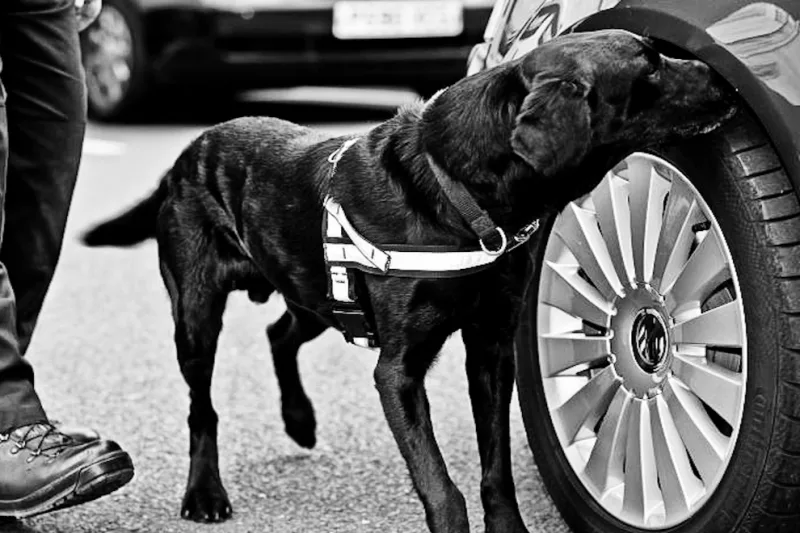
With utmost discretion, France is working with police services in Iran via a consultancy firm for the French Ministry of the Interior. Contacted by OWNI an official from the consultancy firm, Civipol, confirmed that 20 sniffer dogs will been sent. The first delivery of a total of 52 dogs will be completed by October 25. the operation is being funded by the Iranian National Drug Control Headquarters, who answer to president of the Iranian republic, Mahmoud Ahmadinejad.
Officially the dogs are being provided to aid in the fight against the trafficking of heroin, imported from Afghanistan and transported across Iranian soil before flooding European markets. But these dogs could have other uses, particularly for a regime with a reputation for opposition repression.
The operation is embarrassing for the French Ministry of Defense, who alongside domestic police services were responsible for training the dogs. The French military are unwilling to accept responsibility for cooperating with Iran on security matters while relations with Tehran remain strained to say the least. There is also the matter of the swift and brutal justice that awaits drug traffickers in Iran.
Condemnation from Western capitals
In the latest example of diplomatic tensions between Iran and the West, the Foreign Affairs Council of the European Union voted on October 10 to impose a new wave of sanctions on Tehran. They targeted 29 Iranian officials “involved in the repression and violation of human rights,” the French Foreign Ministry explained in a statement. Two days later, Washington accused Iran of being behind an extraordinary plot to assassinate the Saudi ambassador to the United States.
In this climate, the training and supply of the dogs is not universally supported. OWNI has learned that it was senior military staff from the office of the President who gave the green light. Nobody from the Ministry of Defence has been willing to accept that responsibility. It’s unusual behaviour for an institution which does not have a rebellious reputation, but the use of sniffer dogs is troubling. It’s entirely possible that the sniffer dogs are in fact being used as attack dogs, for the purposes of crowd control.
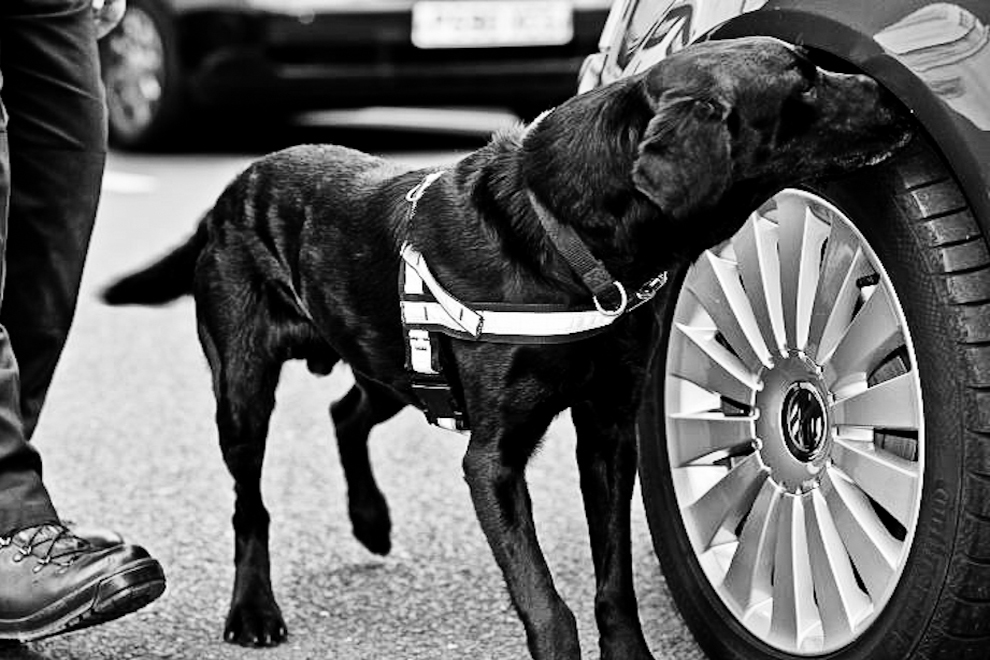
A report by the Foreign Affairs Committee of the French parliament submitted on October 5, 2011, devotes a long section to the developing “repression, followed by a deterioration of the human rights situation” since 2008. It also mention supporting reports by Amnesty International and Human Rights Watch of “a massive system of repression directed against all protesters” that already trained dogs could serve to reenforce.
Even more worryingly, drug traffickers arrested by the Iranian regime receive swift and brutal justice. Members of the Foreign Affairs Commitee reported that the French embassy in Iran had recorded up to 360 executions between January and mid-June of 2011, of which 274 have been confirmed, the remainder related to unconfirmed “mass hangings of drug traffickers”.
With 252 confirmed executions in 2010 Iran were just behind China, where more than 1000 executions were carried out. It’s a grim record when taking into account the contrasting population sizes of the two countries. On May 13, the Secretary General of the High Commission for Human Rights in Iran had acknowledged “the high number of executions and attributed it to efforts to combat drug trafficking”, says a report by the office of the General Secretary of the United Nations published on September 15, 2011.
Cultural and scientific cooperation at a standstill
Cooperation between France and Iran has seen better days. In terms of cultural and scientific planning, it has withered on the vine since the reelection of Mahmoud Ahmadinejad in June 2009, deemed fraudulent at the time. On the Iranian side, a diplomat assured OWNI that cooperation had deteriorated with the arrival to power of Nicolas Sarkozy, who is alone responsible for the current state of relations according to Iranian diplomatic officials.
As regards the providing of training and dogs, the Civipol website makes mention three previous episodes: two audits in January and September 2007, as well as a delivery of twenty dogs in September 2008. We were assured by an official of the company that others had taken place, without specifying the details of previous operations, adding that the site was not up to date. Tensions that emerged in June 2009 had caused an interruption in the supply of dogs. The Ministry of Foreign Affairs has assured OWNI they were not aware of this information: “We have no information on the interruption of deliveries.”
Photo Credit: Flickr CC LeoAmadeus, Defence Images
💬 Discussion
No comments yet. Be the first to comment!