
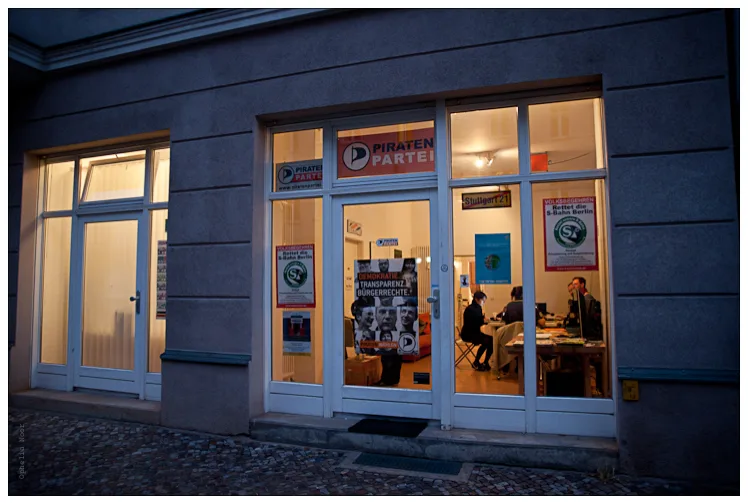
The Berlin HQ of the Pirate Party, November 2011
It’s been more than two months since the German Pirate Party (PP) won fifteen seats in Berlin’s regional parliament. As Pavel Mayer, one of those elected, explains, the party has opted for a short-term role.
As an opposition party you point out the mistakes, you troll the government. That’s your job.
This very young party, which has only existed in Germany for five years, will not join a coalition. It’s a position based on pragmatism, according to Alex Morlang, another elected representative.
In Germany, parties have arrived from nowhere and exploded. Then they’ve joined a coalition and they’ve lost out. It’s difficult and time consuming to learn how the system works. That’s not an option. If we join the coalition, we’ll be reduced to pieces or ripped apart. We have so much to do; the first part of our term will be devoted to the budget. That’s a specialist job.
The first step is to learn to survive here, even as an opposition party. First and foremost we’re looking to work together, within the group, which we’ve never done before. We have to stay solid – if one of us leaves, there is no longer any group.
Opening the doors
If there was any question of leaving the door open for negotiations at the start of October, it would have been done on principle and without illusions. Pavel explains further.
We wanted to show the public that we’re not people who run from their responsibilities or only oppose other people’s ideas. The other parties didn’t want to talk to us, so there’s not been any negotiations yet.
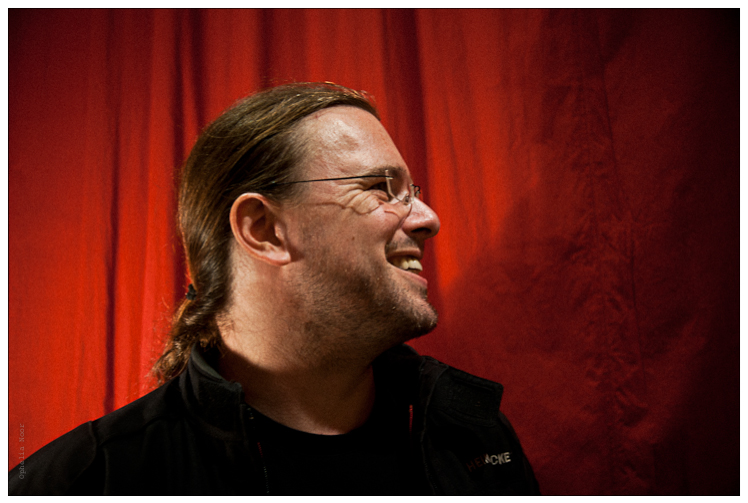
Alex Morlang, Prenzlauerberg, Berlin. November 2011
“The SPD (Social Democrat Party) has the choice of a coalition with the Greens, which failed for various complicated reasons, or with the CDU (Christian Democratic Union),” explains Frédéric Happe, a Berlin correspondent for Agence France-Presse. “The Pirates could only come into play in two possible ‘constellations’, which are each as unlikely as the other. Firstly there’s ‘Rot-Rot-Orange’, with the SPD and the Left Party (Die Linke). The PP have indicated they would have some difficulty working with the Left Party, in part because of links and a perceived nostalgia that some of the Greens have with the GDR and the Stasi, the former political police of East Germany. Otherwise there’s ‘Schwarz-Grün-Orange’ – a coalition with the CDU and the Greens. It’s hard to imagine the Greens agreeing to cooperate with the Pirates, since the PP won most of their nearly 9% of the Berlin electorate by picking off environmental protester votes.”
In the parliamentary jungle, however, some will be more friendly than others. “We will try to form alliances too. We have things in common with the Greens and the Left Party,” continues Alex Morlang. He believes some of the Greens are not so vindictive as all that. “Thirty years ago the other parties hated the Greens. They did everything they could to block them. The Greens have therefore taken the decision to support us, because they don’t want that to happen again to others.”
This does not preclude other alliances at district level. “In one district the PP made four proposals,” explains Alex. “They spoke with the Greens, who were annoyed at seeing these young upstarts who wanted to change the rules. They also spoke with the SPD and the Left Party; they even talked to a small conservative faction made up of just four people. In the end everyone voted for our proposals,” he said.
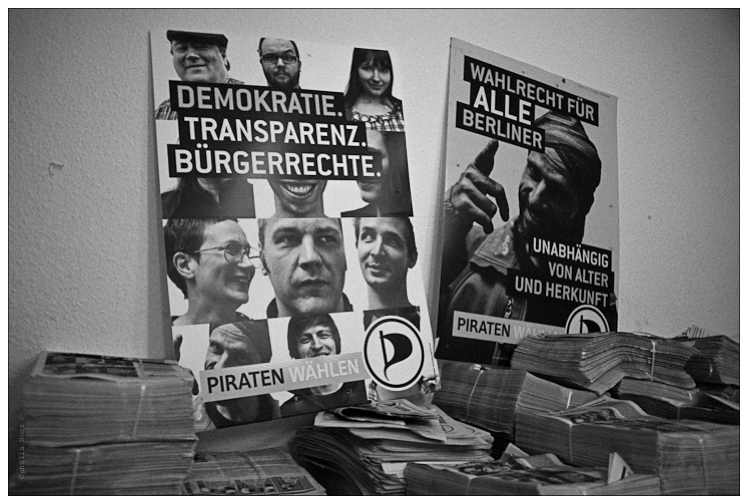
Posters from the latest campaign
If there must be a coalition in Berlin, it will come later. Within two years, Pavel believes, once they’ve ‘opened the hood of the engine’. Like any good hacker – he is close to the Chaos Computer Club, the famous Berlin hacker collective – Pavel uses a computer metaphor.
The political machine of parliament has buttons and levers that you can control. You have to understand what happens if you activate them. Once we know exactly how the machine works, then we can modify it.
Pavel has already begun that task. At the inaugural parliament session in late October, he announced that the internal rules should be changed so that the representative as an individual has more power. In their current form, he argued, the rules favor the group. “That distorts the principle of democracy,” he suggests. “An elected official, representing 20,000 citizens, is obliged to go with the group’s decision, instead of his own.” This attempt at an ‘update’ was greeted with incomprehension. “Most of the other elected officials didn’t understand. They’ve been there 10, 20 years. They no longer question the system.” He plans to bring the matter before the Constitutional Court.
“Liquid Democracy”
Fresh, new and enthusiastic in a place where sincere emotion is rarely seen, the Pirates are running the risk of institutionalization. Like the Greens, who were crushed by the skulduggery of coalitions – divided into two factions and made bourgeois and comfortable after thirty years in the political game. Alex laughs.
“Of course that scares us! As some former Greens have joined the PP, we have had the opportunity to look at their history. We are quite different. In the beginning the Greens, like the Nazis, wanted to protect German trees. They were feminists and pacifists, who spent a lot of time debating whether it was necessary to print on paper. Now that we have the Internet, a lot of things have become possible. We have tablets and wikis, we can work independently of time and space, the most brilliant minds can collaborate. It’s changed things fundamentally. The next step is liquid democracy.”
“Liquid Democracy”, to the PP, is about going back to the fundamentals of democracy, allowing people to participate directly in the political process. Proposing, supporting and amending initiatives. The focus is on horizontality, transparency and the obligation to be constructive. Time-wasting trolls need not apply. To achieve this they use a brand new tool that the German PP has been developing since 2009, called LiquidFeedback. It’s already used in Austria, Switzerland and Brazil.
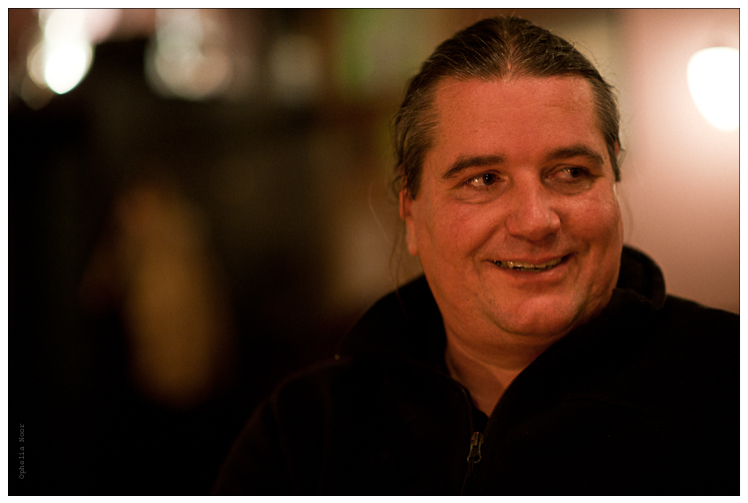
Pavel Mayer, elected representative of the Pirate Party in Berlin, November 2011
So the tool is available and operational, but are the citizens using it? “At the federal level, about a third of the PP take part,” says Alex. “The idea attracts people. Some people joined us just for that. In Bavaria, where the system isn’t being used, people who came to use it were asking “where is it, where is it?””
This is not the classical idea of revolution. We didn’t use their encyclopedia, we built our own. They built networks for consumption, and nobody cared. Instead, we built the Internet. They wanted to sell us software, who cares? We made free software. They tell us how to run a government, who cares?
Who cares indeed, except that the law does not recognise computer servers as members of the PP. The decision-making still happens in the office.
Saviours, not enemies
Somewhat optimistically – or pretentiously – Pavel believes that this desire for change is fundamentally shared within politics:
The other parties have high expectations of us. They think we have a secret that they have to learn. They aren’t really attacking us yet. They’re curious – they see us saviours, not enemies. They’re beginning to understand that society is changing, towards the information society. They don’t understand it but they want to embrace it. It’s the future, they can’t avoid it.
However, when the young members of the Greens proposed implementing LiquidFeedback, the older members voted against it. Bloody democracy.
________________________________________________________________________________________
Image Credits: Ophelia Noor [cc-by-nc-nd]
💬 Discussion
No comments yet. Be the first to comment!