I could not hear his voice, his face looked like a cubist painting.
On Saturday night, Farnaz Seifi, an Iranian journalist and blogger based in Germany, tried as normal to call her brother in Iran using Skype. She couldn’t. The Islamic Republic of Iran has launched a new wave of Internet censorship since last Thursday, February 9. Thousands of Iranians reported not being able to access Facebook, Gmail or Yahoo accounts. According to an Iranian news agency, 30 million Iranians may have lost access to their mail service, one-third of the population.
Even those Iranians with knowledge of censorship circumventing tools – proxies or Tor software – cannot connect to the web. On Twitter, the hashtag #filternet appeared for those voicing their concerns. Sites that require a secure connection using the SSL protocol appear to be the main target. According to the hacktivists behind the Tor project, the Iranian authorities censor the web in three ways. By examining connections in depth using a technique known as deep packet inspection; by directly blocking certain IP addresses; and by filtering certain keywords.
The connection speed has been deliberately slowed to such an extent that “checking email almost becomes a challenge,” Farnaz explains. “My brother opens Gmail, makes himself some tea, comes back and the homepage is still loading.” Thomas Erdbrink, the Washington Post’s correspondent in Iran, experienced similar difficulties:
Gmail has been blocked the whole day in #Iran, it happened before but now that VPN’s are working so poorly, its a real pain
— Thomas Erdbrink (@ThomasErdbrink)
According to Farnaz, the authorities have also been taking down satellite dishes, going house to house smashing them to pieces. Access to information is becoming so restricted that many Iranians “are tweeting that our country will soon be like North Korea, cut off from the world,” she laments.
External assistance
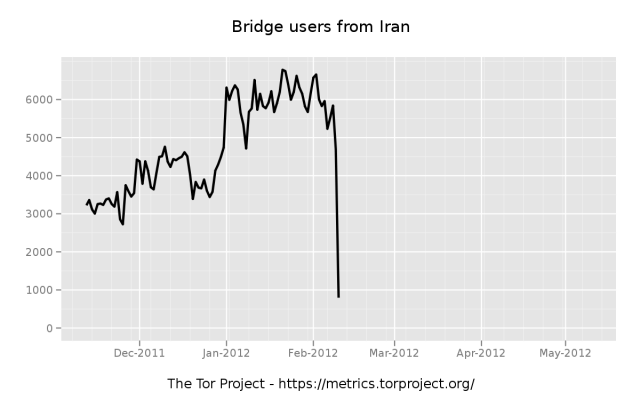
The Tor community reacted quickly to this latest crackdown. 50 to 60,000 Tor users in Iran could be targeted by this censorship according to Jacob Appelbaum, one of the leaders of the project. On Friday, he launched an appeal:
Help users in Iran reach the Internet [...] Details are rather rough but we’re working on some solutions.
The Tor team reportedly have an “ace up their sleeves”: a Tor bridge (a hidden intermediary program between the user and the server they want to connect to) which allows the user to “camouflage traffic”. Volunteers are needed to operate these bridges.
Massive filtering
In contrast to the regimes in Egypt or Syria, the Iranian regime does not appear to have cut the country’s access to the global network. The level of incoming and outgoing traffic remains stable. Figures from Cedexis, a company specializing in Internet traffic measurement, show no disruption on or around February 9. This means the filtering taking place is targeted, as confirmed by the Transparency Report provided by Google. Between February 9 and 10, Gmail was no longer accessible while other Google services remained.
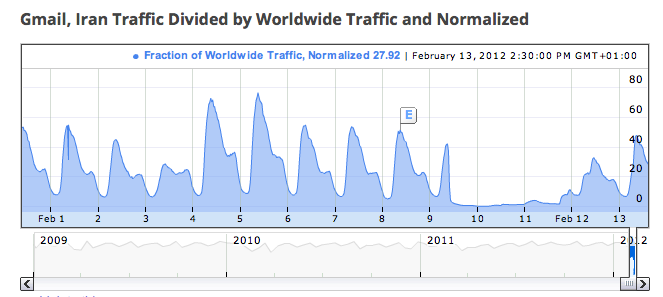
This is not the first time authorities in Tehran have attempted to shut down Google’s email service. Last year they announced their intention to permanently block Gmail and replace it with a national service. The announcement, as with so many others, was not followed through on, but it did cast doubt on the level of confidentiality that a mail service run by the authorities would provide.
Elections in March
On March 2, Iranians go to polls for parliamentary elections, the first elections held in the country since Mahmoud Ahmadinejad’s disputed victory in the 2009 presidential vote. Reformers have announced their intention to boycott the poll. Mehdi Karoubi, a leader of the opposition green movement that emerged in the wake of Ahmadinejad’s reelection, has strongly criticized the upcoming vote:
The authorities do not believe in the popular vote and are preparing a dummy election.
The opposition has also called for demonstrations. On February 14 of last year, 25 Bahman in the Iranian calendar, the last gathering of the green movement took place, held that day in support of Arab revolutions. This latest filtering of the Internet is likely a response to reformers renewed momentum. “The exiled opposition has made a statement and asked people to go out into the streets to protest on Tuesday,” says Farnaz Seifi. “(The regime) block user access to most sites and reduce connection speeds as much as they can, just as they have done many times before, whenever Mousavi and Karoubi called on the public to protest,” she explains.
Authorities also turn to coercion to snuff out opposition momentum. “Recently, they have been summoning political prisoners and demonstrators who had been briefly detained,” reports Farnaz Seifi, “and forcing them to promise not to participate in any event during this period.”
Halal Internet
This renewed censorship has rekindled a longstanding ambition of the regime: the introduction of a halal Internet. This “national internet” would operate in essence as a giant Intranet. “Some experts believe they can not build an Intranet, due to a lack of equipment and technology,” says Farnaz Seifi. “But the Minister of Communications and Technology has repeatedly confirmed that they are working on it, and that access to all ‘bad and evil’ sites, like Facebook or Twitter will be blocked.”
Reza Moini, an Iranian specialist for Reporters Without Borders, told Rue89 that he believes work on this halal Internet is well underway:
We are increasingly headed towards a national Internet. According to my information, Internet access may remain in some places, such as large corporations and banks. They want to separate more and more these two areas: a slow and filtered Internet for the people, and another for dignitaries and large companies.
To carry out the filtering, the regime may be relying on western technology. Since 2009 several companies have been revealed to be selling equipment to help censor the Islamic Republic, including Nokia, Siemens and an Irish company, AdaptiveMobile Security. More recently, an Israeli firm, via a Danish company, were exposed for their role. Last week, Le Canard Enchainé in France revealed that the Bull group, the parent company of Amesys, has a branch in the country in recent years. The same Amesys that has become well known for selling not very democratic net censorship solutions to governments around the world.
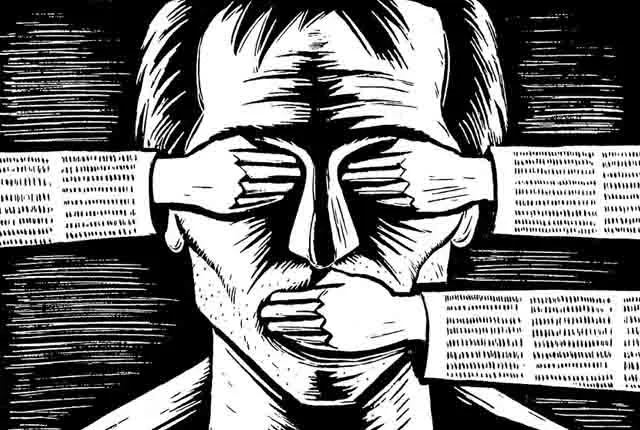
Illustration by Eric Drooker via Isaac Mao/Flickr (CC-BY)
Follow @pierre_alonso and @sabineblanc on Twitter
💬 Discussion
No comments yet. Be the first to comment!