
We’ll call him Abu Jaffar. For security reasons, he doesn’t want to be identified by his real name or photographed. We met on the Turkish side of the Syria/Turkey border. Between puffs of apple hookah, he explains to OWNI how he and his friends went about setting up a media unit to cover the Syrian revolution, especially in the areas of Latakia and Jisr al-Shughour in Jabal al-Zawiya.
What were the circumstances of you crossing the Turkish border?
I had a friend, his name was Mohamed Sabaq. I speak in the past tense, because my friend died of a gunshot to the head that tore off the entire back of the skull, on December 27, 2011. He had just crossed the Turkish border, in fact he was 100 metres inside Turkish territory. He was 29. I knew him from school, we were neighbours. We loved watching action movies together, but in silence, not like other Syrians who just chatter during a movie. Mohamed was always quiet and reserved, never a word spoken out of place. I think of him every day.
How is the work you’re doing organized?
I was in charge of logistics. Mohamed, who was a TV engineer in Latakia, was the technical project manager. He was the one who was posting videos on YouTube, all the videos posted to the Freedom 4566 account [Editor's note: there are over 400 videos, with Arabic descriptions, showing the daily repression in Syria. Some of the videos are extremely graphic]. At first he did this from home and then we decided to head towards Erber Jaway in order to use the Turkish Internet. We had laptops, plug-in 3G Internet and everyone had an iPhone. This equipment has quickly become our standard hardware for sending images and communicating. Mohamed was posting images but also providing training for some members of the Free Syrian Army, or anyone else who was interested.
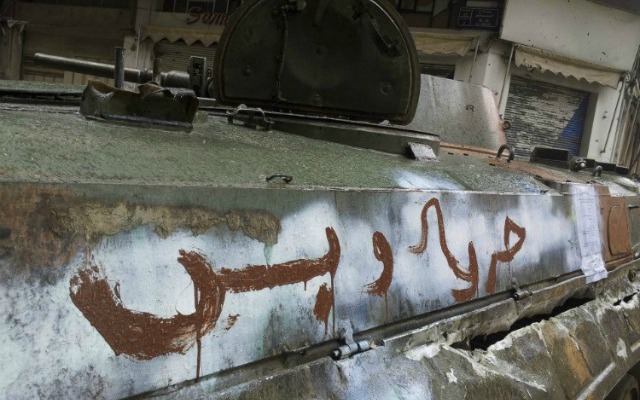
"Free Syria" written on an abandoned regime tank in the city of Homs, February 2012.
When we needed to restock, we went into Turkey. All the equipment was funded by Syrians living abroad, including two doctors in the US that I don’t want to name. The money was sent to us via Western Union. We returned to Syria and this time we started to cover a bit better Latakia and Al-Qusayr.
Have you noticed anything that would suggest your communications are being monitored by the Syrian services?
I can’t say too much about our information security, it’s Mohammed who was looking after that. But for sure, we change passwords frequently. Our little group had begun to expand. We needed active people who were quick learners, so we were joined by some other friends of ours. There was Anas, Bashir and Tariq. I continued with my logistical role, going back and forth to Turkey to buy cameras and computers and recover funds that were sent to us. We were able to expand our operations into Homs, Jisr al-Shughour and other cities.
Anas and Bashir were responsible for the area of Jisr al-Shughour. The last time we heard from them, it was just before the army was to lead an assault on the city. We were very concerned, given what we had been seeing all the time. Something terrible must have happened. Ten days later, we saw them on official Syrian television. They were confessing that they were terrorists. They showed the places where they operated. They had no marks on their faces but something had changed in their expressions. I know them well, I knew they were not in their normal state. We immediately sent their photos to Arab television channels, to Al Jazeera, Al Arabia. For them not to be executed, we need to create as much publicity as possible. The regime is still more careful when it comes to well-known people.
Have other activists replaced your imprisoned comrades?
We had to reconstruct the unit. We recruited new people and started again. This time they operated out of Ramel, the Palestinian refugee camp in Latakia. There was Abu, a Palestinian, Abdel and Ibrahim. They organized the finance, receiving aid from abroad, from France, the United States and Saudi Arabia. When the army attacked the camp, it took three days to take control of it. Throughout those three days, they broadcast live images of the fighting. They were all arrested in the end. We did the same thing again as we had done for my friends, we sent their pictures to the major television channels to protect them. We were in the process of setting up a network to cover the countryside and cities in our region when special forces tracked down my friend Mohamed and followed him, and, well, you know the ending.
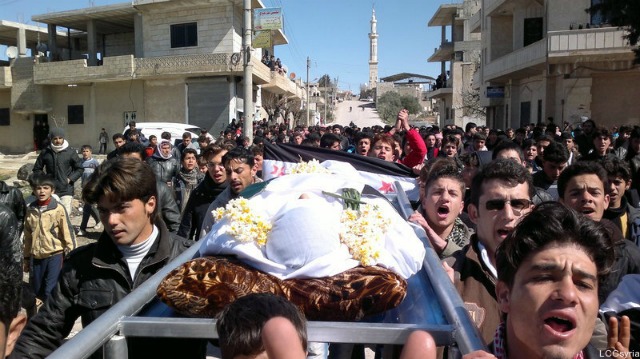
A funeral procession in the city of Idlib, March 3, 2012
At first, Abu Jaffar was depressed and angry at having lost his friends. He has since resumed operations from Turkey, and is waiting to start work again inside Syria.
Image Credits: LCC Syria
💬 Discussion
No comments yet. Be the first to comment!