
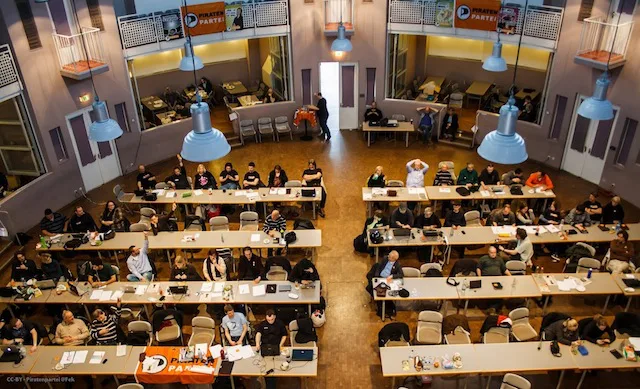
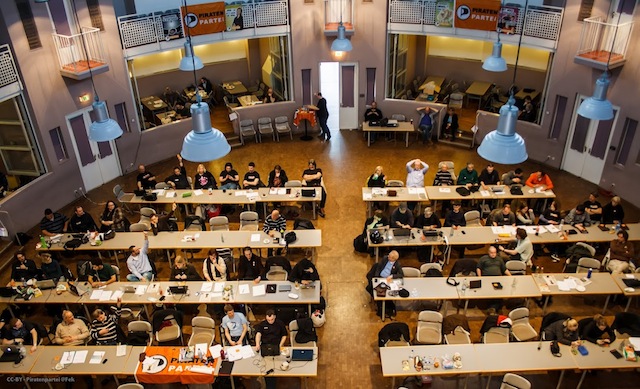
The Pirate Party is “a substantial factor” in German politics. That statement came not from a spokesman for the young political movement born in Sweden and growing rapidly in several countries, but from the German Chancellor, Angela Merkel.
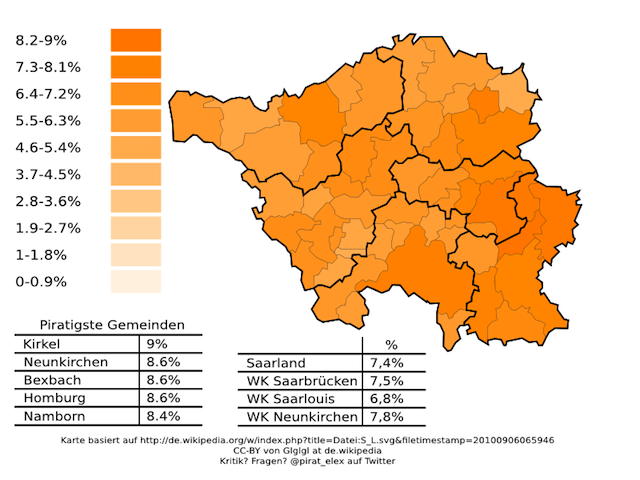
She was speaking after last Sunday saw the German Pirate Party (PP) enter the regional parliament in Saarland, a small state situated on the German-French border. They took home 7.4% of the vote, making them now the fourth-ranked political force in Saarland, ahead of the Greens and the Free Democratic Party (FDP), both members of Germany’s ruling coalition government. The FDP in particular were severely punished by voters; they managed to capture just 1.2% of the vote, an embarassing result that means they miss out on any seats in Saarland.
For the Pirates it’s another remarkable result that builds on progress made in Berlin last September. In the capital city’s regional parliamentary elections they won 9% of the vote, securing them 15 of the 149 seats up for grabs. The PP’s victory last autumn “is not that surprising given the profile of Berlin,” wrote Louise Culot in these pages.
Their program is based on the ideals of freedom, knowledge sharing and participatory democracy – ideals dear to a large part of the local electorate. For a city with a young, creative, cosmopolitan population, home to a huge number of digital artists, graphic designers and filmmakers of all kinds, these ideas have resonated with the expectations of a generation.
On the Road, IRL
But Saarland, a tiny industrial state, has an entirely different profile. “I thought the Pirates were a big city phenomenon. I’m a little surprised by their result in Saarland,” Nils Diederich, a political scientist at the Free University of Berlin, told AFP. Assumptions like that mattered little to the Pirates who claimed victory in Saarland on Sunday.
We decided to go ‘offline’ to the people in the provincial areas of the Saarland. We presented our ‘Pirates on Tour’ events in the provincial regions. And we guess that a lot of people understand our political message. We are not longer a ‘one hit wonder’!
If, given the party’s origins, their target market remains “geeks”, their audience now seems to have expanded well beyond that section of the population. Gefion Thürmer, a member of the party’s national executive, agrees.
The Pirate Party may be seen as an urban party, from superficial observers, but this is certainly not the case. Our topics – fundamental rights, civil participation or transparency of the state – are just as important in urban as in rural areas. They affect people in every level of the society.
Father of PP “impressed”
Rick Falkvinge, the Swede who launched the PP in 2005 before stepping aside from politics, compares the German party’s experience with how the Swedish party has progressed.
I think it’s not so much urban, as it is progressive and embracing change, pointing at citizens as a positive force in society in ways that the previous parties currently don’t. After our success in the European elections in the Swedish Pirate Party, political analysts were very confused – none of the traditional dividers applied. There were only two consistent patterns – that we had a huge support among the younger generation, and that we had hotspots of support around universities, technical universities in particular.
That said, we had a lot more activists in cities with universities, and our organisation was less strong in more industrial areas. Surprised may not be the right word, but I have to say I’m impressed with the operative and political capability of the German Pirate Party, in how fast they’re learning and adapting.
Berlin, by nature a progressive city, constituted fertile ground for the PP to flourish in, according to Falkvinge. And that’s not to forget the symbolic impact of their initial victory in the capital city.
“They expanded their proposals to include other social issues,” says Maxime Rouquet, president of the French Pirate Party. “For example they offered free public transport in Berlin. This is one of several possible futures for the PP.”
Behind the tributes of Angela Merkel, however, there is a palpable sense of contempt emanating from the traditional German parties. Contempt that may be hiding a now genuine fear of these troublemakers. The secretary general of the CDU, Hermann Gröhe, rejected the PP as being stuck in the limbo of the protest party, another way of saying that they can never be a serious party of government.
Young men who vote for the first time send out strong messages of protest (…) How can we respond to these calls for greater transparency and participation in politics?
More than 10,000 new members
The goal now is to consolidate this encouraging debut – a record for any political party since the founding of the German Federal Republic, as noted by Der Spiegel. Further electoral tests will be coming soon and the PP are confident, a fact reflected in the polls. If the voters of Saarland identified with the PP’s program, the voters of Schleswig-Holstein and North Rhine-Westphalia should do too, believes Gefion Thürmer.
Since the first poll in Berlin that showed nearly five percent for us, and finally due to the two parliaments we entered in Berlin and Saarland, we won more than 10,000 new members. These need to be integrated. We have two more state elections this year, and the national election in 2013 which need to be prepared for. We are confident that we can gain some seats in the Bundestag.
But the question of whether they will join a coalition, if that scenario were to arise, has not yet been decided. “This will have to be decided by our members,” she explains. “Certainly we want to bring our political positions forward, and if in the long term this is most possible within a coalition, it is something we will consider.”
Rick Falkvinge is confident in his political offspring, taking their eventual entrance to the Bundestag for granted.
I am convinced the German PP will remain successful in the short term. Once in (regional) parliaments and the Bundestag, there will be new challenges – getting re-elected is a different game from getting elected in the first place. But seeing how they appear to balance the political game with brutal honesty towards the people who elected them, it is my impression they’ll keep growing in the coming decades and remain a locomotive for Pirate Parties in other countries.
The Pirates are currently polling at 5% in Schleswig-Holstein and 6% in North Rhine-Westphalia, with elections due to take place in May.
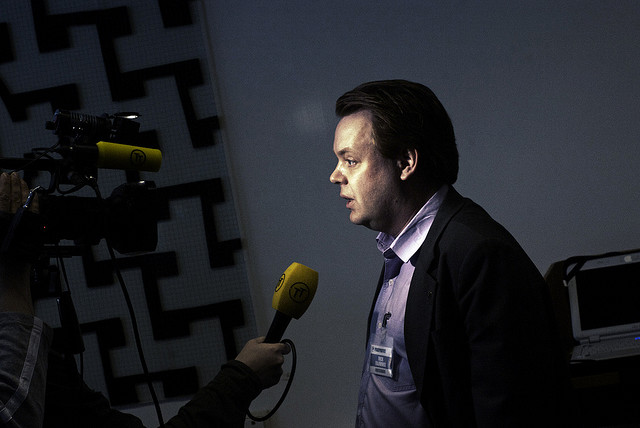
Rick Falkvinge, Pirate Party founder, Sweden 2009
As part of their ongoing development, the German PP must also avoid ending up like the Greens, the former anti-establishment heros now adrift in coalition agreements. Gefion Thürmer believes good political reflexes and changed times can help them avoid this pitfall.
The Greens grew older, and instead of keeping in mind what had made them special, they became established and adapted the behaviours of the other parties – they no longer dared to follow new ideas or work out new concepts.
The system of the Pirate Party, with grassroots democracy and all decisions made by the members, is not in as much danger of this happening, because there are so many people who always bring in new ideas.
The German example
Alongside Sweden, Germany is so far the only country where the PP has been able to achieve this level of success. Gefion Thürmer believes that the German context is just one aspect that has contributed to their success.
Certainly the Germans have been waiting for a party that does not disappoint them and really tries to achieve what will serve the people best. Germans are used to politicians who do not listen to their needs or do not understand the way society works today, with all the new developments of the Information Age. The Pirate Party is different: it evolved from a generation that embraces these changes instead of rejecting them, and tries to adapt what is possible to make politics more open to the people instead of deciding above their heads what they think is best for them. People want to be in charge of their own lives and their own society, and the Pirate Party wants to enable everyone to actually do this.
The political scientist Nils Diederich, talking to AFP, adds a note of caution amidst all this Pirate-related optimism.
I certainly wouldn’t rule out them passing the 5% threshold for entering the Bundestag, but they will need to add a little more political substance.
Image Credits: Carolina Ruiz Leon CC-BY-NC-ND
💬 Discussion
No comments yet. Be the first to comment!