
With its Great Fire Wall, through which every search carried out by Chinese Internet users passes, China can claim to have built an instrument of web censorship which has created political prisoners and caused deaths. In recent months, the ruling party have increased measures directed against web freedom, suggesting the regime’s intention to curb dissent, and in particular organised dissent.
Massive censorship
Until recently there had been no organised movement of hackers in China responding to this massive and visible state censorship. In a political scene that’s been turbulent since the fall of Bo Xilai and the heavy media coverage of the case of Chen Guancheng, Chinese authorities are keen to suppress any further signs of weakness, and subdue dissent on the Internet.
The first action of the brand new Anonymous China group dates back to early March, following the arrest of alleged members of the LulzSec hacktivist group (with whom Anonymous China supporters had been collaborating). But it wasn’t until April 5 that Anonymous China really made themselves known. On that day supporters hacked over 300 sites linked to the government as well as many commercial websites.
In their message addressed to the Chinese people that they posted on the hacked pages, the hackers encouraged them to rise up and overthrow the regime, and to use VPN’s (virtual private networks) to circumvent censorship of the Great Fire Wall. In the aftermath of the attack, most of the sites had regained normal function.
In a statement sent to AFP the following day, Internet users claiming to represent Anonymous China promised to continue and step up their actions. Since the initial mass attack, a number of more isolated and lower profile operations have been carried out. On April 27, Anonymous Analytics published a 44-page report implicating the multinational tobacco producer “Huabao” in dumping activities and misappropriation of funds involving its billionaire founder Chu Lam Yiu.
More recently, on May 8, the site of the University of Hangzhou was targeted, with user and administrator accounts being revealed. According to Reuters, the majority of ‘members’ operating as part of the Anonymous China collective live within Chinese territory, even if those operating the group’s Twitter account are likely based abroad.
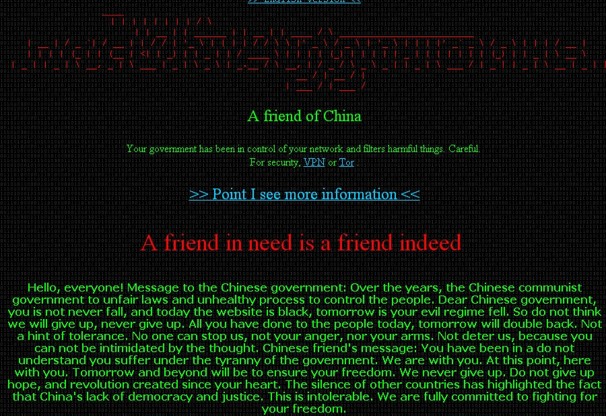
Message posted on hacked sites, in English and Chinese
Crucially, the 18th national congress of the Chinese Communist Party, held every five years, will take place in October. The central government and senior party officials are therefore particularly inclined to take whatever measures are necessary to prevent any disorder that could disrupt the event.
Since the last full plenary session of the party in late 2011, a strengthening of measures targeting dissent on the web has continued with the slightest of pretexts. The latest crackdown, euphemistically christened “spring breeze”, is evidence of the central government’s keen awareness of the role of social networks in the organisation of social discontent. The government has, it seems, no desire to be a collateral victim of the Arab revolutions.
Lockdown
Officially devoted to cultural reform, the plenary session at the end of 2011 was a way for the central government, aware of the growing number of Internet users bypassing censorship, to consider a series of measures aimed against “rumours harmful to social order“. A meeting was organised in early November between the government and some forty companies centrally involved with the Chinese Internet network. This meeting resulted in a commitment from those ‘gatekeepers’ of the Chinese network to implement all the government directives in the fight against “rumours and false information“.
By using this type of terminology, and recruiting the active collaboration of service providers, search engines and microblogging platforms, the government is seeking to increase its capability to shut down all information related to riots, demonstrations and political or diplomatic incidents – all whilst tracking down any whistleblowers. The Department of Technology officially enacted the collaboration at the end of February by announcing the requirement for developers of websites to reveal their identity to the authorities and representatives of service providers. The measure has since been extended to micro bloggers, although with less restrictive parameters. While demonstrations attended by thousands of people are common in China, coverage in the media sphere is immediately nipped in the bud by the web police.
Around mid-March, two weeks before Anonymous China’s massive attack, the decision-making and incarceration began to accelerate. Following the ouster of Bo Xilai, one of the highest-ranking members of the party, hundreds of thousands of messages began spreading on blogging platforms. Some predicted a coup in Beijing. The central government immediately made arrests and between March 29 and April 2 banned users from commenting on the two main blogging platforms – Tencent and Sina. The arrest of so-called dissidents was facilitated by one of the most regressive laws in terms of human rights that China has endorsed in recent years. On March 16, the People’s National Assembly passed a new law on detention.
The latter authorises the parliament to secretly jail, without charge and for a maximum period of six months, anyone suspected of crimes “endangering national security”, including Internet users.
Between mid February and mid April, around 1,000 people were arrested, 50 websites were closed, 3,000 were reprimanded and 210,000 microblog posts were deleted by Chinese cyber police.
Moreover, and as an example, notable online dissidents Chen Xi (陈 西) and Chen Wei (陈卫) were sentenced in December to eleven and nine years in prison for “subversion”, as Reporters Without Borders revealed
However, as Séverine Arsène, specialist in Chinese media and Internet, points out:
The hardening of repression and the will to silence dissent are indeed real and are partly related to the context of the party congress in October and political tensions as evidenced by the arrests that took place recently in Chongqing. However we see that it is becoming increasingly problematic for the authorities to imprison or punish with impunity, outside the law and outside of a legal appearance to the public and abroad. Some of the latest measures taken were in fact already applied before but the government legislates because it is a way to legitimise repression. This reflects somewhat a respect for the “formalities of law” in the face of an online dissent that the government can no longer contain.
Besides a purely repressive use of the web, the regime is more and more making use of technology as a strategic tool in all areas of its policy, to understand and target the potential dissident risks and to manage economic, diplomatic or military interests. This political strategy to rely on new technologies to govern is actually derived from a much older thinking deeply rooted in the Chinese conception of power. In the sixth century BC, the strategist and author Sun Tzu wrote in his Art of War:
He who excels at resolving difficulties does so before they arise. He who excels in conquering his enemies triumphs before threats materialise.
Image Credits: (CC-by) Abode of Chaos
💬 Discussion
No comments yet. Be the first to comment!