
January 18, 2012. A massive blackout hit the Internet. Reddit, WordPress, Tumblr and giants such as Wikipedia and Google made all or part of their sites inaccessible. They were protesting against the Stop Online Piracy Act (SOPA) and the Protect IP Act (PIPA), two bills aimed at strengthening copyright protection measures. As a result the media frenzy provoked by such an intense and coordinated mobilization, legislators rowed back.
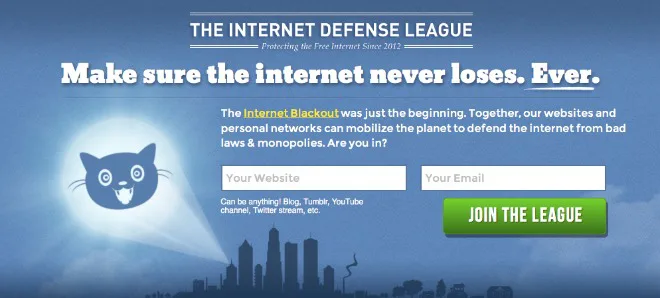
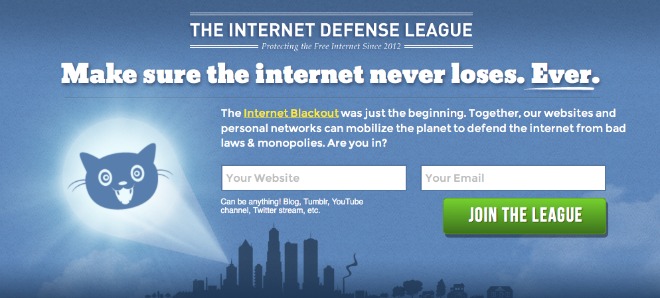
January 18 marked the birth of a genuine counter-weight against the established Washington insiders of the cultural industry lobby. That battle is being formally structured with the imminent creation of “The Internet Defense League“. The “League” – an idea borrowed from the world of superheroes – aims to “defend the Internet from bad laws and monopolies“. It also places particular weight on the role of every individual in spreading its messages.
Among its members are Reddit and WordPress, as well as NGO’s such as AccessNow and the Electronic Frontier Foundation (EFF). The initiative is the brainchild of members of Fight For The Future, the young group which coordinated much of January’s blackout campaign. Funded by a foundation and individual donations, it now has six full-time employees. When it came to choosing an emblem for this “League” they opted for a cat, the “unofficial mascot of the Internet“.
OWNI talked with Douglas Schatz, one of these new Internet activists.
What did you learn from the fight against Sopa?
The fight against SOPA showed us that there are millions of people out there who care deeply for the safety of a free and open Internet. The pervasiveness of the Internet has created a highly collective culture that runs counter to more traditional forms of business. But that culture didn’t really have a way to organise and unify that voice. That’s where we came in. We didn’t create the opposition to SOPA, we just collected and amplified it.
Do you think the involvement of companies like Reddit is essential to your actions?
Companies like Reddit are unique in the sense that they grew in a very organic way. Reddit’s user base is large, enthusiastic, and (mostly) unified. But Reddit (as a website) does not innately possess the ability to reach the ears of their political representatives. By using the size and enthusiasm of Reddit users in conjunction with our communication tools, we can funnel massive action towards Washington D.C.
What is your relationship with other groups such as the EFF?
We are very friendly with organisations like the EFF. There is a small coalition of organisations that are fighting to defend Internet freedom. We all work with each other to fight issues relating to tech policy and the Internet.
Do you have the purpose to encourage ‘slacktivism’?
The term “slacktivism” is fairly meaningless. Online organising and activism includes traditional organising ideas and is essential to a democratic process and culture. It also almost always makes traditional organising bigger and more effective. The tools we developed for the SOPA and PIPA fights mobilised large numbers of people who communicated with their personal networks in new and old ways, but were still very effective in terms of getting the Internet’s message to senators and representatives. This allows us to build an extremely broad coalition of Internet users, regardless of technical knowledge or political affiliation.
Additionally, in modern American politics awareness is half of the battle. SOPA was a bill that had very little fanfare surrounding it. It was passed through committees quickly and quietly in order to avoid confrontation. So people who liked, tweeted, or posted images and URL’s helped make the bill become a mainstream issue.
What is your answer to those who argue that Internet activists like yourselves are working hand in hand with ISP’s and Internet giants (Google, Facebook) to deregulate the market and undermine the cultural industries?
Our organisation works on defending the Internet for the public interest. Google, Facebook, Twitter and so on are companies that have a lot of power online. They work on issues that make sense for their business interests. We happened to be on the same side regarding SOPA. That might not be the case for all issues. We haven’t been able to contact anyone at Facebook, we’ve had little contact with Twitter, did not ask Google to participate in the blackout, and most of the major ISP’s in America have significant stakes in the content production industry and have not been particularly friendly to our cause.
We don’t advocate deregulation of the Internet. We want the rights and basic freedoms we access through the Internet to be protected. The Internet has completely revolutionised modern society and gives people a foothold to engage in it.
Do you plan to get involved in Europe, and if yes, how?
The Internet Defense League is all about Internet defence, regardless of the threat’s country of origin. Anyone in the world can become a member of the league, and will be able to bring all threats to our attention.
Additionally, we are allied with the organisations La Quadrature Du Net and Avaaz.org, who already do great work in Europe.
Do you agree that there is, as some are saying, a “war on sharing”?
It could probably be better described as a war on alternative distribution models. We, as a networked society, are moving towards communicating via “the cloud”. It’s just another form of communication. But older forms of distribution (like Hollywood and the MPAA) are financially entrenched in their older models, and have been doing all they can to stop technological advances.
Do you think a cute cat is a better signal than the bat-signal?
We decided to use a cat because cats have become the unofficial mascot of The Internet. According to Professor Ethan Zuckerman’s “cute cat theory of digital activism” people will only become interested in fighting for the Internet if their mundane activities (like watching cat videos) are threatened.
💬 Discussion
No comments yet. Be the first to comment!