
In a media environment evidently oppressed by the overbearing hegemony of politics, corruption and sex scandals, a hostile job market is contributing to driving Italian journalists over the edge.
According to the Italian website Liberta di Stampa Diritto all’Informazione (LSDI) at least 40,000 journalists are effectively ‘invisible’ as they don’t meet the strict requirements needed for entering the Ordine dei Giornalisti – the only existing institution supporting members of the trade- whereby one must have undergone training with the same publication for at least 2 years publishing at least 200 articles, requirements established by the Fascist dictatorship of the 1930s.
Last week, LSDI called for the government to improve the standards of labour rights and to set a minimum wage. It stated in a press release that it believes:
It is absolutely unacceptable that independent labour is paid with compensation so low that the vast majority of freelance journalists declare an average annual income that is lower than the poverty threshold set by ISTAT [the Italian statistics institute].
According to sources freelance journalists are paid as little as 5 euros per piece.
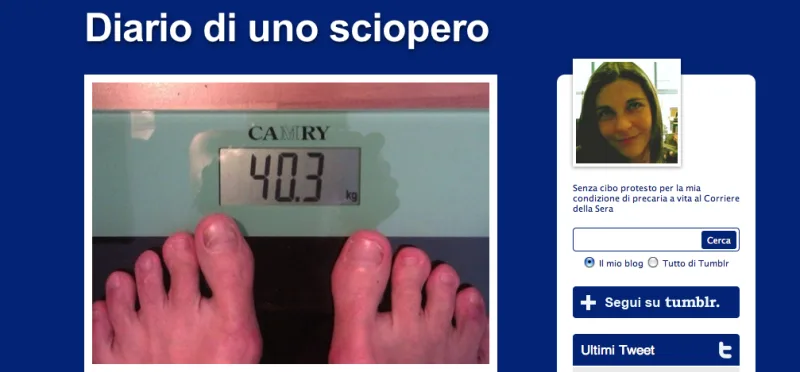
Recently, some of them have resorted to drastic measures. Paola Caruso, 39, has been working at national newspaper Il Corriere della Sera for the past 7 years but only managed to get a temporary contract 3 years ago. And whilst the carrot of a job opportunity has always been held in front of her, when the opportunity did come she was rejected and, crestfallen, she threw down the gauntlet and decided to go on a hunger strike.
The strike began this past saturday and so far Caruso, who has been documenting it on her Tumblr blog, has managed to get a few shows of sympathy and some press coverage.

The same Ordine dei Giornalisti has defined the current situation as a “new form of slavery”, the president has also commented on Paola’s strike by saying:
“It’s like a ‘wild west’ of sham hiring with inappropriate and abusive contracts that are never sanctified; young journalists are beginning to realise that they are bound to remain in the lower steps of the editorial hierarchy. This is unacceptable and the government has to intervene, given the millions of euros it invests each year on the editorial caste”.
Many Italian journalists are also attempting to find an outlet in new initiatives dedicated at re-establishing Italian media’s lost and tarnished reputation. This group tends to look beyond the rules upheld by the establishment, and is trying to find refuge in the web. New trends reveal a clear pattern within this professional circle, as numerous news websites and blogs have emerged since the trend sprouted in 2009 when Luca Sofri’s successful news/blog site, il Post, was launched.
According to a 2010 survey by Human Highway and Liquida Italy now counts 1.7 million bloggers – half a million more than last year. The study also concluded that 23.1% of the 24 million Italian netizens read blogs regularly, and the majority of them focus on current affairs.
The past two months have seen the launch of two further websites that purport to fill the gap in the market left by proper news reporting.
Lettera 43

Launched on October the 7th, the name symbolises “the union of old and the new”: Lettera is an Olivetti typewriter favoured by many journalists, whereas 43 represents 2043, the year in which, according to Philip Meyers, the last copy of the New York Times will be published.
In his first editorial, editor in chief Paolo Madron is quick to establish the lack of political affiliation of his website, a further sign of how weary journalists and editors have become with newspapers being instruments of party politics.
Another unusual move was to employ journalists that are no older than 30.
“Access to the job market has been barraged, and they are victims of a self-referential clique, deaf and blind to the world and values of the new generation. The élite should, instead, be open to a generational turnover in order to enliven and strengthen the profession. Here at Lettera43 we want to give them an opportunity”
What prompted him to create Lettera43? “I believe in online journalism and I disagreed with the editorial practices of my former paper, il Sole 24 Ore. I left because I believe they weren’t and still aren’t publishing news. It was a bit like going to a pizzeria and not being served a pizza. What’s the point?”
The building process was fairly simple: “We put together €1 million among ourselves, the founders, and managed to gather an injection of €4 million from various investors and financiers. We plan to fund ourselves via advertisements, donations and by selling content. We plan to announce a few partnerships in the next 20 days”. Amongst the financiers a number of powerful figures such as ex-Fiat CEO Paolo Cantarella, founding father of private equity fund Sator, Matteo Arpe and Angelo Mario Moratti, member of the Moratti clan, a family that dabbles in both football and politics.
As usual in this job market, the job opportunities at Lettera43 were not advertised in a job site; rather its imminent launch was announced this summer on Dagospia – a current affairs blog akin to the Drudge Report – whereby many were propelled, but not openly encouraged, to send their CVs and covering letters to Paolo Madron.
This is as close to a job ad as you’ll ever get. Journalist have to fossick for job opportunities mostly through connections. To give an idea to the lack of legitimacy of classified ads, suffice to say it is not unusual to find ads requesting for a female journalist di bella presenza (good looking).
Because of this, the job market is far from being transparent and there is no way to monitor respect for equal opportunities.
Siamotuttigiornalisti.it
Launched this summer, siamotuttigiornalisti purports to be a kind of ’wikipedia’ portal for free information, run by a group of four full-timers – of whom just one is a journalist – and 20 part-time contributors, all of whom are unpaid. It took two years to launch and has a familiar rationale: finding a “breath of fresh air” from an opaque information industry, plagued by the dearth of free and uncensored news and an overwhelming obsession with party politics.
Siamotuttigiornalist is so far self-financed, but will soon launch a round of funding, encouraged by promising traffic figures: the website has in fact recently registered around two thousand visits per day.
This portal aims at merging the role of ‘reader’, with that of the journalist and editor. Anyone can publish any news: thought the focus is mostly national its philosophy is based on “service to the community”.

The founding father is Alberto Troia, 63, an IT engineer based in Rome. He says they “want to focus on topics that the mainstream media normally relegates to brief paragraphs, such as breakthroughs in scientific research”. He cites an interview to a Nobel prize winner as the most successful piece of news published so far.
“We’re searching for alternative sources of information and want to mainly aid i giovani, the young”.
Despite the varying degrees of success, each outlet appears to have the same raison d’être – to provide information free from censorship, distortions and political bias, as well as new opportunities for those who have been denied them by a rigidly cast system that seems to have no intention of letting go of its privileges.
From the business side of things, the market is clearly fermenting: the number of readers is growing exponentially, as the research has shown, and with it (as to be expected) the time spent reading each news piece.
One feels that the Italian labour market is escaping the rule of capitalist competition as – civic, political and social considerations aside – Italian journalists effectively remain an enormous untapped resource, and there is little to be gained from ignoring it.
——-
Photo Credits: Flickr CC ABC Archives
💬 Discussion
No comments yet. Be the first to comment!