“I met wit Napper Tandy, and he took me by the hand, and he said ‘How’s poor ould Ireland, and how does she stand?” – The Wearin’ o’ the Green (Irish Ballad)
January 25th marked the beginning of the Egyptian revolution, but for the Irish February 25th is set to mark a new dawn in political life. This Friday the people will cast their votes in a general election that will lead to the biggest political shake up in the 89-year history of the state.
This quiet revolution carries no catchy colour moniker – some might say the Irish have had the colour drained out of their faces along with the money from their bank accounts – but for a small nation of less than four and a half million inhabitants, the election affords the unique opportunity to redraw the political landscape. Though Ireland is neither Egypt, nor Greece, protests and civil unrest have occurred in on the streets of Dublin, (no small thing for a traditionally reticent and passive populace) notably at the end of 2010 after the humiliation of having to accept a 67.5billion euro IMF bail-out.
Even the outgoing Fianna Fáil government are running on a message of change. After the country’s catastrophic economic collapse since 2007 – it is the only viable position.
Éireann opened the front door to find her E.U. landlord standing there with a concerned look on his face and shopping basket of essential items to hand over. It was, for many, the tipping point. The political crisis triggered by the bail-out led Taoiseach Brian Cowan to call an election more than a year before his term was due to expire.
A Social Media Election?
Times are tough, but this is not the Ireland of Angela’s Ashes – Frank McCourt’s celebrated memoir of impoverished upbringing in Limerick City in the 1930s and 40s. Ireland is a technologically advanced nation that has more video game consoles per head than any country outside of Japan. Two million of her citizens are on Facebook.
This has been labelled the first general election of the social media age. All the main parties including Fianna Fáil, Fine Gael and Labour have been keen to use Facebook, You Tube and Twitter to reach the electorate.
Social media is not going to swing the Irish election – it’s a foregone conclusion that Fine Gael, historically Ireland’s second largest party, will lead the next government – but there has been a lot of interest in how candidates are adapting to the social media age. It seems their approach is reactionary, stemming mainly from a desire not to be left standing by their rivals. At the start of February there was a surge in candidates signing up for Twitter, with over 50 new accounts in one week alone.
Social media is new to most Irish politicians and certainly there have been some missteps, even by the big parties. Fine Gael were panned for using terms such as ‘Twolicy’ (an ill-conceived union of the words Twitter and Policy) on their main site.
It’s not enough just to be on social media, candidates must make good use of the new technology to be effective, argues Stephen O’Leary of O’Leary Analytics.
Speaking on Irish radio last week he said:
“A lot of people are just going on [Twitter] because they feel it’s the place to be. [However] certain politicians aren’t just broadcasting ‘On the doorstep, everyone is telling us great things,’ but are engaging with real questions and the candidates who do that have the best chance of converting tweets into votes.”
One Irish bookmaker is even running a ‘Golden Tweet’ award for the candidate with the best use of social media in a campaign.
Independents’ Day
Social media is evening the odds for independent candidates in this election and it’s here that democratising effect of the digital revolution are really being felt. There are an unprecedented 202 independent candidates battling for places in the 166-seat Irish parliament in this election – up from the 90 that contested in 2007.
A new generation of would-be Irish politicians are using their tech-savvy to produce impressive online campaigns including the sort of slick promo videos that were, until recently, the preserve of big parties with big budgets and a direct line to the folks at state broadcaster RTE.
Poster-boy for this ‘cub’ sub-set of independents is Dylan Haskins, running for the Dublin South East constituency, whose ‘, campaign video, with its upbeat message that Ireland can rise phoenix-like from the flames, has received over 30,000 hits on You Tube.
‘It Starts Here’ is as slick as a US presidential advert – this from a 23 year old Trinity College student, albeit one with an interest in film-making. It’s Haskins and other young independent candidates with an intuitive understanding of how social media works who have the best chance influencing first and second time voters in the 18-25 demographic. His own website,Dylanhaskins.ie features prominent endorsements from heavy-hitters such as celebrity economist David McWilliams.
This week McWilliams himself launched thepeopleseconomy.com, a site set up to make economic issues accessible to all. It contains a guide to the key economic issues and includes questions to ask politicians on the doorsteps.
Amid all this, Legacy media are vying to make their presence felt . Interestingly three of the top ten tweeters during the TV3 Leaders’ debate last week were news organisations.
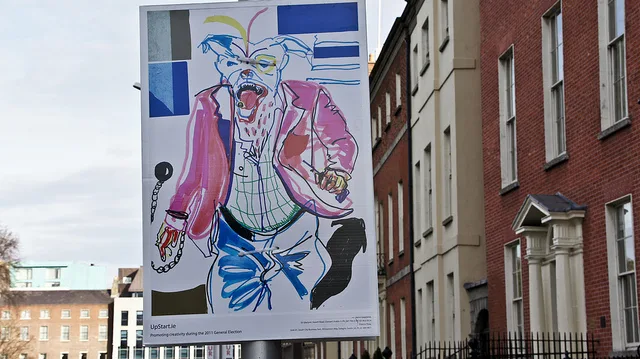
Fittingly, Irish have remembered their artistic and literary heritage in this historic election. Non-profit arts collective Upstart.ie have erected hundreds of thought-provoking posters on lamp-posts in the capital. They sit alongside traditional campaign posters featuring the head and shoulders image of a candidate. These works of art are designed by ordinary people as well as artists and writers. Many make comment on the myriad repercussions of Eireann’s economic collapse. Some depict scenes of individual despair, such as the world-weary beggar huddled in a doorstep. One has the drawing of a harp, (the icon of Ireland chosen for the ‘national’ side of Euro coins) but with snapped strings, above the message ‘due to unforeseen circumstances we regret to inform you that Ireland is cancelled.’

Nothing Going On In Ireland But The Election - Upstart.ie's Poster Campaign
However the pieces fall on Friday, it will be many years before normal service resumes in post Celtic Tiger Ireland but when that day comes the people will look back on Feburary 25th 2011 as a key date in Ireland’s history.
—
Photo Credits: Flicks CC informatique
💬 Discussion
No comments yet. Be the first to comment!