
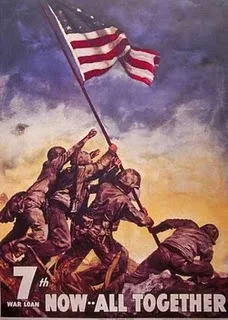
Today’s post is covered in dust and filled with retro possibilities. My love for vintage ads (which are found in several other articles) now has a post for itself. Obviously I will not do an article called “Old Advertisements,” which would not be very useful nor interesting. So, after some reflection, I decided today’s article will cover the world’s history over a span of two centuries. Read: Propaganda.

The magnificent flag of propaganda

At any rate, propaganda is not hard advertising, but it was the most common model of communication in the nineteenth century – in both times of war and political stability. Here is propaganda (sorted by country) in retrospect, like you’ve never seen before.

The glory of communism - brought to you by propaganda
North Korea: Stronghold for current propaganda
As the last communist dictatorship in Asia, North Korea is by far the country which has the most mastery over propaganda. Problem: How do you make your people believe your country is great when even the rats are trying to flee? Answer: Indoctrinate your entire population with myths and let propaganda take care of your communications.

The peasant, happy in the countryside


The green pastures in North Korea (Currently in a state of famine…)


A “natural” smile


Of course, THE number one enemy of communism is capitalism. So who is a worthy representation of capitalism? The United States. Therefore North Korea develops propaganda against its enemies: Americans. Sometimes it’s extremely violent.

A country openly hateful towards the USA


“Do not let the America wolves destroy your life”


Use of American symbols, like the capital…


…or the eagle, the USA’s national bird (here attacking an innocent Korean baby).


“Nothing will stop our progress!”


“Everyone against the American enemy.”

The American economy is symbolized by the capital
On the same note, we also have propaganda on the country’s technological advances and resources – but also on production, which is a rich topic on its own.

Korean metal workers


Only the latest technology for this competent country


A developing railway system thanks to heroic miners!


While these posters have a 70s or 80s flavor, they are still seen after the turn of the century.
The representation of the enemy is very present in North Korea, along side images of agriculture, technology, and production. Yet there remains an element that most commonly appears glorified: The (single) political party. This is the foundation for North Korea’s society.

All classes are represented by the glory of the political party.


The glory of communist North Korea is always celebrated


The Juche and the flag – The country’s symbols. Above: “The brave Juche”


The Korean people – a happy people

North Korea is one of the last Stalinist Communism countries, known for its supreme propaganda techniques: Joyful protagonists, unrealistic situation, divine-like powers, etc…. All of this is reminiscent of the other major players in the propaganda war: The USSR.
The USSR: Propaganda with a capital P
Even though the USSR no longer exists, it was one of the greatest powers of propaganda. Posters with ultra-ideological representations came in the thousands, and it actually established the organization for modern propaganda. As the ancestor of North Korean posters, there are similar structures shared between ideology and indoctrination.

Icons of the communist USSR: Lenin…


… and Stalin: “Let us understand our leader Stalin, and enter into communism.”

Lenin glorified

Contrary to North Korea, in Russian propaganda we see the dominance of red and ideological symbols tied to a particular class: the workers. It’s logically represented in a particularly antagonistic way against the United States.

Representation of the workers and the proletariat


The happy people in the countryside

The USSR’s propaganda machine was known to exhibit its military power through showing off its weapons and related military equipment. We figure, they want their people to be afraid so they can be reassured. The USSR is strong – and shows it.

Strength in numbers: A unique niche for the country’s propaganda


The National Railroad Company

“The enemies are before us – The Russians must resist the enemies of the revolution”


The army and the aircraft fleet

This type of propaganda is also recognizable through pervasive references to blood and war.

The enemy is capitalism


"Defend Lenin's city"

Everyone is called upon for the confrontation.

The importance of speech is also unique for the USSR. At the time there was an evolution of freedom of expression, and this agitprop reflects t quite well. Additionally, despite its broad censorship the press is important in society. It’s represented on the same level as books and other sources of knowledge.

“Keep your tongue in your mouth.”


"Rumors, lies, stories, Speaking"

The call for knowledge – Below: The poster revisited by Franz Ferdinand.


Pravda: The Russian newspaper

A poster denouncing capitalism

The press celebration - 1926
Like North Korea, there is evidently an endless celebration of communism and the unlimited power of the political party – The very foundation of the USSR (CCCP).

“10 years of the October Revolution”


The people armed and ready to defend the CCCP (URSS).

“Everyone for victory!”

These posters show us the different symbols present in Russian propaganda and recaptured by North Korea. While these images are used by the two powers, one of them branches off to create more original propaganda.
The URSS and Jewish propaganda
Before WWII, the USSR was one of the main countries for European Jews. Today Russian Jews are a minority, as most of them migrated to Israel or the United States. Yet we can find their cultural traces in propaganda through numerous posters in Hebrew which promotes the USSR.

The proletariat Russian Jew, represented in several posters.


Always the Jewish farmer in the USSR.


Poster showing Russian Jews migrating to the US
The two communist powers show off their symbolism in their posters: the colour red, army, power, the proletariat, success, the workers, etc… Today, a third Communist power stands alone with its propaganda (And finally with a communist market – hello paradox).
China
Unlike its counterpart, this power has done little in terms of propaganda – but the litte it has done is different from the works coming from the USSR and North Korea. We find many of the same symbols, but the prominence of children especially allows this propaganda to be lighter.

"Wrangly loves and respects the teacher"


"We love Science"


"Peace and Friendship"

Of course there are the usual symbols of communism, glorifying the people and other representations of the country…


The symbols are present, yet without the same violence seen in the USSR

Honor the flag and work


The family first


The army: Less blood, more arms


The working class in a more “traditional” representation


The little red book- Pro-Mao propaganda

In the three countries, we’ve seen that communism was a major actor in developing propaganda. Obscuring reality and finding comfort in imagines of power which are effective against fearful things is now a possibility – thanks to propaganda.
Although don’t forget that different wars fueled global propaganda. The USA comes to mind.
The USA: The military superpower
The world’s economic superpower has indeed used propaganda. During two wars, the Cold War, and different geopolitical crises, the country became a major actor in global propaganda.


Glorified Uncle Sam.


Values: Respect, honor, and patriotism.

The unsurpassed American patriotism

With the United States, it’s simple: The army, Red, White, Blue, the Marines, and the star-spangled banner – Nothing more, nothing less. The Marines and Navy are particularly represented.


The Navy – Men & Young Men


The American colours and traditional Navy uniform


Recruitment for the Marines – “The Navy Needs you! Don’t read American History, MAKE IT “

All the symbols: The Flag, the Statue of Liberty, and Uncle Sam

Beyond these two branches of the army, we also find the Air Force and the Army – Very present and the pride of the United States. They are naturally found in propaganda.

Army Air Force: Typically masculine


Women in the service


Propaganda during WWII


USA mass production.


American propaganda is primarily used to promote the military, not a certain ideology (Although Uncle Sam is a good vessel for this). However we find the famous “bonds” sold during WWII to finance the country and its arms.

Uncle Sam, always there with his bonds – and still pointing his finger.


“Pushing back the barbarians” thanks to bonds


The Japanese enemy in American propaganda
In all its forms, American propaganda remains 100% focused on the army and combat: through bonds, the Marines, Navy, Air Force, and ground forces… The enemy is nothing specific other than being a barbarian. This propaganda is in itself very patriotic – and totally different from European propaganda.
Europe
This last geographic category concerns Europe. While propaganda is less important, it can be found in posters over the last two centuries. We find that Spain is the principal actor in European propaganda – notably because of the Civil War.

France: Cold War – Algerian War


Germany – Hungary


Nazi propaganda: The perfect Arian worker family


Italy – WWII


UK – Caricature of Churchill – God Save The King


Portugal – Basque Country


“Ayuda a la Evacuacion”: Help the evacuation


Socialism forges a new Spain – Women’s involvement for victory


“The unity of the People’s Army will be victory’s weapon.”


Propaganda in the regions which want to be independent: Catalonia and the Basque Country


The Spanish Republic

Throughout this article, we’ve seen that propaganda was one of the driving forces for values and ideology in each country over the past two centuries. Whether used in internal conflicts or major world wars, propaganda is considered a real media form for the time period. Yet one question remains: are there still traces of propaganda in modern times?
And now?
Today, propaganda can be recognized thanks to all the aesthetic symbols found in certain advertisements. Advertising reuses certain propaganda symbols, and the result is usually very creative.

Using M&M’s to show the old Soviet symbols – Art promoting Obama is modern propaganda.


Just for a final bang, this last post is very…current.
Clearly all historic forms of propaganda had specific symbols and precise rules. Today, we can find traces in art, but it’s especially present in advertising.
This article was initially published on Advertisingtimes
Photo credits: via Advertisingtimes ; via Flickr by motobrowniano [cc-by-nc-sa]
Translation: Stefanie Chernow
💬 Discussion
No comments yet. Be the first to comment!