
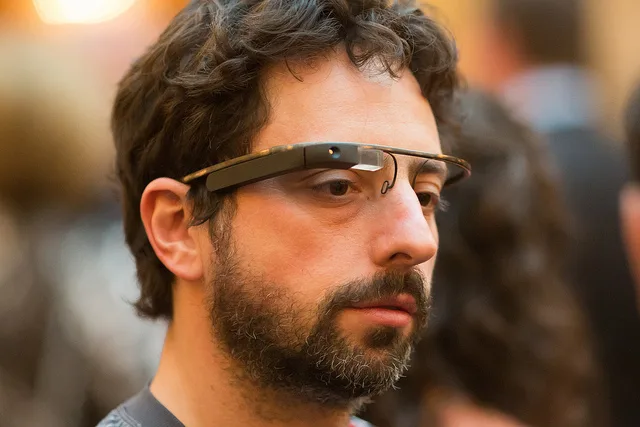
Google has just released a concept video for its Project Glass. The video features Google’s augmented reality (AR) glasses that allow the wearer to see computer images overlayed on whatever they’re looking at. When the wearer looks at the sky outside they can see the current temperature, weather forecast, and so on.
The video takes us through a day in the life of a Google glasses wearer. Judging from the fact that he appeared to sleep in his jeans, eats a calorie-laden egg and ham bagel for breakfast and meets his friend for a coffee from a van on a street without entering into much of a conversation, he’s presumably modelled on a Google engineer.
Technical fibbery?
In an article in Wired, Roberto Baldwin questions the technical capabilities depicted in the video, suggesting that the device shown would not be capable of generating the sort of visual and interactive experience portrayed.

A device that actually delivers some of that functionality is already available commercially, but is substantially more bulky. Interacting with it is via a more believable button control system.
When Google co-founder Sergey Brin was seen wearing a prototype of the glasses, he refused to let blogger Robert Scoble try them. With good reason too, as it would be very surprising if the glasses were actually capable of very much at this stage.
Eyeballs as billboards?
Of course the video is unrealistic for a number of other reasons. Google’s only reason for interacting with someone via a device of this sort would be to collect more detailed information about the person and also to target advertising at them. This was more accurately portrayed in parodies of the video (here and here) that appeared not long after the launch of the original.
As a portrayal of the way a wearable computing device would interact in our lives, the Google video was disappointing. It would be nice to think that something offering us augmented reality would do just that, augment our experience and way of interacting with our environment and others. Instead, Google seems to be offering banal variants of what we can already achieve more successfully using a mobile phone. The idea of having something with the potential pervasiveness of the glasses (even if the battery life extended beyond a few minutes) does not promise to enhance our lives in any meaningful way.
Other tech companies have their own say
Of course, Google is not the first company to attempt to portray technology’s role in our future. Nokia, whose business failings should give us pause when it comes to trusting their ability to predict anything about the future, released a
in 2009 that featured their take on augmented reality glasses. Which, yes, you guessed it, tell you the weather! (In addition, the Finnish female wearer seems to only ever be able to reply to incoming messages by selecting a single smiley face emoticon. In the future it seems, all communication will be necessarily brief.)Microsoft’s concept videos at least show a degree of imagination.
has a school child in a classroom interacting with a child in a different country seamlessly across a glass partition. Words that they speak are automatically translated, and the pictures they draw animated. Microsoft’s vision relies very heavily on its Surface technology and so some of the possibilities are not that unrealistic. And yes, Microsoft also has its own of AR glasses. They’re used for translation and quickly taken off when that role has been carried out.The history of future telling
Looking back at what people were
in the 1920’s and 1930’s, the mobile or wearable phone was predicted, as were robot assistants. Their vision of cities filled with flying vehicles and multi-level elevated roadways went on to influence modern films set in the “future”, such as Minority Report and Blade Runner.In 1939, General Motors (GM) made a
depicting their vision of the 1960’s. In an analysis of the film, Dr Leonard Evans deconstructs the predictions based on “stridently naïve optimism” about life continuously improving for all. The GM film focuses on cars being able to travel on uncongested freeways with wireless sensors maintaining an awareness of other vehicles around them. GM were only out by 50 years of so – this technology has become available to a certain extent in recent years. We certainly don’t have fully autonomous cars though, and there is no hint in the film of the horrors of the Second World War and other wars to come between the making of the film and the 1960’s.By the 1960’s, the UK Post Office was (accurately) predicting the arrival of videoconferencing by the 1990’s.
The view according to science fiction
Technology companies have a vested interest when portraying the future. It is presented in a way that highlights the use of their technologies (real or imagined) and is always going to be fettered by that perspective. Science fiction writers, on the other hand, have no such bounds and can often imagine future possibilities with more accuracy. In the 1890’s H.G. Wells famously predicted genetic engineering, laser weapons and mobile phones (ok, we don’t have time travel yet).
William Gibson’s Neuromancer predicted many aspects of the Internet as it has developed over the following 20 years.
Sci-Fi writers’ views also tend to be more realistic in examining the potential societal impact of technologies such as Google’s glasses. There is no more chilling vision than Lauren Beukes’s novel Moxyland which portrays a world of video loggers recording all aspects of their life and people turning their bodies over to advertisers. The central technology in that book is the mobile phone, which provides access to buildings and proof of identity. The police can deliver shocks to the carrier and disconnection effectively denies citizens access to any aspect of mainstream life.
How true this vision of the future turns out to be, we’ll have to wait and see.
Image Credits: Thomas Hawk CC-BY-NC
Follow @David_Glance on Twitter
💬 Discussion
No comments yet. Be the first to comment!