
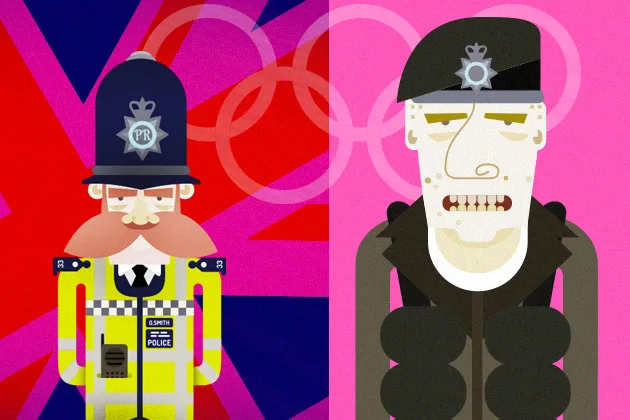

For the XXXth Olympiad, which opened last Friday in London, the organisers have been safe, very safe. Here’s a figure to illustrate this excess: for every one athlete competing, there are four security personnel (see our visualisation).
The British Army is providing 17,000 personnel, 70% more than the number of troops in Afghanistan. At first, the total wasn’t as high as this: at the last moment, 3,500 soldiers were called up to resolve the failure of the private security company G4S, undisputed gold medallists in the damp squib.
A gold medal fiasco
“Fiasco”, “shambles”, “inexcusable”, “unacceptable”, “amateurish”. British MPs didn’t have words strong enough to describe the “humiliating” failure of G4S, reported the Guardian in an acerbic article. Nicola Blackwood, Conservative MP for Oxford West and Abingdon, confessed to having had little trust in G4S beforehand, and “now we don’t have any at all“.
The private security giant had won the tender and was, initially, to provide 2,000 guards, for a contract of 86 million pounds (about 108 million euros). The deal was revised upwards in December: it finally reached over five times the number that the company originally undertook to provide – 10,400 in personnel and a bill amounting to 284 million pounds (362 million euro).
But whoops! As the fateful date drew near, G4S announced that it couldn’t honour its commitments. On July 12, two weeks before the start of this great festival of sport, the company stated that its recruitment and training goals couldn’t be met. A tough blow for the organisers of the Olympics, who had placed the safety of the event at the top of their priorities. Memories of the 2005 bombings are still alive. The day before the explosions in the Tube and on buses, the IOC announced that London’s bid for 2012 had been accepted.
Neutralising a minefield
In the face of the G4S fiasco, the authorities launched a public relations demining operation, with a lot of faith placed in the power of self-fulfilling prophecies. The London 2012 chairman Lord Sebastian Coe seemed confident.
We will work very hard, we will remedy this. Security will not be compromised. This is not about numbers, this is about the mix [of staff].
The Culture Minister echoed this. ”It is completely normal” for a contractor to fail meet its commitments on a project of this size, said Jeremy Hunt, who mentioned, along the way, the “honourable” behaviour of G4S. MPs, who summoned the company’s director Nick Buckles to a hearing, did not share this view, and Nick Buckles himself expressed regret for having accepted the contract.
The result has vindicated the sceptics. The Guardian reported that tests to join the G4S Olympics security team could be taken several times by those who failed at the first attempt. Apprentice guards were able to openly discuss answers among themselves in full view of supervisors. As for the use of scanners, future officers received minimal training, 20 minutes, to learn how to detect weapons.
Militarising a nation
The fiasco of G4S has had two serious consequences. Firstly, it has ruined the chances of G4S in a tender for the management of nine prisons and the privatisation of policing in Surrey and the West Midlands, a record contract of 1.5 billion euros. Secondly, it has militarised the country throughout the entire period of the Olympic Games.
Faced with the shortcomings of G4S, the authorities decided to call in the army. 17,000 soldiers have been deployed, a situation unheard of since the Second World War. Surface to air missiles were installed on several sites inside the capital, including the rooftops of apartment buildings.
The inhabitants of Fred Wigg Tower in East London, tried to oppose it. In vain. The High Court ruled on the side of security. One of the residents’ lawyers, Martin Howe, told the French news website Rue89.
This is the first time in the history of Britain, during peacetime, that troops and weapons have been stationed in a residential area, among ordinary citizens. The last time was during the Blitz in 1941 when the Luftwaffe came. It was a very different situation.
In Lexington, north of central London, a water tower houses a battery of high speed surface to air missiles with a range of 5 km. A warship, HMS Ocean, is anchored in the waters of the river Thames, and transports combat helicopters. Secretary of State for Defence, Philip Hammond said that “personnel deployed on the ground will be supported by high speed jets and helicopters that will protect the skies over London during the Games“.
A series of arrests
Anti-terrorism agencies have not been left dormant during preparations. In a rare public statement, the head of MI5 – her Majesty’s secret service – warned that the Olympics were “an attractive target” for terrorist groups, adding the bureaucratic flourish, “Planning for the future is always planning for uncertainty“.
The Games are not an easy target and the fact that we have disrupted multiple terrorist plots here and abroad in recent years demonstrates that the UK as a whole is not an easy target for terrorism.
Scotland Yard has combined its words with action. In late June, two suspects were questioned by the Anti-Terrorism Branch of the Metropolitan Police. They had been seen paddling a canoe near the Olympic Village and firing guns in Essex, east of London. A few days later, though formally unrelated to the Olympics, seven other suspects were arrested in the north of England.
“Faster, Higher, Stronger”, under the worst summer weather that London has seen since records began.
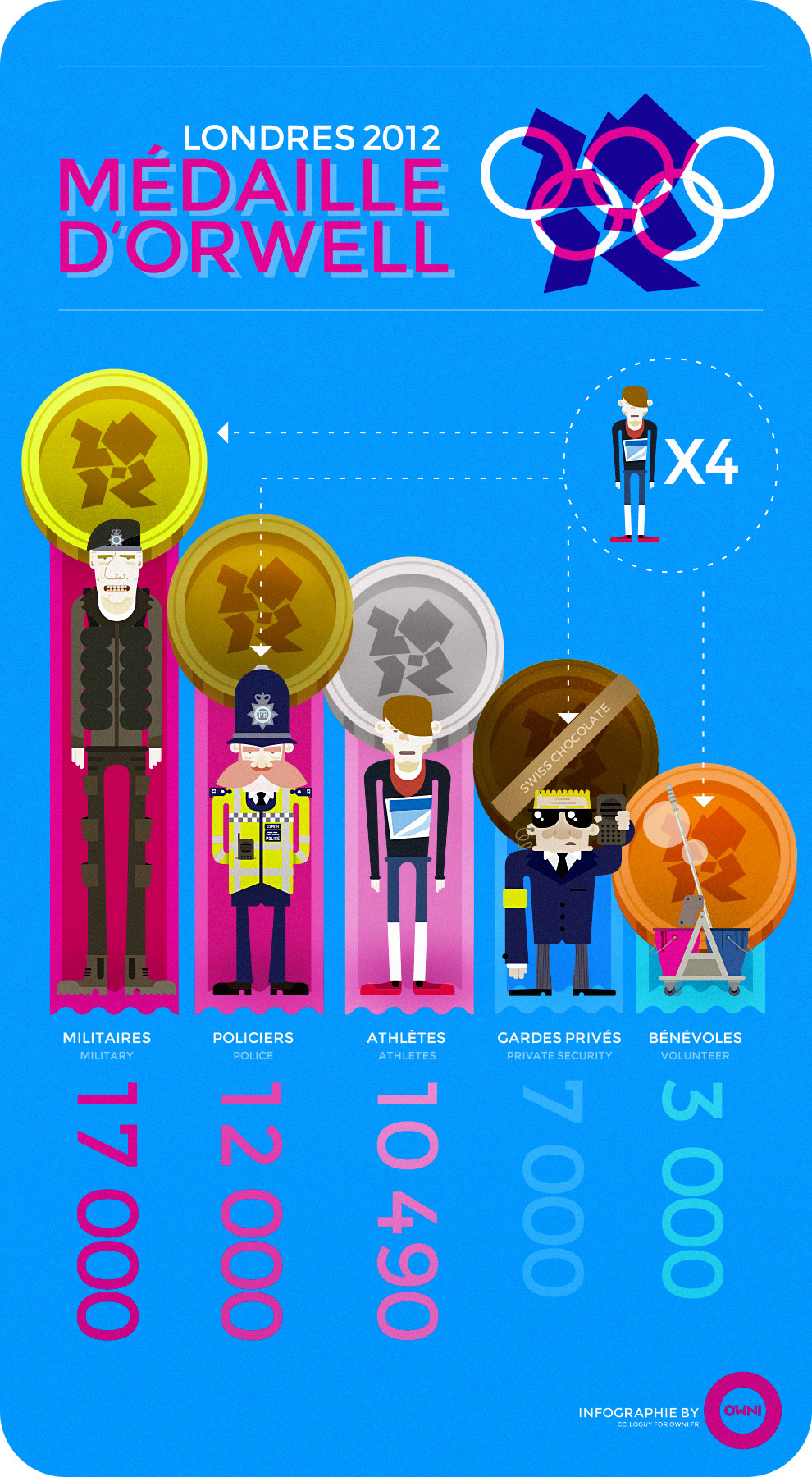
Click on the infographic to view in high definition
Infographic by Loguy, with the help of Aidan Mac Guill, editor-in-chief of Owni.eu.
The data and sources used in the infographic are available by following this link.
💬 Discussion
No comments yet. Be the first to comment!