
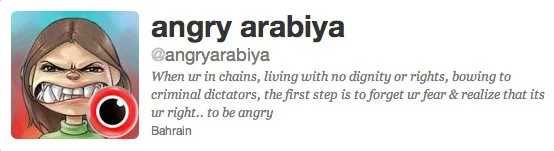

@angryarabiya has over 45,000 followers on Twitter. She is a ‘pasionaria’ of human rights in Bahrain, where since spring 2011 a wave of popular protests has led to the deaths of dozens of demonstrators and the arrests of thousands of others. In February 2011, she was dragged away in handcuffs by security services for daring to protest alone on a roundabout. In November, she blocked a convoy of police vehicles by herself, refusing to move.
@angryarabiya has not tweeted since late July. On August 2, she was arrested again for protesting alone on a roundabout, her leg in a cast. At the end of June, she reported, the police had thrown a tear gas grenade at close range at her leg. In August, she refused to cooperate with a police officer until he provided her his name, as she wished to file a complaint for mistreatment. The officer asked his police chief what he should do if the woman refused to give a blood sample. “Stick the needle in her neck,” was reportedly his reply.
Accused of “destroying government property” (during a previous incarceration, she had torn up a photo of the King of Bahrain), “participation in an illegal gathering”, “inciting hatred against the regime”, as well as having impeded traffic, her cases will be heard in September, October and November.

Zainab Al-Khawaja in front of the Bahrain Financial Harbour in Manama (21/4/2012). Photo @Kareemasaeed via Global Voices.
@angryarabiya, Zainab Al-Khawaja by her real name, is 29 years old and has a two-year-old daughter. This past year she began a hunger strike to protest against the imprisonment of her father, her husband and her brother.
If my father is going to be killed, I want to die as well. We’ve always been taught by my father that dying with dignity is better than living as slaves.
Zainab grew up in exile in what she describes as a “family of activists”, and carries a boundless admiration for her father. Abdulhadi al-Khawaja, wanted by the authorities because he was part of a committee for the defence of political prisoners in Bahrain, lived in London in the 1980’s before obtaining political asylum in Denmark, and then Danish nationality. Co-founder of the Bahrain Centre for Human Rights (BCHR), he returned to live in the country of his birth in 2001, as a result of an amnesty law and a commitment from the monarchy to allow human rights NGO’s to operate in the country. In 2004, the BCHR was outlawed, and since then its members have been repeatedly harassed, beaten, banned from travelling, imprisoned and tortured.
In January 2009, Abdulhadi publicly denounced the regime’s corruption, arbitrary arrests and regular use of torture. He called for citizens to pursue a course of non-violent civil disobedience, which led to his being charged for disseminating “propaganda” aimed at overthrowing the regime.
The BCHR website is just one of the thousands of sites to which access is restricted by authorities in Bahrain, who are not slow to attack journalists and media in the country. The site documents (warning: disturbing images) the numerous cases of torture and injuries attributable to police forces. Dozens of children and adolescents have been mistreated, and dozens of protesters, including many children, adolescents and the elderly, have been killed by police who fired tear gas, or buckshot, into their legs or heads.

Demonstration in support of Abdulhadi al-Khawaja organised by Amnesty International in Denmark
Abdulhadi al-Khawaja is now one of the Bahrain 13, a group of opposition figures, human rights activists, bloggers and democracy advocates imprisoned in spring 2011. On the night of April 9, 2011, he was arrested at his home by a score of hooded policemen, beaten by five of them, dragged by the neck downstairs and, unconscious, to the police station. His two sons-in-law were also arrested; no explanation or justification for the arrest was offered to his family.
Abdulhadi al-Khawaja was sentenced in June 2011 by a military court to life imprisonment for “organising and leading a terrorist organisation“, “attempting to overthrow the government by force and in connection with a terrorist organisation working for a foreign country” and “raising money for a terrorist organisation“, after a “travesty of justice” that was denounced by numerous NGO’s, the UN, the EU, France and even the United States. On May 25, 2012, Abdulhadi ended a hunger strike that had lasted 110 days, after he was finally granted permission to testify, in a wheelchair, before the Supreme Court of Bahrain.
That testimony is terrifying: beatings he received from the police resulted in fractures of his jaw and nose; surgery in a military hospital was required to place 18 metal plates and 40 screws in reconstructed bones; his convalescence should have lasted three months, but after six days in the hospital – blindfolded, handcuffed to his bed, harassed at night by men threatening to rape him – he was placed in isolation for two months in an unlit cell, without leave and without contact from the outside world. Every night after midnight, masked guards would enter the cells and commit acts of verbal, physical and sexual violence to each inmate, one by one, so that the others could hear their cries.
One day, he was allowed to shave himself and wear a suit, in order to meet a “personal representative” of the king who proposed to him “to ask the king for forgiveness for what I had done” in front of a television camera. He refused. Sapped of strength by his torturers, who began to rape him, Abdulhadi al-Khawaja says that in order to make the violence stop, “I could do just one thing”: he escaped his torment by banging his head against the ground until he lost consciousness, despite the fact that his fractures had not yet healed.
On September 4, 2012, a Bahraini judge confirmed the prison sentences of the “Bahrain 13″. Seven of them, including al-Khawaja, were sentenced to life in prison. As the verdict was announced, clashes broke out between demonstrators and police, dispersed by stun grenades, tear gas and buckshot.

Background of Nabeel Rajab's Twitter profile
Nabeel Rajab (@NabeelRajab, 171,000 followers on Twitter), is the successor to Abdulhadi al-Khawaja as head of the Bahrain Centre for Human Rights. He has also been repeatedly targeted and imprisoned, especially because of what he posts on his Twitter account. In April 2011, he was accused of “fabricating” a photograph of a protester who died under torture in prison. The charge was eventually dropped after five guards were charged with the murder.
In May 2012, he wrote on Twitter that he had agreed to an interview with Julian Assange. In the aftermath, his house was “surrounded by nearly 100 policemen armed with machine guns,” as he explained to the founder of WikiLeaks. Nabeel was amused to have been able to fool the authorities who had been unable to prevent him from going to London to speak on Assange’s TV show.
When they realised that I was not at home, they asked my family to tell me to go to the public ministry today at 4am. But I’m here.
It was last night, but I’m used to it. I gotta go back there, I gotta face it. You know this is not the first time but that’s also the struggle. It is for freedom, for democracy that we are fighting. All this comes at a price and we have to pay it, and that price could be your life, but we are willing to pay for the changes we demand.
Asked about his two children, 9 and 14 years of age, Nabeel Rajab explained he was forced to change schools because they were harassed by other children of members of the ruling family.They walk with him at the head of each protest because their house was sprayed with tear gas more than 20 times last year, and because they saw their father being taken from his bed at night and beaten before their eyes.
Back in Bahrain, Nabeel Rajab was arrested upon leaving the aircraft, and jailed for two weeks for having taken to Twitter to accuse the Minister of the Interior of not sufficiently investigating the deaths of many civilians.
On July 9, he was again arrested by masked men and incarcerated because of a tweet described as “defamatory”: he dared to write that the Prime Minister was not “popular”, a tweet which earned him a three month prison sentence, since struck down. Accused of having participated in three unauthorised demonstrations, he also received a sentence of three years imprisonment, for which his appeal will be heard on September 10.
The names of these human rights activists, and the torture they have been subjected to, were exploited in a particularly cynical attempt to spy on political opponents involving a British arms dealer specialising in digital surveillance technologies.

Nabeel Rajab, Abdulhadi and Zainab Al-Khawaja
To learn more about the situation in Bahrain, you can also follow @maryamalkhawaja, sister of @angryarabiya and daughter of Abdulhadi al-Khawaja. She has taken over from Nabeel Rajab as head of the Bahrain Centre for Human Rights.
💬 Discussion
No comments yet. Be the first to comment!