
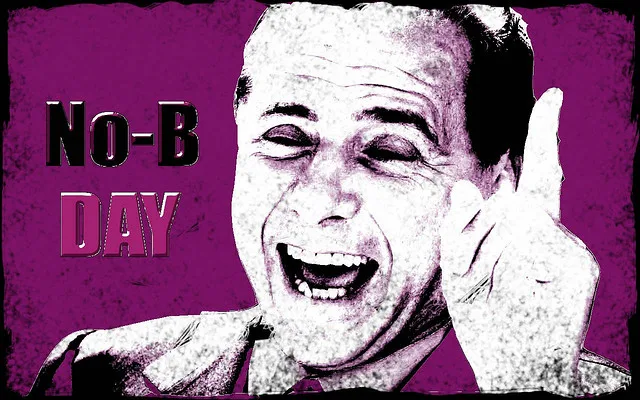
In October 2009, the Italian web was on fire: the Constitutional Court had just scrapped a proposed law that would have shielded Silvio Berlusconi from his multiple accusations. On Facebook, the mysterious «San Precario» was urging the Italian people to take to the streets to pressure Berlusconi into resigning. Then later in Rome, on December 5th after two months of restless work by volunteers across Italy – creating Facebook pages, printing and distributing fliers, organising flash mobs – some 500,000 protesters gathered on the streets.

Under the name of “Popolo Viola” (purple people), a colour chosen for its political neutrality, many started to gather online: veteran Berlusconi opponents, enraged ‘precari’ (temporary employees), anti-Mafia activists, even youths bereft of a political past. This was not merely a protest: Emanuele Toscano, sociologist organiser of the No B Day went on to observe “an ecosystem of biodegradable networks has blossomed. They can assemble and disintegrate, depending on the need.” The online world had become a rebound space for people otherwise suffocated by the ‘berlusconization’ of the public sphere.
A subjugated media
The Internet in Italy has first and foremost represented a new avenue in a media sector otherwise totally dominated by Silvio Berlusconi. The Prime Minister owns a vast private TV empire (Canale 5, Italia 1…) and doesn’t hesitate to violate the laws by preventing other media companies from growing in stature. He can count numerous supporters on the newsstands, like the daily Il Giornale), owned by his own brother, that regularly classifies the Internet as the source of all evil.
Public channels don’t enjoy a lot of freedom of expression. It’s a culture which started to emerge in 2004, when
he considered too critical. One of them, Michele Santoro, host of the controversial current affairs show Anno Zero only got his job back thanks to a ruling of the Court of Justice. It didn’t stop there though: this year, on March 25th, his show was once again censored, and as a result, the Anno Zero team was compelled to stream it online. Debate and polemics are no longer allowed on public networks, and whenever someone comes close to crossing the line, the Prime Minister doesn’t hesitate to call personally to intervene, live, .A dormant opposition
Italy’s political opposition deserves recognition, at least if only for its inconsistencies. Activists that gather through the Internet against berlusconism “are not satisfied with the ways opposition groups organise themselves and play their role”, says Federico Mello, journalist for Il Fatto Quotidiano. They consider the leading opposition party - the PD or Democratic Party - a dead weight in the fight against Berlusconi. For example, despite a street gathering half a million people in protest of his main adversary, it was only at the very last minute that the secretary general, PierLuigi Bersani, decided to publicly endorse the initiative. No wonder the young have abandoned all faith in party apparatchiks.
A country for old men
Politics aside, the Il Corriere della Sera – despite hardly being a vessel for the left-wing party – denounced the country’s gerontocracy in a piece headlined “Italy is no country for young people“. Schools and universities are undergoing a crisis, as a result of budget cuts. The young, including graduates, are condemned to menial jobs. According to Istat – the national Italian statistic institute – in the second trimester of 2010, the unemployment rate for 15-24 year olds rose to 27.9%.
This is a situation all the more unacceptable when one considers how the administration has promoted TV starlets to the role of cabinet members, how the corruption scandals are piling up and how the head the of government, under countless investigations, throws extravagant parties, appears on the front pages of tabloids with prostitutes and alters the Constitution to avoid legal prosecution.

A number of successful case studies have begun to rise out of the ashes of traditional media. The representatives for the « Movimento 5 stelle » – a political movement created and organised solely through the web – were elected in two regional councils. Comedian Beppe Grillo – a hybrid between Coluche and Michael Moore – was ousted from TV in the late ‘80s, and found a home on the web in 2005 and learned how to make the best of its resources.
Information slingshot
According to Wikio, despite being one amongst many, Beppe Grillo’s blog is the most read political blogs in Italy. SImilarly, on the website of the daily Il Fatto Quotidiano, (a newly-founded newspaper criticizing the state’s wrongdoings as much as the opposition’s impotence), articles are shared up to 15,000 times per day on social networks or by e-mail. To one of its journalists, Federico Mello, ”Italian citizens don’t just search for information, they also spread it online”.
It’s not just restricted to a few: many websites have growing levels of participation. Spinoza – a satirical news blog – counts 7,000 contributors. “The blog exploded in notoriety after Berlusconi’s victory in the 2008 elections. That’s when readers began to post their own jokes”, explains Alessandro Bonino, co-founder of the blog.
Articolo 21 – named after the article of the Constitution guaranteeing press freedom – also choose to rely on the user generated content. Its first objective is to denounce TV propaganda.
Valigia Blu gathered a mocking choir before the headquarters of national broadcaster Rai which recited the most ridiculous headlines from its news channel.
Legal and technical obstacles
Is this movement coherent enough to change politics and society? The forces against it are strong: despite petitions spread through the web by Beppe Grillo gathering 300,000 signatures, a bill drawn up in response to this popular initiative aiming to reform political life still rests in a drawer in the Senate. In the meantime the government has tried to promote other laws, to prevent the press from publishing wiretapped conversations and to limit freedom of expression to such an extent it summoned the angers of the OECD, which last July asked for the ‘gag law’ to be withdrawn.
This is a text which could have silenced controversial bloggers for good. It imposed on them the same duties as the press, such as having to remove content within 48 hours should the government so decide, together with hefty fines for dissent: 12,5000€ in some cases.
In addition to the impositions on comment publication, even access to the internet itself remains very limited: less than 50% of households have access to the web, according to Istat. Such slow takeup is exacerbated by the quality of the network, which in many quarters is considered to be preposterous due to the lack of state investment in infrastructure. On the other hand, nearly all Italians watch TV.
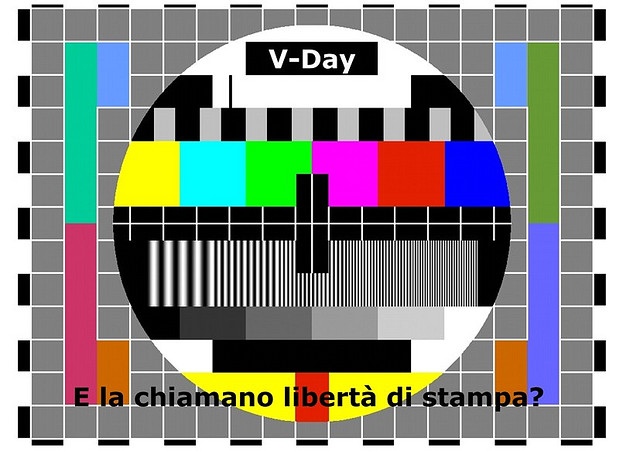
“It’s hard to engage with the rest of the country; at the moment, we’re alone”, lamented an anti-Berlusconi protester on October 4 in Rome. This is an isolation which compounds the problematic fragmentation of opposition movements, leading to some true moments of confusion and dilution of arguments. Beppe Grillo doesn’t support the initiative of the “Popolo viola”. There is no correlation between the first and the second ‘No B day’ groups (the second happened on last October, 4th), and the Popolo Viola are divided on multiple issues, the foremost of which is the collaboration with mainstream political parties.
Unmasking the President’s TV Channels
Nonetheless, political figures are starting to open up. The Italia dei valori, an opposition party, supported the protests of the “Popolo Viola”. In the Partido democratico, representatives and leaders are pushing to open up the party. And a rising star of the left, Nichi Vendola, governor of the region of Puglia, has benefitted greatly from clever use of online campaign tactics.
Although the government has often attempted to raise strict barriers on the internet, for the youngest the battle is far from over. The new generation absorbs most of its information online, is actively involved and has abandoned the proverbial “political apathy” described by Gian Franco Mascia. They leave their defeated parents at home, sat on their couch in front of the President’s TV, and turn to the web where there’s still hope that change can happen, even in Italy.
–
Translation by Federica Cocco
Photo FlickR CC JCP.im, Redbanshee, Gengiskunk, Bondine.it.
Bibliography
Federico Mello, Viola , Aliberti editore 2010
Gianfranco Mascia, Il Libbro viola, B.C.Dalai editore, 2010
Marco Travaglio, La scomparsa dei fatti, Il saggiatore 2007
Concetto Vecchio, giovani e belli, chiarelettere, 2009
Arturo di Corinto, Alessandro Gilioli, I Nemici della Rete, Rizzoli 2010
💬 Discussion
No comments yet. Be the first to comment!