
![[Liveblog]: After Tunisia, Egypt is on fire](https://owni.eu/uploads/owni/picture-21-c4b0da7b.webp)
On Tuesday, January 25, 2011, the Egyptian people took to the streets of Cairo, demanding the departure of President Hosni Mubarak after enduring 30 years of corrupt government.
OWNI is following the story to keep you informed of any developments.
 Source: @CarlosLatuff on Twitpic

[21h21] According to Syrian blogger Maurice Aek – cited by Global Voices - Syrian media has taken some liberties when reporting events taking place in Egypt and Tunisia. the events in Tunisia and Egypt. The state media has in fact reported that the Egyptians had descended into the streets to demand the departure of the Israeli ambassador, and have ignored the real reason of Ben Ali’s flight.
[21h04] Though internet has been blocked in Egypt, this has not stopped Anonymous from provoking the Egyptian governmen even more. Indeed, activists have been making use of fax machines to send thousands of copied of Wikileak’s lates revelations on Egypt.
[21h00] A US government official has told The Associated Press that the United States is reconsidering its annual pouring of $1,5 dollars of aid to Egypt.
[20h56] According to Nile TV, looting has begun at the ruling National Democratic Party’s offices, which have been in flames for several hours.
[20h51] According toReuters, who site official medical sources, 410 people were wounded on friday’s Egypt demonstrations.
[20h22] According to a journalist for The Atlantic, quoted by the Sunlight Foundation’s website, Egypt spends the Sunlight Foundation’s website, Egypt is a profilic spender when it comes to lobbying Washington. This mainly benefits the U.S. arms industry: the U.S. government against emoluments, Egyptbuys weapons Discount from U.S. manufacturers, with strong support fromWashington lobbyists.
[20h15] According to American journalist Jeremy Scahill, the White House briefing on the situation in Egypt has been postponed, as well as that of the State Department, as Egyptian President Hosni Mubarak is expected to make a statement at any point.
[20h12] The curfew imposed throughout the country is being enforced in the three major cities: Cairo, Alexandria and Suez, Al-Arabiya reports.
[20h05] While the situation in Cairo seems to have quieted down, take the time to have a look at this superb series of photos shot in the Egyptian streets.
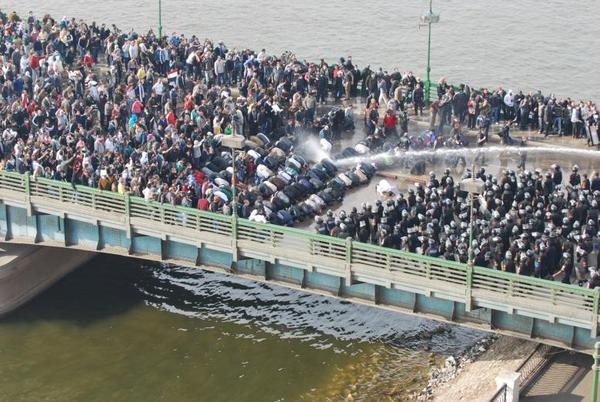
[19h55] An exceptional photo, posted on Twitter, shows riot police shooting at demonstrators with a water cannon whilst they were praying in the middle of a bridge in Cairo.
Via Olly Wainwright.
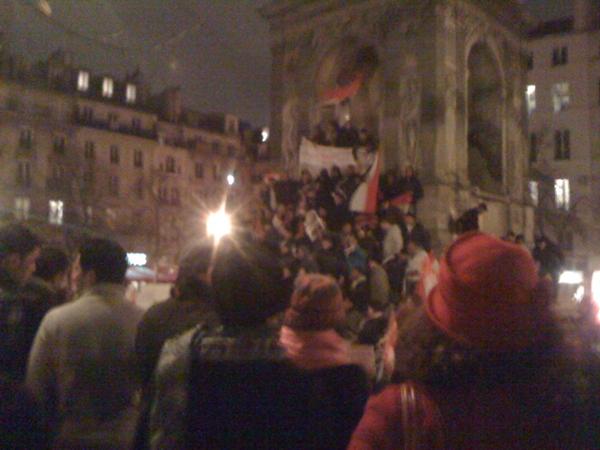
[19h52] Châtelet, Paris: Protesters gather in support of Egypt
Since 18.30 a few dozen demonstrators have gathered near Chatelet in Paris in support of the Egyptian people. @Dreamer_ML was there, and posted a photo of the event on Twitter. According to him, Tunisians and Algerians have gathered to show their support. Other sources mention the presence of militants of the NPA. You can find other photos on this plixi account.
[19h45] LeMonde.fr has published an interactive online map of the Egyptian demonstrations.
[19h44] French Foreign Minister, Michele Alliot-Marie calls for “restraint and dialogue” (AFP).
[19h43] Oh his blog, iRevolution, Patrick Philip Meier, ihas put together a list of essential wesites to follow to better understand the unrest in Egypt.
[19h40] While their tanks are taking over the streets of several Egyptian cities, a group of Egyptian army generals are now in the United States, CNN reports. They are meeting with U.S. generals at a US and Egypt Military Cooperation Committee roundtable.
[19h11] President Obama has gathered his close advisors around him to monitor the situation in Egypt (source: Associated Press quoted on the Guardian’s website). According to Al-Jazeera, he was reportedly given a 40-page report on the Egyptian situation.
[19h10] The army has also been hailed by the protesters in Suez, Al-Jazeera reports.
[19h00] Telephone operator Vodafone has indicated, via AFP, that they received instructions to stop their services, directly from Egyptian state officals.
[18h55] An Al-Jazeera journalist refers to “several tens or even hundreds of thousands of demonstrators in the streets of Cairo today”.
[18h48] On the left; images broadcast live by Al-Jazeera. On the right: images broadcast by the official television station. According to Al Jazeera journalists, the two cameras are only a few hundred meters apart, but pointing to very different parts of Cairo. 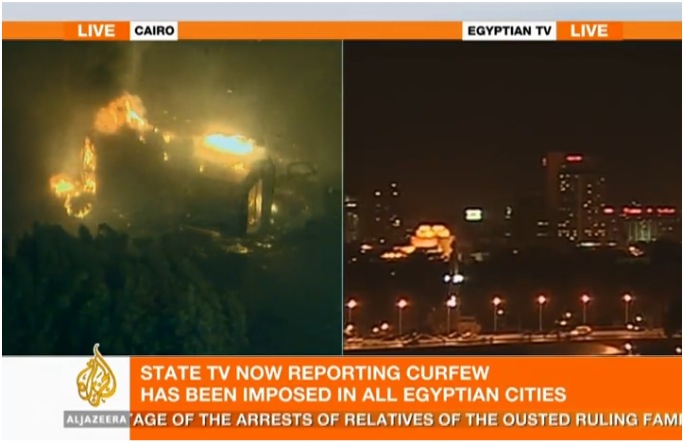
[18h46] Egyptian tanks, greeted by protesters. (Al-Jazeera)
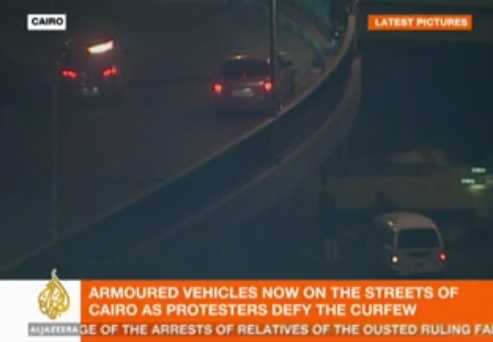
[18h36] The army has raided the streets of Suez, according to Al-Jazeera, while television journalists have noticed that the police have deserted the streets of Cairo. According to these journalists, some of their colleagues suspected of sympathizing with the protests were ”put on leave” for an indefinite period.
[18h28] Egypt is almost deprived of her access to the Internet, with the exception of the TOR network, which has seen traffic literally explode.
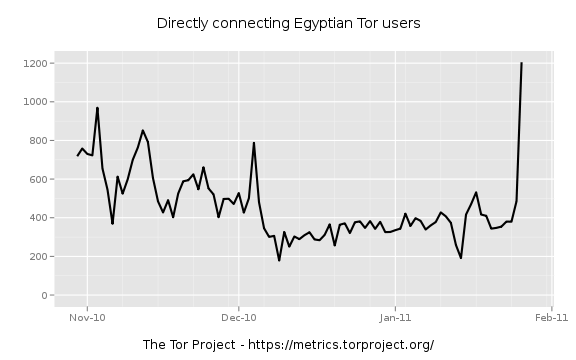
Pour plus d’informations.
[18h25] Hillary Clinton : “it is not with rubber bullets and water cannons that order will be restored.”
Hillary Clinton spoke there a few minutes live on Al-Jazeera, and was intended soothing.
She claimed to be «deeply concerned about the use of violence by Egyptian police and security forces against protestors». She also added: «we call on the Egyptian government to do everything in its power to restrain the security forces,» and «protesters should also refrain from violence and express themselves peacefully».
«We urge the Egyptian authorities to allow peaceful protests and to reverse the unprecedented steps it has taken to cut off communications.» she also said.
«These protests underscore that there are deep grievances within Egyptian society and the Egyptian government needs to understand that violence will not make these grievances go away.»
Clinton recalled the longstanding friendship between the two countries:
«We urge Egypt – a longtime US ally – it to “engage immediately” with opposition groups and others to enact broad economic, political and social reforms.
We support the universal human rights of the Egyptian people, including freedom of expression, association and of assembly.»
[17h58] Ramy Raoof’s Flickr gallery has some great shots of this afternoon’s events, and is available in Creative Commons.
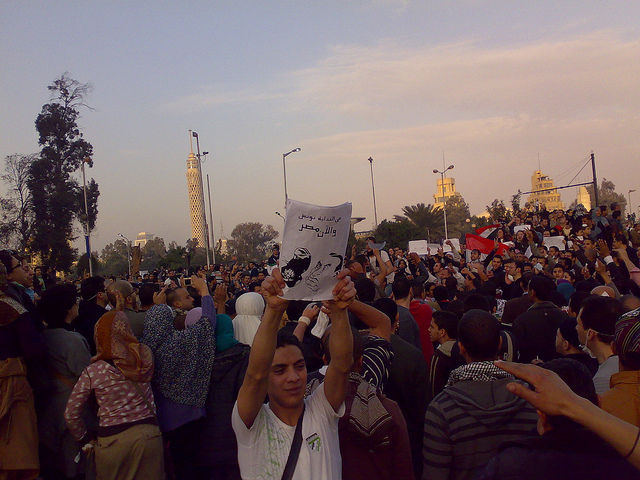
[17h52] Al-Jazeera’s cameras have caught both gunfire and explosions. The fire is still raging in the NDP building and threatened to spread to the closely-located museum. Firefighters are yet to intervene at the scene. Protesters and police stopped to perform the last prayer of the day.
[17h41] Some amateurial photos of events in Egypt have managed to leave the country. These striking images show the confrontation between the police and demonstrators on a bridge in Cairo.
[17h30] FDN, a historical French internet access provider, has set up a dial-up account, which allows all Egyptians with a phone line capable of contacting France to have access to the Internet, bypassing the blackout the country is undergoing. The dial-in number: +33 1 72 89 01 50 (login: toto; password: toto).
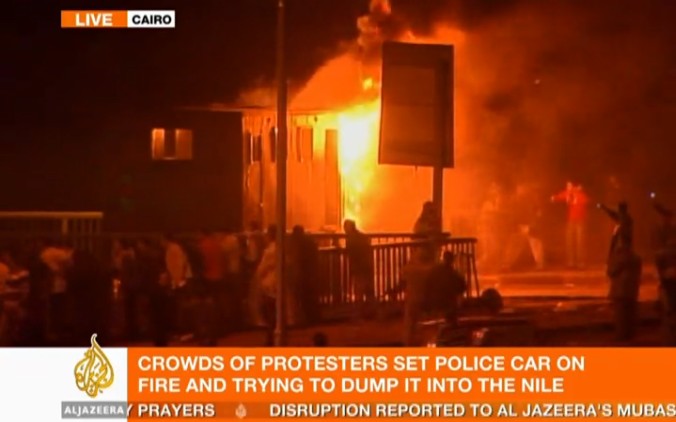
[5:22 p.m.] A thick black smoke has emerged from the headquarters of the ruling party, the NDP. It seems molotov cocktails may have been thrown at the building. Al-Jazeera journalists stressed the symbolic value of the fire.
[5:21 p.m.] A protesters attacked a military truck and its occupants in Suez. (Al-Jazeera)
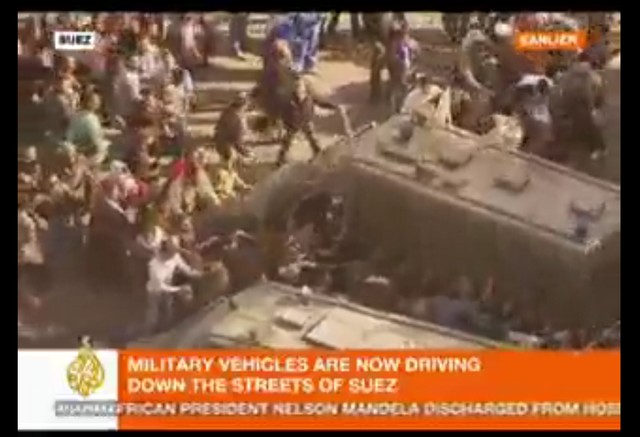
[5:17 p.m.] Demonstrators burnt an army truck on a bridge, after trying to push it down the river, in Cairo. (Al-Jazeera).
[17:06] According to Al-Jazeera TV, President Hosni Mubarak is about to make a statement on Egyptian television.
[16:55] The police storm of Al-Jazeera quarters. According to an Al-Jazeera English journalist reporting on events, security forces arrived at their door to interrupt all broadcasting of events.
[16h45] General chaos
With military forces making their entry in Cairo (along with demonstrators), the situation has become increasingly confused. While the Egyptian government imposed a curfew from 6pm, Al-Jazeera has published pictures pictures of police throwing stones and them, and the to let the proters pray before them.
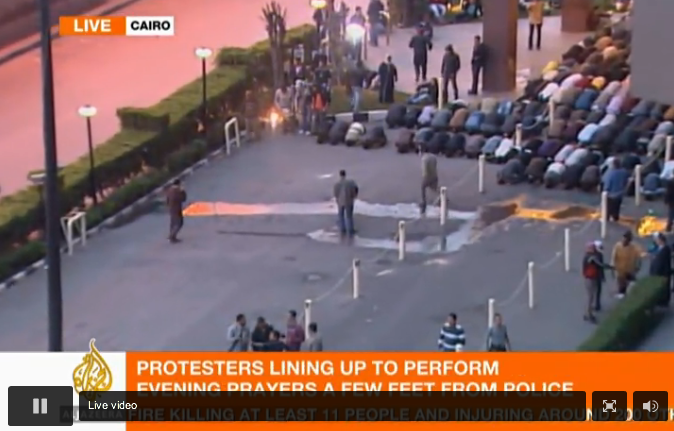
The Al-Jazeera correspondent also confirmed that security forces had invested the building of the chain, perhaps to interrupt the signal from the television.
[16h] Are protesters being shot with live ammunition? This video from the Associated Press shows a man falling to the ground, apparently hit by a bullet shot by the law enforcement:
[15h30] Shutting down the internet was “a declaration of war”
The disappearance of 3500 BGP routing tables is what causes the inaccessibility of the Egyptian network, says specialist blog Renesys. “Manipulation,”says Benjamin Bayart, president of French ISP NDF since 1997, “is fairly simple”.
A command line typed into a router or a power failure in a data center is more than enough to physically turn off the Internet in this country.
Specifically, there are more roads to access the Egyptian sites, from abroad or within the country itself. The chairman of NDF has pointed out that in France the maneuver would seem unrealistic, since it would require, in addition to a court order, the approval of thousands of network operator intermediaries, such as Internet hosts.
This sort of operation, adds Benjamin Bayart, amounts to an “act of war ”:
In conflicts, we first cut the media. Cutting the Internet is like blowing up bridges and railroads. What is happening in Egypt is extremely violent.
[15h15] Amateur radios: friend or foe?
On another EtherPad, amateur radio station (aka HAM radios) are presented as the most effective way to communicate with protesters, even though precautions are still in use:
Some sources say that most amateur radio stations in Egypt are run by people trained in military radio and therefore likely to be loyal to the regime. It is better to be cautious and avoid disclosing their frequencies before the army changed sides.
[15h] “How Egypt shut down Internet”
Hours after the Internet blackout was announced, the first elements of analysis are exposed. On Lemonde.fr, Damien Leloup argues that the state has asked internet service providers to cut off not just “access protocols DNS (Domain Name Server, which directs the computer to the addresses of sites),” but also to intervene on the BGP (Border Gateway Protocol), which holds information on the IP addresses used by ISPs). In the past, Pakistan used to this type of filtering to temporarily censor YouTube.
[2:45 p.m.] Who is going to read the newly-released Wikileaks? Andy Greenberg, Forbes journalist famous for being the first to interview Julian Assange, wondered whom these leaks are really targeted at, given that internet access has been nlocked out in the whole of Egypt. Finally, he contemplates whether the initiative is not in fact intended to put the United States - once again - face to face with their responsibilities.
[14h] “Rock The Casbah”
On a EtherPad dedicated to the Egyptians Anonymous suggest to avoid using the web (rather battered in recent hours) to connect them. They even go further and call for agitprop methods:
A document has been prepared for demonstrations on Friday. This is a flyer that can be easily copied and distributed. It contains all the tips to make this appointment a success. If you don’t have it, ask someone you trust to print it. This process takes time, therefore, anticipate.
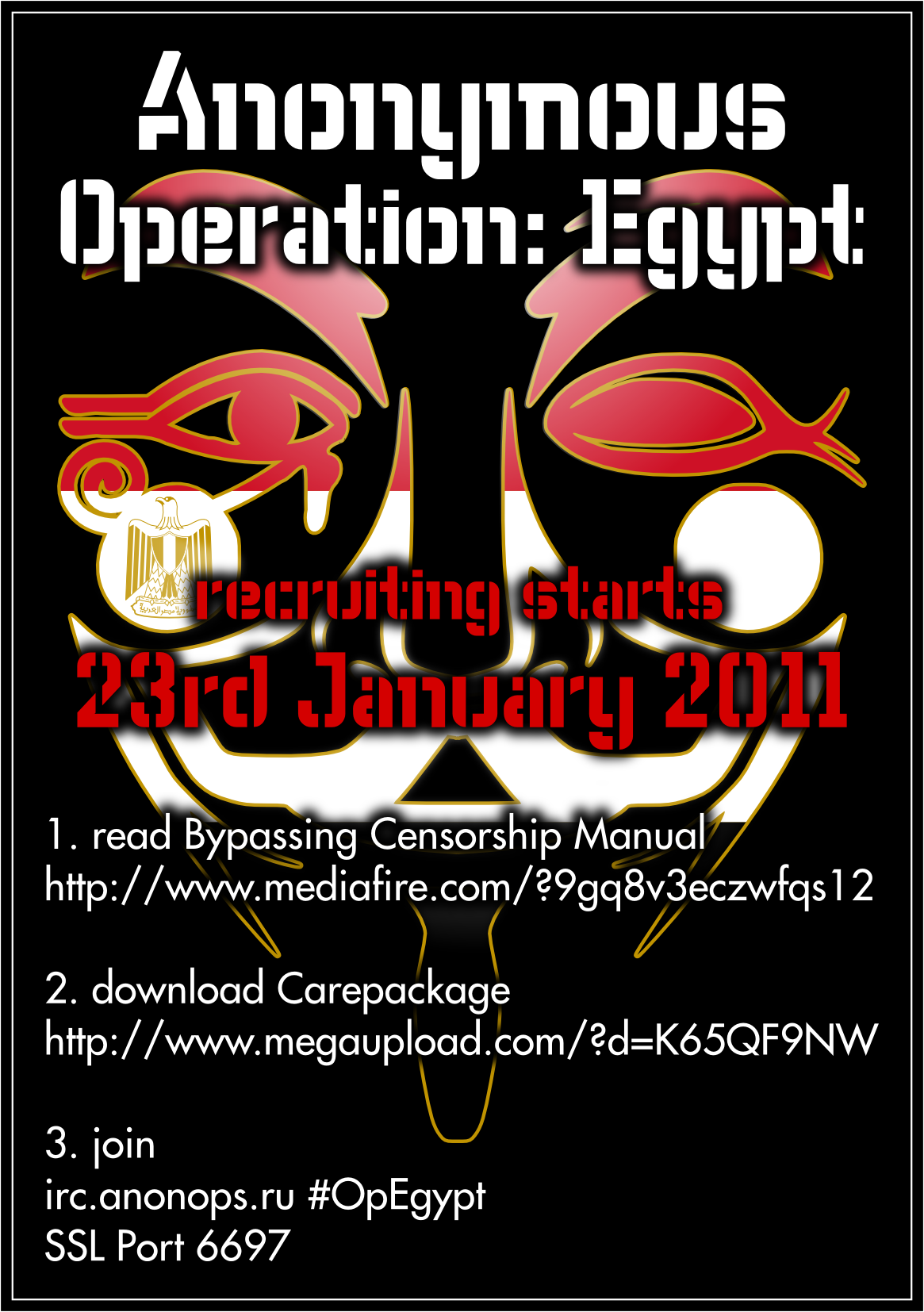
And further down:
Do not rely on online communication today. Pay attention to rumors. Contact as many people as possible, and make you a second opinion always. PS: This shouldappear on the document, but someone asked the question: bicycle couriers arefaster if the Internet does not work (in the traffic of Cairo, they are faster than thepolice..
Ending on this note:

[13h50] WikiLeaks releases a memo highlighting the impact of the Internet in Egypt
A diplomatic cable published in 2009 highlights the growing importance of Internet, especially by 160,000 Egyptian bloggers in the media space and politics.According to the American representative in Egypt, “blogs have significantly expanded the number of topics including the Egyptians can discuss publicly,” and “write more and more to defend their political projects.” ”The discussions on blogs about sensitive issues such as sexual harassment, sectarian tensions and the military question represent very important change that has influenced society and the media,” the document said. This movement came the Internet would have led traditional media to address previously taboo subject, like sex or abortion, according to the telegram.
This also refers to the relative tolerance of the Egyptian authorities, who do not hesitate to arrest bloggers too critical of Mubarak, while allowing users some leeway to “criticize the government.”
By contrast, Americans are skeptical about the ability of this movement to really unite “the role of bloggers as a cohesive force of activists has largely disappeared because of climate policy more restrictive, measures the Egyptian government andtensions among bloggers. “ Similarly, cable emphasizes the weak role played by bloggers in the recent examples of “cyber-activism of the masses”, which were further organized through Facebook.
[1:00 p.m.] 4 French journalists arrested in Cairo. The information comes from the Ministry of Foreign Affairs at a news conference.
[11h57] Wikileaks publishes a volley of documents on Egypt
Wikileaks has released around 70 diplomatic cables, mainly from the United States Embassy in Cairo, but also of Tel Aviv, Paris, Tripoli and others. All these cables primary concern in Egypt.
The publication of these documents comes as part of the publication in the drop ofmore than 250,000 telegrams diplomatic since November 2010, of which only ~ 1%is publicly available today. By speeding up the publication of these documents,Wikileaks increasing the pressure on the shoulders of the Egyptian government.
OWNI team is mobilized to analyze the documents revealed.
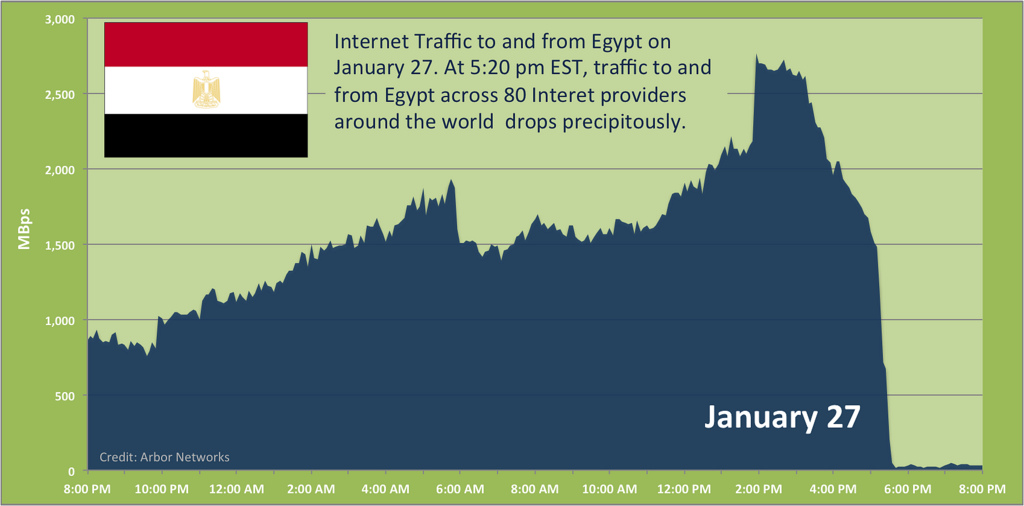
[January 28 - 9h50] Egypt has shut down all international connections to the internet
Several sources have confirmed that the Egyptian network was cut last night, at around midnight local time. Seabone, a major Internet service provider for Egypt based in Italy, reported there was no Internet traffic going into or out of the country. The cut would cover both the Internet and telephone connections, with the exception of a few companies and the Egyptian Stock Exchange. More protests for freedom of expression are expected today.
[January 27 - 11h22] The Egyptian stock exchange has been suspended
Having lost around 6.25% in the first 15 minutes of trading this morning, the Cairo stock exchange has decided to suspend transactions. Yesterday, Egypt’s EGX 30 Index lost 6.1%.
A few minutes after trading resumed at 11:30 (local time) the index lost 10.3% (find out more here), reaching its lowest level since 2008.
[6:15 p.m.] “Can the Egyptians revolt?”
When Al-Jazeera mentioned the revolt Tunisian, opinions split in a very detailed article considering a simple question with a complicated answer: Can the Egyptians rebel?
Alaa Bayoumi begins by lampooning the idea of a resilient Egypt “because it is an agricultural society, and farmers need stability and to work their lands.“ However, Egypt is also becoming a service economy, “creating a new economic elite, dominated by owners of newly privatized state companies.” This development has widened the gap between social economic standings. Correlated with the emergence of a “new generation, millions of young people are cynical about the world’s future and their country.”
[6:10 p.m.] RSF concerned about filtering and violence against journalists
In a statement, Reporters Without Borders condemns the censorship of the Internet and the treatment of journalists and media assistants on site. The organization said that telecommunications networks have been blocked, which is not surprising given that Egypt is on the “Internet enemies” list. It also deplores the arrests, the molestation and assault against journalists, whether Egyptian or foreign.
[6:05 p.m.] YouTube video highlights of events.
The video shows the crowd on an avenue in Cairo, along with protesters throwing stones at police
The Interior minister Habib Al Adly has ordered Police to arrest and attack protesters. It has been reported that medical students were arrested by plain cloth police officers, while twelve activists were taken into custody in Monofeya, Mubarak’s hometown.
More live sources:
Facebook: The Movement’s official page: We are all Khaled Said
Reflets.info: liveblogging via Bluetooth of January 25 events.
Global Voices: video of the 25th of January protests
—
Photo Credits: Wikimedia Commons, Flickr CC Sarah Carr
💬 Discussion
No comments yet. Be the first to comment!