
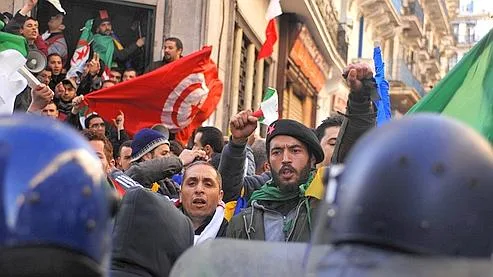
In the same line of thought as André Gunthert [FR] and Patrick Peccatte [FR], it is evident that the French media has skewed the representation of events in Tunisia and Algeria. This is made obvious in instances where French media selects pictures of “riots” that are strikingly similar to the ones in France in 2005 and echoes praise for the Tunisian Revolution. So, last Saturday I thought it would be interesting to compare the media coverage from both Parisien.fr and Le Figaro.fr, who both published riot imagines a few hours apart .
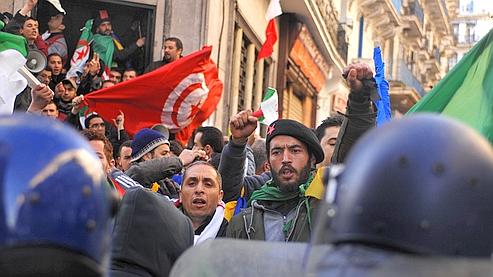
The illegal demonstration for democracy in Algeria was interpreted in two very distinct ways. Through these differences in reporting the same story, it is apparent how the French media manipulates its presentation of events and ultimately our perception of facts and ideology.
Le Parisien.fr : Projection of French sterotypes onto Algerian riots
For Parisian.fr, the demonstrations in Algeria are displayed as an iconographic riot in which the media organization applied some of the same techniques used to illustrate urban violence in France. Notice that the photo was shot directly behind the police, giving the imagine a feel of the need for protection against menacing youth. The vantage point is behind the policemen’s shields, reassuring a sense of protection from projectiles launched by the angry crowd.
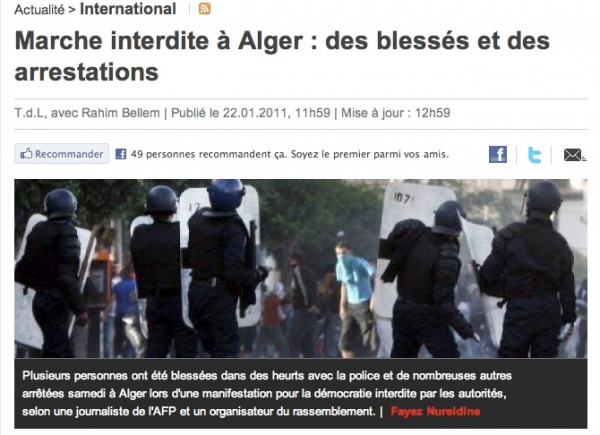
"Many people have been injured arrested on made on Saturday in Algeria due to the illegal demonstration for democracy, according to an AFP journalist and an organizer of the protest."
The demonstrators appear to have no reason for their actions, just like the French youth who insist on rioting. Rather, they seem to be driven by immediate rage, or by some other violent primal need as explained by Michel Maffesoli. The concept of rioting seems to indicate intense emotion, and that is exactly what is portrayed in the above photo. There is a tendency to only “feel” the image without divulging further into the logic behind the violence.
Never mind that TheParisien.fr did not caption this photo – taken by Fayez Nureldine (AFP) – which was taken during the 7th of january protests, and not during the mobilisation of Algiers. This is just another sign of the paper’s intentions. Its aim is to undermine the motivations of the young protesters, whether they’re from Algiers or Nanterre…
The rhetoric is one that emphasizes the words “wounded”, “arrested” and “illegal.” It creates a bias to side with the law enforcement, regardless of the issues pertaining to democracy. The cause in Tunisia falls on deaf ears, and the events in Algeria do not gain much more sympathy. The newspaper depicts a direct parallel between France and these other countries: The same angry youth, the same problems…
Le Figaro.fr: The conflict, Democracy, and Ché
Le Figaro.fr is distinguished from other newspapers because it represents events in an innovative form. For the Algerian protests, there is a more integrative approach of reporting between the concepts of a revolution and a riot. Here, we find iconographic elements seal the two notions together, giving rise to a new representation of the social conflicts in Maghreb.
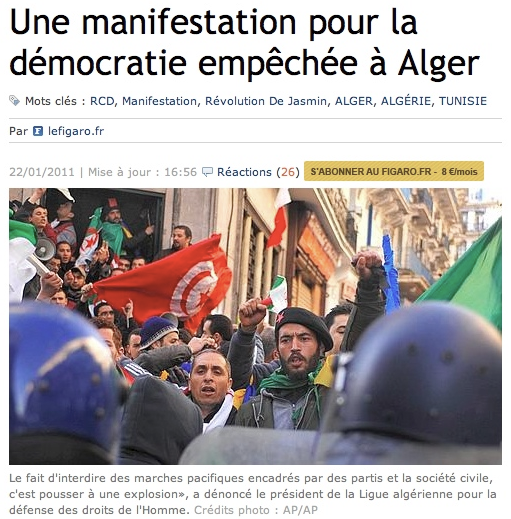
Nobody knows what course history will take in Algeria, and whether it will aid its path towards emancipation. After the surprising turn of events in Tunisia, the newspaper has taken care to preserve their own credibility and though they tend to inform without hesitation, the images they publish remain ambiguous and hard to interpret. This particular image is so unfamiliar it seems staged.
In this picture of the riot, the viewer is associated with the crowd confronting the police force. We are still behind the policemen yet they are noticeably less present, allowing us to see through into the eyes of the angry men (yet no women see above the crowd, as symbolic of the Marianne in France). The concept of a revolution is not only displayed, but it is an element indivisible from the riot. The title reads “A Demonstration for Democracy,” being much more specific than Parisian.fr’s headline of an “Illegal March” leading to injuries and arrests. Le Figaro dives right into the middle of the confrontation and acknowledges the two sides of the demonstration. Instead of having a female symbolizing a revolution like the French, the photo caption is a well known quote from Ché, along with alluring to the red revolutionary Tunisian flag in the background. Clearly, the men raising their fists in outrage are seeking more than merely making violent threats.
The portrayal of the photo is more balanced in its interpretation, instead of relying on riot stereotypes. This new type of image of the Algerian revolution creates a visual association with a type of antonomasia, a subject previously studied here [FR]. Walking in the footsteps of the oppressed in Latin America, the people of Magreb march towards freedom and justice. What previously appeared to be a riot without a purpose suddenly becomes a democratic movement for a higher ideology. Consequently, the fact that the picture is taken behind a police force no longer insinuates the need for security. So, then, what are they doing here? What are we really afraid of? What about French riots? (Ok, that might be for a later time)
The revolutionary icons
It is unlikely that the editor of LeFigaro.fr thought through these implications when he chose this photo. It’s colorful and oozing with a revolutionary passion that is currently popular in the southern Mediterranean. Regardless of what went through the editor’s head, other factors played into LeFigaro’s bold move. There was the shift in the media’s representation that followed the downfall of Ben Ali. Additionally, L’Express and Nouvel Obs front pages’ depicted signs of an iconographic revolution similar to the French revolution. So this “new” type of photo isn’t really groundbreaking, and probably would not have been selected if it wasn’t for previous stereotypes.
Following the events in Tunisia, a revolutionary and democratic imagery is being instilled into the French consciousness: an iconography that will possibly inspire the proverbial newspaper columns …
It isn’t just the dictators against the Islamics in Algeria, there are also more liberal revolutionaries. Judging from the numbers it’s not a revolution for independence, but at least they are showing an aspiration for equality. Previously, it was impossible for the French media to do anything but echo the sentiment of French urban riots when covering Maghreb, nor could they seriously analyze the rationale behind the revolt. The press overlooked the expressions of justice, liberty, and equality.
By rioting, the Tunisian people were able to raise their voices and be heard. It’s too simple to represent them as masked figures amoungs the chaos and tear gas. When their faces are unveiled, so are different lines of reasoning. Thus, Le Frigaro.fr, so fond of images of young rioters, began to show a fuller dipiction of the events.
In any case, the comparison between the two photos of the same event emphasizes the methods used in images to imprint a certain idelogical view onto the readers. And maybe, at this very moment, we are beginning to form a new awareness for Maghreb.
-
Billet publié initialement sur Culture Visuelle/Parergon sous le titre: Le Ché d’Alger ; naissance d’une nouvelle image du Maghreb ?
Crédits photos : Captures d’écran du Parisien et du Figaro sur Parergon/Culture Visuelle; Antonio Perezrio sur Flickr sous licence cc-by-nc-nd
💬 Discussion
No comments yet. Be the first to comment!