
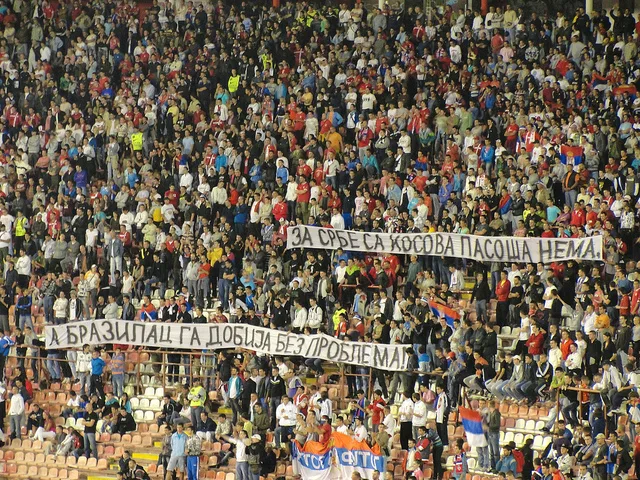
Ten years after the wars that ravaged through the Balkans, Serbia has still not achieved peace. This sentiment can be observed at football matches where the stadium is filled with crazy hooligans. There isn’t a match without fighting, rioting, or a burning of the former Serbia flag. In September of 2009 a man named Brice Taton, a fan of the Toulouse team, was killed during one of these violent episodes. While those responsible for his death received 4 to 35 years in prison, this and similar episodes makes it less likely that football will be an instrument of peace instead of war.
Every Saturday, Jelena plays football for her little league team. She warms up and then makes her entrance on the field with enthusiasm. The first pass goes to Hazema, a Bosnian Muslim. Alena, an orthodox Bosnian, gets the second pass. Jelena is orthodox as well, bust of Serbian descent.
Her coach, Simo Tumarčić, appreciates that this interaction is not trivial and is very proud of his protégées. “There has never been a fight or incident between the players,” he said with a smile. “The girls are bonded together.” Simo, 30 years-old, is from Bosnia. He decided to lead this multicultural team because he believes that through this sport the children can overcome the the hatred of their parents and reject the war (not to mention the nice salary given to him by the Cross Cultures Project Association).
Can football help renew the dialogue?
Anders Levinsen, Founder of the Danish Cross Culture Project Association (CCPA), is very familiar with the wars in the Balkans. From 1991 to 2001, he was part of the UN peacekeeping missions responsible for preventing violence between Serbia and Bosnia, during the two major conflicts in the Balkans. “Yes, I’ve seen the horrors of war,” he recalls. “But mostly, I saw that peace would be impossible because the lines of communication were never reconstructed between these former enemies.”
Trying to bring together government officials from both sides is premature, as it feels like only yesterday they were trying to kill each other. So, Levinsen used football as a pretext to bring the Bosnians and Serbs face to face. In 1999 at the Bosnian-Serbian border, he organized an event with one-hundred Serbian children and one-hundred Bosnian children to create multicultural football teams. “It was a celebration, the return of peace!” He recalls gladly “There wasn’t just children, but also their parents, and volunteers who acted as coaches, referees and translators. And many government officials too.”
After the war, Anders Levinsen continued the endeavor. He created the Open Fun Football Schools where he coached Bosnian and Serb children. The coaches also come from all over the Balkans. “This school is not just about learning football, but also about creating peace,” affirmed Levinsen.
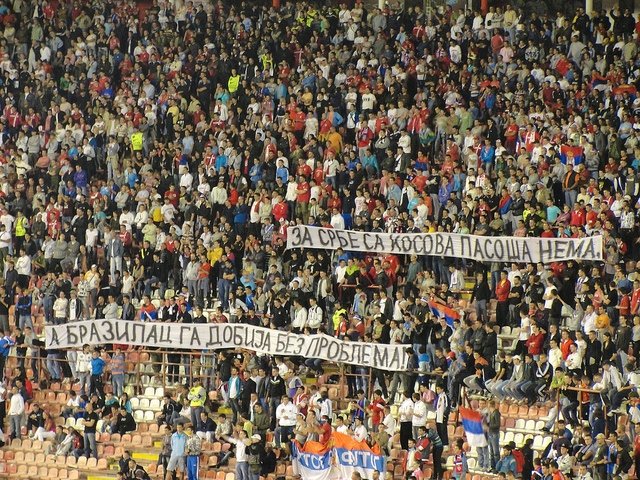
Football, the school of peace… providing there aren’t any games
For Anders Levinsen, “Football is the easiest and less expensive method or achieving peace.” This rests on one condition: the teams can never have any games. So in fact there aren’t any matches in the CCPA. “Every time we organize a game, there are problems,” Levinsen admits. “The Serbs want to play separately and the Bosnians as well. It soon becomes a conflict between two sides, and that’s not our concept of football.”
Bogdan, a 28 year-old from Serbia, has a different idea of football. He refuses to be interviewed in any other way besides the telephone, and he only calls from telephone booths in ten-minute intervals to make sure the police are not tracking him. Bogdan is unemployed, which allows him to boast about his status as a “professional hooligan.” For him, football without games is not a sport. “I know very little about football, like the strategy and all. I’m interested in the games, the battle field, the tension between the two teams.”
A pretext for war
Bogdan is a fan of the Partizan, the best team in Serbia. Every Sunday at the stadium he is in the forefront of the stands waving the colors of the of his country (including those of Kosovo, which unilaterally declared independence in 2008). “There isn’t a match which doesn’t finish with me in a fight with a fan of the opposing team,” Bogdan brags. What kind of fights does he prefer? “Those with the Bosnia team. Like everyone else, we prefer the local type. Brice Taton was mostly a mistake, even if some wanted to put more pressure on the government,” explains Bogdan.
For him, the football matches are not just games. They represent a simple means of existing in the eyes of the authorities. “The matches permit us to be visible to politicians. They are reminded that we are there, and the next time they try to pull some bullshit move on Serbia we will burn more than an embassy,” he explains. In February 2008, the day after Kosovo declared its independence unilaterally, the US embassy was burned to the ground by thousands of young Serbs who were led by the notorious hooligan gang. Bogdan was one of them. “Don’t believe the media, we are a very popular here in Serbia,” Bogdan affirms. “We are a political force, and our agenda is what every Serb dreams of; we avenge our country. Football is a way of making war.”
“Football is often a microcosm of war. It’s mirror that reflects all the tensions in society,” remarks Franklin Foer. Author of the bestseller “
” the American explains his passion for the incestuous relationship between football and politics. “The most striking example is in Serbia, especially with the match of 1990 which foreshadowed the war.” When conflict is about to break out, football can indicate the warning signs along with play a part in the aftermath. Arkan is a prime example, as he was the head of the Red Star fans before the war. When the war began, he later became a key leader in the genocidal Serbian group and recruited his “Arkan’s Tigers” from his former football club. Together they were responsible for numerous incidences of ethnic cleansing during the war.Football: An outlet for repressed nationalism
Is football an instrument of peace or of war? For Rubin Zemon, a researcher at the Euro-Balkan Institute, thinks it depends on who is manipulating this powerful tool of influence. He explains “(In the Balkans,) it is unfortunately nationalist who know how to work the system.”
In the former Yugoslavia led by Tito’s iron fist, individual nations had no freedoms over their cities, let alone compete in multicultural teams. Flags and other national symbols were confiscated by the police. This repression of nationalism eventually escalated which led to the wars in the 1990s. “After the war, they invaded the stadiums,” explains Rubin Zemon. “Thanks to the discourse that mixes Serbian pride and revenge, hardcore Serbian nationalists have attracted youth from disadvantaged backgrounds. These kids make up the majority of their support base.”

Emil* is a prime example of these impressionable youth. This Red Star fan willing confesses that he formed his political opinions in the football stadium. “Before, I wasn’t interested in politics. With the other fans, I began to speak and participate in demonstrations,” says Emil. “I began to understand what it meant to be a Serb, that it would be my fight for my whole life to make sure Kosovo remained part of us and that other nations respect us.” It’s the same story for Bogdan. It’s in the stadiums where he learned the national anthem along with the “true” borders of Serbia which include Montenegro, Kosovo, Macedonia, Croatia, and parts of Bosnia-Herzegovina, Albania, Bulgaria and Hungry. “In the stands, I learned what makes me a Serb,” Bogdan pridefully asserted.
“Football channels violence”
Bogdan’s status as a hooligan isn’t completely by choice. At the age of 28 he has not been able to find work and “has nothing else to do.” Serbia leads Europe in its unemployment rate, which affects 30% of the workforce. “I am proud of my country, but it is an economic nightmare,” laments Bogdan.”Football makes me forget that I have no future,” adds Emil, who also comes from a poor social class. While Emil was able to earn a scholarship and studied at one of the best universities in Belgrade, he believes “it will not do anything anyways.”
If the youth were able to find work, hooligans would cease to exist,” predicts Ivan Stojič, assistance coach for the FK Rad Belgrade football team (One of the top five teams in Serbia). “After all, the value of football is not completely negative in themselves. Sometimes it has prevented people from turning to drugs and crime. Problems arise when the youth have nothing to do and go to the games because they are unemployed. They eagerly await each Sunday because they can enjoy themselves during the match….” For Franklin Foer, it not bad if “football channel violence,” as he believes it it better than it being channeled outside the stadium’s walls.
A compliant government?
Foer forgets that violent fans often emerge. On October 12, 2010 during the Italy – Serbia game in Genoa, channels around the globe displayed imagines of young Serbian hooligans burning an Albanian flag. The game was immediately stopped.
A few days later, the Serbian newspaper Politika revealed that hooligans were paid more than 200,000 euros to cause a riot that would cause panic throughout Europe and chaos for the Italian police. “Who hired these hooligans, the Mafia? the nationalists? As with Brice Taton’s case, the government was uninterested in investigating further,” says Jean-Arnault Dérens, editor-in-chief of the Courrier des Balkans and an expert on the region. “Maybe it pleases the government to see Albanian flags burning on their television screens?”
In a telephone booth in the south of Belgrade, the voice of Bogdan returns like an echo: “We are a political force, and our agenda is what every Serb dreams of; we avenge our country.”
* The name has been changed to maintain anonymity
EMIL, 19 years-old, fan of the Red Star: “I am capable of killing to protect my team”
My family and I have always supported the Red Star. My grandfather was actually one of the first fans of the team when it was created! He would tell me about how the national hymns were songs for the working-class and that the Red Star was the team of the people. He would add that the Partizan was the team for our enemy’s military. Today, our hymns are less about communism and more nationalistic.
I started going to the stadium with my friends when I was 14 years old. Now I go every Sunday. I am a student in marketing, in one of the best universities in Belgrade. But I don’t care about my studies, it won’t do anything anyways. I will be unemployed like the others. Life here is not just hard, but also repetitive. The matches on Sundays is our only pleasure during the week. I’d go crazy if they stopped me from going! We wait for Sunday with impatience. The worst is Monday, because there are six long days before the next match and I feel like I’m going insane.
Every day, I think about the Red Star: I sing their hymns, watch their videos, and repeat their slogans. With my friends, it is the only thing that really makes us happy and we spend hours talking about our team. Before the matches, we love to meet at a bar not far from the stadium and drink a beer for each player on the team and reminisce about the best plays.
Like all my friends, I am a fanatic. We call Delije “the braves.” The Red Star is my life. Frankly, I love the team as much as I love my parents, my city, and my country. I am capable of killing if someone tries to hurt the team. It’s like hurting my family. I owe everything to the Red Star – the team has taught me how to be a Serb, and also a man.
Sometimes to defend the honor of the Red Star, I am obligated to fight. Last week, my friends and I beat up a Partizan fan because he insulted our team. We broke his arm and two or three ribs. I don’t really like violence, but when it comes to the Red Star don’t test me – I am capable of anything.
Interview by Anaïs LLobet
Translation by Stefanie Chernow
__
Photo Source: Flickr CC attawayjl, caitlinator, dustpuppy
💬 Discussion
No comments yet. Be the first to comment!