
![Japan’s porn culture: The birth of Anthropomorphic Hentai [NSFW]](https://owni.eu/uploads/owni/5433517904_13207b8bc7_z-1b3ab981.webp)
When reading articles on 4chan, including those published on this blog, you might be inclined to think this site for sharing images does not have much depth. However, the platform still remains at its origin an active means for discussions on mangas and Japanese anime, along with other cultural trends associated with these graphic products. Yet a plethora of adult boards under the title of Japanese Culture go beyond the discourse of mangas. The group cosplay and Elegant Gothic Lolita are discussed in terms of their ”imagery” and “role-playing.”
Disclaimer:
The following explicitly describes pornographic products (books, photos, movies) and contains several links to images reserved for adults only (Not Safe For Work in Internet slang).
Editor’s note: Although published on a platform dedicated to promoting the visual, I chose deliberately not to illustrate this post – with the exception of a print by Hokusai, which benefits from a cultural alibi. We leave it to the reader’s discretion if he wants to voluntarily click on the links to view our reported observation.
Among the groups reserved for adults, 4chan proposes 5 dedicated to hentai, which are pornographic mangas and animations. The 5 groups are: a general hentai group, Ecchi (a softer version of hentai) Yaoi (male homosexuality) Yuri (female homosexuality), and an alternative form of hentai. These discussion boards aggregates a number of interesting characters, which we will highlight for Futanari (a female figure with an exaggerated male penis capable of niagara falls-like ejaculations), Bakunyuu (a female figure with exaggerated breasts), and the Shokushu ou Tentacle monster with lubricated tentacles whose origin dates back to a famous drawing by Hokusai.
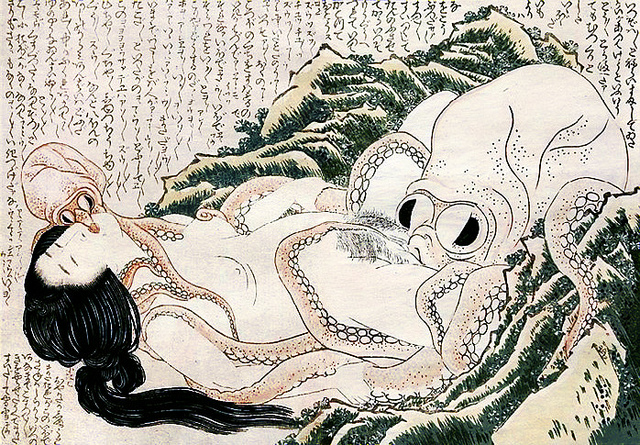
Tako to ama (The Octopus Hunter, known as the dream of the fisherman's wife).
This quick overview of certain forms of hentai can not aim to be comprehensive nor very precise. Rather it is simply a sample what is commonly used over multiple sites and specialized blogs. Pornographic image boards (fapchan) dedicated to both photos and drawings use two separate categories for these different types of images, which builds the nomenclature for hentai drawings. Yet the categories and the subcategories of the hentai genre are more complicated. The article A Short History of Hentai by Marc McLelland gives further knowledge on different japorn structures, such as “the perfect tag” (culture porn), and the list of hentai terms. It represents the comparisons and contractions between these images, and the more adventurous reader can find find further sites here and here.
If we examine conventional sites of pornographic content (photos and videos), we note that in comparison not much traditional hentai is incorporated. In the best case, the most popular categories hentai drawings are not well developed. For example, these different tubes: here, here, here, here and even one of the more well-known sites completely ignores hentai.
It is evident that there is a clear line dividing hentai’s specific channels and conventional porn which offers recorded content. This reflects another line which divides two different audiences.
Personified hentai
Hentai uses a wide range of multimedia: animations, drawings, video games (eroge), Second Life, photoshop editing, and more. There are also certain adaptations such as cosplay which feature roleplaying by both women and men (although it is more rare in the latter case) where the person is vaguely disguised as the drawing of reference. As the name suggests, cosplay is the evolution of hentai in light of de facto porn (photos and videos), as this form depicts paid actors and actresses (probably professionals in the porn industry in most cases).

Eroge
Because of such shift to photos and videos from a solely drawing universe, hentai anthropomorphised. Yet this process can only occur with certain types of images that are somewhat realistic (examples here, here, here, here). The genres ecchi, yaoi and yuri are particularly unable to conform to this evolution as the human body is contorted in a way that is physically impossible (unless very expensive digital effects are used, but that is counterproductive to the profitability scheme of the porn industry). For example, the graphic genres of tentacles and futanari will unlikely adapt to multimedia because they are not easily recreated by actual people, nor would it be very profitable (seen here and here respectively).
Hentai cartoons and photos appear to be disseminated on the Internet on a distinct path from other forms of porn. They address a very different audience, almost as if this media was generated in a solitary fantasy universe. Drawn and personified hentai coexist, but do not mix. So is not acceptable to publish photographic versions on the mangas group (Unless you want a lot of angry comments). For the futanari genre, the fapchan site does distinguish between two discussion boards: futanari drawings on one board, and photoshopped transvestites and dickgirls on the other.
The production of the most extravagant forms of personified hentai depict mainly Japanese actors and actresses. Frankly, a number of these hentai are repulsive for non-Japanese viewers. The tentacle genre is particularly disturbing and has never appealed to the Western porn industry (also see this post on The Perfect Tag).
Futanaria and Mastasia
The evolution of futanari started in a basic photo-shopped form know as fakes (here, here, here).This process is called futinization.
The process further developed to videos by specialty manufactures, and actresses were made into futanari. Futanaria is the most well-known commercial site offering this type of graphic material, and many of its productions are accessible on different tubes, such as here here and here for example.
Futanaria debuted in 2008. The site currently sells more than 70 video clips that use around 30 models whose attire is reminiscent of cosplay hentai. Mastasia, a similar site, also offers videos inspired by bakunyuu.
These short videos represent a crossover between hentai and the Western porn industry. The fundamental codes of the genre are respected: excessive secretions and euphoria, stereotypical bright clothing, no decorations in the interior which is reminiscent of solidarity design, and characters are consistent from one scene to another (the actors and actresses still maintain inflated equipment). Any mistake is not displayed, as to show that these scenes are shot without special effects. The objectives is to make these characters believable despite their improbable activities. However, the effect is evident not only in proportion of the “utensils” used but also in its improbability. Size does not vary throughout progression to the stage of the prolific climax. Transvestite and transsexual actions are also displayed, such as having a double penis and a combination of futanari +bakunyuu features are including in the films.
Hentai fans are drawn to these shared adaptations, which they either love or despise.
Unlike other adaptations of hentai in the real world, like the tentacle genre, the performers of these sites are not only Japanese but represent the diversity in American society; actors are Caucasian, African American, Latin, Asian, etc.
Western approval of the Japanese porn culture
In a post by André Gunthert, he compares a few images from Spielberg’s “Adventures of Tintin” movie with Hergé’s actors. He briefly discussed the conditions for a successful film adaptation of a comic book, concluding with “a good film is based on the proposal of the imagery without the direct referent.”
By liberating the film from its original artistic connections, it can adapt to what may be considered a “good” movie – it is these imagery concepts that are transferred to hentai videos.
Personified hentai oscillates between fake and real. Some genres remain essentially Japanese (tentacle) while others have evolved in tune with western society such as futanari and bakunyuu. These adaptation rooted in traditional hentai work with viewers who are oblivious to the unaltered form of the drawings.

The porn industry’s ability to retrieve different cultural customs is not only possible but it is also commercially favorable. ‘Anthropomorphic’ hentai originated because certain aspects of traditional hentai were embraced by mainstream audiences. Expressed in a more casual manner, Futanaria is shemale++ and Mastasia is bigboobs++.
The imagery may not be very convincing, but it works for the critics who are competent in this domain (refer to by 4chan illustration of the saying The Internet is for porn). It has merged with a well-established category of porn, which created conditions for the updated hentai. Thus there is a revival of a specific form of Japan’s porn culture by a broader pornographic industry, who distributes palatable alternatives to the market.
-
Initially published on the blog Déjà Vu-Culture Visuelle, under the title: Dessins incarnés, le cas du Hentai
-
Photo source: Wikimedia Commons [Public Domain] by Hokusai : The dream of the fisherman’s wife and Shunga-Masturbation-Voyeurisme ; Flickr in cc-by-nc-sa : Persocomholic ; Knowyourmem; Main photo Marion Kotlarski, CC for OWNI
💬 Discussion
No comments yet. Be the first to comment!