
This article was originally published in The Meta-Activism Project
—
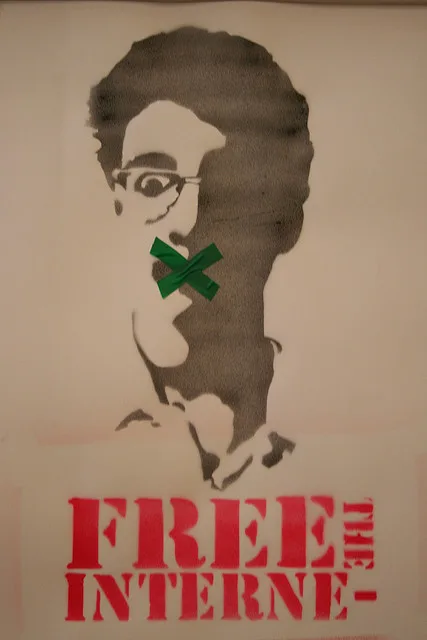
About a third of the way through his book The Net Delusion, Evgeny Morozov references the Orwellian “trilogy of authoritarianism”: censorship, propaganda, and surveillance. This is a useful framework for analyzing digital repression, but Morozov only tells half the story.
Unlike in his chapters on the mythology of the Iranian Twitter Revolution and the neo-con school of cyber-optimism, Morozov is in journalist mode here, rather than attack mode. His chapters on the trinity are original and empirical, yet nhe does not present the other side’s ideas. In this post I’ll review Morozov’s insights on the three pillars of digital authoritarianism and then present the other side: why there is still legitimate reason for optimism about the power of digital activists to combat these forces.
Censorship
 Morozov begins his chapter by explaining why authoritarians might not want to censor critical blogs: they allow an opportunity to gain intelligence. Critical blogs also keep local authorities in check by allowing a higher level of criticism that both allows the central government to play defender of the people by punishing local corruption and gives the illusion of accountability.
Next, Morozov looks at technical innovations in censorship. One new option is predictive individual censorship that would allow a banker, but not a dissident, to read foreign newspapers online. This facility is based on the same types of applications that provide product suggestions on Amazon: computer programs can tell our preferences from the places we visit on the web and build profiles of us based on our online behavior. “Instead of being prompted to check out the ‘recommended’ pages, we’d be denied access to them.”
Another way of using algorithms to analyze aggregate data is link analysis, which can be used to automatically block certain content based on who links to them.
“If a dozen anti-government blogs link to a PDF published on a blog that was previously unknown to the Internet police the latter may assume that the document was worth blocking without even reading it.”
Yet censorship does is not only undertaken by governments. Many outsource the work of censorship to Internet service providers (ISPs) and web site operators, leaving the work and the cost to the private sector. Governments don’t even need to create rules for censorship. “Governments say ‘censor’ but don’t spell out what it is that needs to be censored, leaving it for the scared executives to figure it out” creating an uncertain censorship environment for activists and even encourages companies to over-censor just to be on the safe side. Governments also crowdsource digital repression by outsourcing censorship to their own citizen. In Thailand, a web site set up to collect reports of web content criticizing the royal family blocked 5,000 submitted links in the first 24 hours of operation.
Yet blocking content is imperfect as more and more citizens are learning to user circumvention technology. Even when opposition web sites are hosted abroad in friendly countries, authoritarian governments have found a way to a harass and someones successfully shut them down: the distributed denial of service (DDoS) attack, which involves using software to overload a site with page requests and thus rendering it unable to serve pages to legitimate users. This is a serious but under-reported problem for digital activists around the world, and it is good that Morozov is bringing attention to it. Given repeated attacks, site operators and users become demoralized and may even get kicked off their hosting service since attacks to the site affect the sites of other clients on the same server, making them “digital refugees”. Buying extra bandwidth, the most effective response to DDoS, is prohibitively expensive to most activists.

The Other Side: All these issues are real and serious, but there are ways that activists are fighting back. There are both technical and semantic censorship work-arounds. On the technical side there are anti-censorship tools like proxy servers, virtual private networks (VPN), and circumvention applications like Tor, Ultrasurf, and Freegate that allow activists and the general public to access censored contact by routing requests around blocks.
In addition activists, particularly in China, are developing “semantic” work-arounds, creating alternative spellings and homonyms that allow then to discuss censored topics. The Internet police usually figure out these tricks, but they are forever playing catch-up because it is difficult to predict what alternative word activists will use and activists can choose another if one is blocked.
There is even hope for victims of DDoS attacks. By making a digital home on a popular commercial platform like Facebook, Youtube, of Blogspot, activists force repressive governments into “dilemma actions”: if they block the popular platform they raise awareness of (and opposition to) censorship among the site’s apolitical users. If they try to attack the site at a network level, as Pakistan did to Youtube in 2008, they are assured international embarrassment – and that the commercial provider will be able to recover.
Propaganda
Morozov has the sometimes amusing and sometimes merely obfuscating habit of giving his chapters and sub-sections silly titles. Sometimes they transmit the necessary information (“WWW and W” is about Bush and the web), and sometimes they just obscure the subject. Chapter five, “Hugo Chavez Would Like to Welcome You to the Spinternet,” is about online propaganda, about the use of spin on the Internet.
At its most sophisticated, repressive governments use netizens as their mouthpieces, luring them with the promise of acting as agents of accountability when their true role is to pantomime that role while letting the government off the hook. Not surprisingly, the best example comes from China where a young man died in prison apparently by hitting his head while playing “elude the cat” (Chinese for hide-and-go-seek). This audacious and ridiculous lie set the Internet on fire and the Chinese government asked a committee of netizens to investigate – except they were all current or former employees of state media and their report was “inconclusive.” Apparently the government was too afraid of actual netizens to use them this time, but they might in the future.
Morozov then notes how governments are countering critical content with their own interpretations rather than censoring it outright, knowing that a ban can actually increase interest in whatever is forbidden (the Streisand Effect). For example, following the 2008 war with Georgia, Konstantin Rykov, one of the Kremlin’s favorite digital propagandists, created of an online documentary-style video called “08.08.08: The War of Treason” that “portrayed the Georgians in the worst possible light imaginable”. It was not a tough sell to Russian nationalists, but was a far easier sell than traditional ham-fisted propaganda. Morozov also mentions the thousands of paid propagandists of China’s 50 Cent Party.

The Other Side: Authoritarians are certainly getting more creative and effective at online propaganda, but this does not mean that they are winning. When authoritarians choose propaganda over censorship they are implicitly entering into competition with their detractors and, as in prize fighting, you only compete with a worthy adversary. If the influence of the Kremlin’s detractors could simply be silenced by adding their IP addresses to a block list, then the Kremlin certainly would. By entering into a competitive media environment with its ideological opponents the Russian government is implicitly admitting that their strength and influence, that these opponents cannot be ignored or silenced, they need to be engaged. Though the outcome is far from assured, this is what Gandhi was talking about when he famously said “First they ignore you, then they laugh at you, then they fight you, then you win.”
Surveillance
This chapter reviews the many sneaky ways authoritarian governments have for tracking activists online. In Vietnam, the government hid malware in a download on the site of a respected NGO which turned activists’ computers into “mini-panopticons” in which their actions were visible at all times. Malware surveillance technologies include key-stroke recorders for logging passwords (reuse means just one grants access to many accounts), face-recognition software for digital video, GPS tracking for mobile phones, and data mining (Google knows how often Russians search for “bribes,” “opposition,” and “corruption).
Morozov also argues that surveillance is easier in the digital age. “The old means of doing surveillance usually began with a target and only then searched for the crimes one could ascribe to it. Today the situation is the reverse: Crimes – anti-government slogans are suspicious connected to the West – are detected first, and their perpetrators are located later.” This is a much more efficient system with fewer false positives.

The Other Side: But again, the mere presence of effective surveillance does not mean authoritarians will win. Surveillance is most useful with career activists, and for them it is a real danger. What it is not so useful for is countering one-off activists who take a political action once (uploading a video of a protest) and then go back to their regular lives and the casually political who occasionally pass on a link to a banned web site or criticize a government official online but who are too numerous to take effective action against. The ease of content creation in the digital age makes this kind of semi-activism ever more likely.
This problem of scale is one that Morozov himself addresses but does not resolve. He acknowledges that “there is so much data being produced online that authorities cannot possibly process and analyze all of it.” Yet the scale problem is not primarily with amount of data but the number of unhappy citizens. Practically speaking, what do you do if you work for the Kremlin and know that 1 million Moscovites Googled the word “corruption” last month or work for the Chinese government and know that 200 million citizens watched a
? Knowing is important, but it does not imply that an effective response is possible.As with all these tactics, if a governments oversteps its bounds by impeding the lives of ordinary citizens it lose legitimacy and politicizes the apolitical. From there it is a slippery slope in which ever greater force is necessary to maintain control, which results in ever lower legitimacy. When a government has no legitimacy left the smallest event can trigger a revolt, as former Tunisian President Zine El Abidine Ben Ali learned a month ago when the suicide of a fruit-seller motivated dissatisfied citizens to move out into the street and demand his ouster.
I’m going to now look at two chapters together. This is not only because there are eleven chapters in the book and I need to double-up sometimes, but also because Morozov himself sets up an amazing thematic juxtaposition: In chapter two he successfully shreds the idea that the Cold War is an effective metaphor for the current Internet freedom debate, and then he begins chapter three by using an extended Cold War anecdote to make arguments about Internet freedom.
I really liked the beginning of chapter two. It was just really good, probing, edifying journalism about how the neo-cons got into the Internet freedom game: how the George W. Bush Institute hosted a group of “global cyber-dissidents”, how neo-cons got Congressional funding for Falun Gong to make circumvention tools, how these politicians quickly fell into the inaccurate language of Cold War-speak.
The neo-cons came of age politically and intellectually in the Cold War and were the ones to fight it. It is not surprising that they would come to see the political role of the Internet in repressive regimes in the same light. Morozov does an excellent job of skewering this false intellectual conceit:
Having previously expended so much time and effort on trying to break the Iron Curtain, Western policy-makers would likely miss more effective methods to break the Information Curtain…. Policymakers’ previous experiences with solving similar problems, however, block them from seeking more effective solutions to new problems. This is a well-known phenomenon that psychologists call the Einstellung Effect.
He continues, focusing in on the false Berlin Wall / Cyber-Wall analogy:
Physical walls are cheaper to destroy than build; their digital equivalents work the other way around. Likewise, the “cyber-wall” metaphor falsely suggests that once digital barriers are removed, new and completely different barriers won’t spring up in their place – a proposition that is extremely misleading when Internet control takes on multiple forms and goes beyond the mere blocking of web sites.
These are all good points, but before I discuss the way Morozov falls into his own Cold War intellectual trap in chapter three, I’d like to take a moment to analyze the rhetorical choices in chapter two. Just as he chose his opponents’ weakest argument (“Twitter Revolution”) in chapter one in order to score rhetorical points by playing Harlem Globe Trotters to their local losers, he makes twocareful omissions in this chapter to make the idea of Internet freedom seem intellectually bankrupt.
Omission 1: Treats neo-conservatism as the only intellectual rationale for Internet freedom
In this chapter Morozov treats the idea of Internet freedom (and, by extension, cyber-optimism) as having uniquely neo-con roots. Picking an intellectual fight with a neo-con in the post-Bush era when the US is still mired in Iraq and Afghanistan and an American diplomat cannot say the word “democracy” without being perceived as an imperialist is like attacking US isolationalists after Pearl Harbor – their intellectual pedigree has been so successfully degraded by actual events that they make an easy target. By treating the idea that ICTs can have deleterious effects for authoritarian regimes and that policies should be developed around that idea as a neo-conservative one, Morozov hopes to make the idea invalid by association.
I know many people who believe that the Internet can have these positive effects for activists and pro-democracy proponents : Ethan Zuckerman, Yochai Benkler, and Jillian York at Harvard, Patrick Meier at Stanford, Philip Howard at the University of Washington. Not even one of them is a neo-conservative. They draw their optimism not from past intellectual frameworks but from observation of current phenomena.
Omission 2: Treats digital activism is an idea, not a phenomenon
In Morozov’s mind, digital repression is a reality of multiple amusing anecdotes, but digital activism and the use of digital technology against repressive regimes is just an idea. Yet there are hundreds of examples of members of civil society using digital tools to broadcast alternative political narratives, coordinate anti-government actions, transfer resources, create a shared awareness of shared grievance, and mobilize protest. If Morozov needs some examples, he can download the list of 1,000 cases in the Global Digital Activism Data Set. Digital resistance to authoritarianism is real, not just the misconception of neo-cons. Yet it is easier to invalidate a phenomenon if you pretend it doesn’t exist.
So why, after successfully cutting off the intellectual legs of Cold War-inspired proponents of Internet freedom does Morozov remove his own in chapter three by using the Cold War as a predictive model? In chapter two he writes that:
Anachronistic language skewers public understanding of many other domains of Internet culture, resulting in ineffective and even counter-productive policies. The similarities between the Internet and technologies used for samizdat – fax machines and photo-copiers – are fewer than one might imagine.
 This is all true, so why, after critiquing “anachronistic language” and Cold War thinking does he launch into an extended anecdote about how cable TV undermined democratic aspirations in East Germany during the Cold War? If he is savvy enough to argue that the similarities between fax machines and photo-copiers and the Internet are few, how can he allow himself to overlook the differences between the Internet and television? Read-write capacity, consumers becoming content creators, media fragmentation, the “former audience” – these are not new ideas.
Broadcast hasn’t been an accurate metaphor for the Internet since the beginning of the millennium, and Morozov knows this. By comparing the complacency created by Western TV in East Germany to the complacency created by web TV from the likes of Russia.ru today, he is doing exactly what he excoriated the neo-cons for: using a “Cold War metaphor” to suggest an understanding of digital repression in the modern day.
So why does he do it? For the same reason that he makes so many rhetorical choices in his book: because its easier to defeat a proposition if you pretend it does not exist. It is no accident that nearly every case in the Global Digital Activism Data Set involves self-publication of user-generated content. Content creation is crucial to most of the elements of successful digital activism: offering alternative narratives, creating a sense of shared grievance, mobilizing supporters. By choosing a metaphor from the broadcast era of television – and pretending it is analogous to the Internet era – he also pretends that the creative capacities of the “former audience” not only are unimportant but also don’t exist.
Winning arguments by cherry-picking weak ideas that he can easily defeat and pretending that challenges to his rhetorical view do not exist is poor journalism and poor rhetoric. Morozov is an excellent writer and analyst capable of winning arguments even when he has not tilted the field of play in his own favor. Perhaps for all his bombast he is less intellectually confident than he appears.
—
Photo Credits: GusEds, Stian Eikeland, laverrue, alphadesigner and Brian Lane Winfield Moore
💬 Discussion
No comments yet. Be the first to comment!