
![[Liveblog]: UK Court rules Julian Assange will be extradited](https://owni.eu/uploads/owni/liveblog-1326b25b.webp)
There is no doubt that Julian Assange and WikiLeaks is the hot controversy. From releasing leaks pertaining to dictators in the Middle East to the Mafia in Italy, it is evident that WikiLeaks has opened a Pandora’s box that springs humanity into the age of transparency.
But is Assange really the knight in shining armor which the powerless have been dreaming about? Not according to two women in Sweden, who are trying to extradite Assange from the UK for accusations of sexual misconduct. This personal scandal has changed the WikiLeaks narrative, forcing Assange to fight for his credibility and, ironically, his private life.
Is Assange a villain or a hero? OWNI has our correspondent in London for the two-day hearing to find out the final verdict.
The French adaptation of this live blogging is available on OWNI.fr

[4:30pm] Words from the defeated
After a crushing verdict, it appears the defense is squirming in light of the reality of extradition. Mark Stephens spoke briefly after the hearing, stating the prosecution was charging too much for the case. Currently, the charges just for translations were around 30,000 pounds. He clarified that Assange will appeal, and his case will remain along the same lines as the skeleton arguments. Will the appeal overturn the verdict, or will the same arguments lead to the same results?
According to the Guardian, Julian Assange did address the public a few hours after the court adjourned:
Belmarsh was a rubber stamping process. It comes as no surprise but is nevertheless wrong. It comes as the result of a European arrest warrant system amok. There was no consideration of the allegations made against me. No consideration of the complaints against me in Sweden. We have always known we would appeal. We have always known in all likelihood we would have to appeal….
…It has been falsely stated that I said the CIA or Pentagon was involved in the initial allegation. I have never said that. I have never said who was behind those allegations, simply that they were untrue. Why is it that I am subject – a non-profit free speech activist – that I am subject to a £200,000 bail, that I am subject to house arrest when I have never been charged in any country.
The scrutiny of the European arrest warrant system needs to begin now, it cannot be the case that filling two pages with someone’s name and a suspicion – not a charge – can lead to their extradition to one of 26 European nations.
Three people a day are being extradited from the UK under a rubber stamp process.

It looks like Assange’s skeleton case will be buried, and he’ll need to start preparing for Sweden. Until an appeal makes Assange’s defense return from the dead, this wraps up today’s liveblog.
[1:00pm] VERDICT: Assange extradited to Sweden
 Judge Riddle shot down Assange’s case today as he pointed out the flaws in the defense’s arguments:
- Mr. Hurtig was an unreliable witness. “Hurtig said it was astonishing Ny didn’t try to contact his client – I believe this to be untrue. I don’t accept Hurtig’s mistake was genuine, his statements was a deliberate attempt to mislead the court.”
- The merit of the EAW is valid, and Ms. Nye could legally initiate the warrant. “I am looking at the warrant alone, no extrinsic evidence. The warrant is valid. The defence’s attack on the credibility of the source has not been convincing. They merely criticised her (personally).”
- The prosecution was legitimate in requesting that Assange to be interrogated in Sweden, as the underlying intent was clear. “I don’t know why (conversations by) phone and other methods of communication were not accepted, that’s not for me to decide. It is not unreasonable for me that a prosecution requests interrogation in the country for such a serious matter…The boundary between suspicion, preliminary enquiries and prosecution has been crossed.”
- The accused sexual misconducts by Assange follows the legal definition of rape:
- The judge does not acknowledge the claim that Assange would not receive a fair trial in Sweden. This includes the accusation that Assange would be extradited to the US or Guantanamo. “The Human Rights Convention says everyone is entitled to a free and open trial free from political influences (even when) publicity will influence the trial. I have not been given any evidence, any past cases where (unfair treatment) has happened before in Sweden.”
“Offence 1 specifically alleges that Assange used violence and forced the injured person and constricted her freedom to move. The complainant did not consent to this. This is an extradition offence. Offence 2 says Assange molested the party and violated her sexual integrity. The complainant made it clear she was not consenting to the act, as sex happened without her knowledge (she was asleep). Again this meets extradition criteria. Offence 3 says Assange deliberately molested the complainant and violated her sexual integrity. This is an allegation of rape. The defence said this does not amount to rape in most European countries. The complainant was asleep – in this country that is rape”
After reviewing the final decision (which the full version can be found here), he announced that the court accepted Sweden’s extradition application. Assange was still granted bail after paying a £200,000 security deposit. The editor of WikiLeaks has 7 days to appeal, and it is more than likely he will fight back.
Statements from Assange are expected later this afternoon.
[February 24, 10:30am] Judgement day
Two weeks after Julian Assange’s extradition trial, the verdict will be handed out today. It is evident that both no matter what the ruling is there will be appeals, especially from the defense. Julian Assange recently hired two Australian lawyers to ensure that his human rights were being observed.

WikiLeaks supports protesting in front of Belmarsh Court
Will Assange be extradited to Sweden for sexual misconduct? What implications will this case have for the future of the European Arrest Warrant? Owni’s correspondent @federicacocco will be live tweeting from the court throughout the day.
[4:30pm] Day 3: Last statement before the verdict on February 24
After a long two and a half day hearing, the court adjourned for two weeks to reflect on the final decision. It is very likely that this case will be subjected to appeals even after the verdict on February 24. As of this point, it is hard to predict where things will end for the face of WikiLeaks.
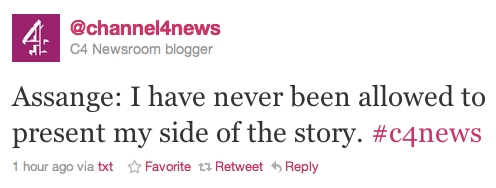
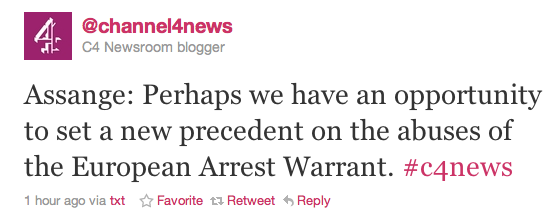
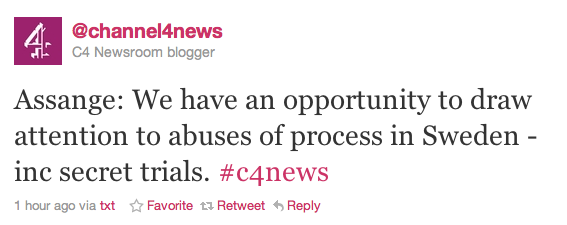
Channel 4 tweeted Assange’s statement after the closing remarks today:
[2:00pm] Closing remarks: the prosecution
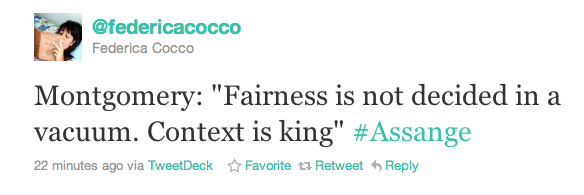 Prosecuting attorney Clare Montgomery closed with the following arguments:
- Marianne Ny’s authority in issuing the EAW is certifiable.
- The purpose of the warrant was clear under an international context. The EAW was clearly to prosecute, and this case does not concern whether he is convicted of rape crimes.
- Regardless, rape is a very serious crime and qualifies for extradition under European law. Thus the measures taken are proportional.
- Ny should not be obligated to be a witness in the extradition hearing as that is evidence for a separate case.
- Montgomery clarified issues pertaining the case in Sweden being held behind closed doors. “As for secrecy, no one suggested the Swedish Court is indifferent to this issue. Calling it ’secret trial’ is a parody. It’s just that the evidence is considered in private…There’s nothing in this case now that suggests abuse or that the trial would reach a level of flagrancy.”
Robertson gave a brief 10 minute reply. He noted that he never said rape was not a serious offence, but it was still the court’s duty to decide if the accusations actually summed up to rape under UK and European law rather than just Swedish law.
The trial ended for the day, with Assange’s verdict being revealed on Thursday, February 24.
[11:30am] Closing remarks: Assange’s defense
The hearing began with Geoffery Robertson calling for an adjournment due to recent comments from Sweden’s Prime Minister concerning the case.
In our view this enhances the perception of justice being impaired. Evidence of ‘toxic nature’ of antagonism, all the more extraordinary as the Prime Minister said in January he’d be wrong to comment on this case. So why did he think it was ok to launch such attack only a few weeks later? Does he have political motivations? This is a complete contempt of the principle of presumption of innocence.
While Judge Howard Riddle recognized Robertson’s point, the application for adjournment was shot down in favor of finishing the hearing.
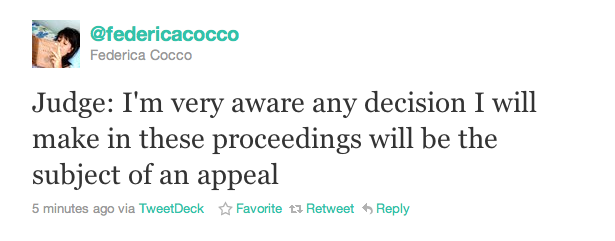
Robertson had one hour to wrap up his case. His final points included:
- As the burden of proof is on the prosecution, Ms. Ny should be required to testify.
- Sweden’s courts are not as efficient as conventional knowledge, even though they are a member of the European Court of Human Rights. Currently they have 139,000 cases pending before the Court of Human Rights. If the case wrongly went to Sweden, it could take years before justice was served. Additionally, Assange’s trial would most likely be held in secrete leading to doubt that he would have a fair trial.
- In issuing the European Arrest Warrent (EAW), there was too much emphasis in Sweden’s legal system rather than a broader international view. “Issuing authority (can not be made by a) public prosecutor, but Swedish prosecution authority. Especially because this is not a conviction warrant. Ny is absolutely, totally wrong.”
- In a further violation of the EAW, the issuing of the warrant was “disproportional,” as there were easier ways of communication such as phone interviews which were denied by the prosecution.
- Issues of double criminality was emphasizes. In Sweden there is a downgraded form of rape called “minor rape.” This legal term only exists in Sweden, thus other countries would consider Assange was being tried twice for the same crime.
[February 11, 10:41am] Day 3
Closing remarks will begin soon at 10:30 am in London. It is predicted that a decision will not be made today and it’s likely that both sides will appeal if the ruling is not in their favor.
How will this scandal affect Assange and WikiLeaks in the long run? WikiLeaks has campaigned on behalf of Assange, claiming that these accusations of sexual misconduct is a political stunt. Yet due to Assange’s demeanor, certain former employees have started their own competing website called OpenLeaks. According to the Guardian, Daniel Domscheit-Berg, the founder of OpenLeaks, has just released his book “WikiLeaks: Inside Julian Assange’s War on Secrecy.” According to Daniel, Julian is “an ‘emperor’ who was obsessed by power and money and who had a fondness for young women.” Daniel also recalled Julian’s need for dominance in virtually every situation:
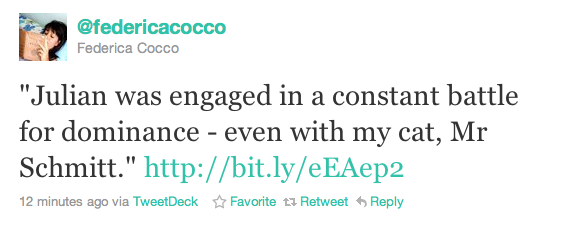 The verdict is still out as to exactly how accountable Assange is for the charges of sexual misconduct. Regardless, will Assange be able to remain the face for WikiLeaks?
[February 9, 11:20am] Assange’s extradition hearing transcript: The twitter version
Editor of OwniEU, Federica Cocco, managed to tweet the two-day court hearing virtually verbatim. That is over 13,000 words worth of tweets! Check out the transcript of Assange’s extradition hearing, transcribed from Federica’s tweets.
[7:00pm] Day 2: After the hearing summary
According to the Guardian, Mark Stephens from Assange’s legal team has challenged Ms. Ny to come to London to testify on her behalf. He indicated that she was ready to put Assange in the spotlight, but wasn’t able to take the heat herself. Assange spoke in a similar tune:
It has been a long day. What we have seen is process abuse after process abuse.
[February 9, 1:21] Update
The Guardian posted a video of Assange’s statement after the hearing:
Summary of day 2: Much of the debate has been regarding who is a fault for the break-down in communications in setting up an interrogation of Assange. While it is evident that the prosecution did repeatedly attempt to make contact with Assange, it appears that there was a system failure on the defense’s side; Assange was preoccupied with the fallout from WikiLeaks and his lawyer was not informed of the severity of the case. There was also a dissonance between the opposing sides whether it was necessary for Assange to return to Sweden for a DNA sample, as the defense emphasized it could be carried out in the UK.
The case, and this liveblog, will resume in full force this Friday on February 11.
[6:00pm] No verdict tonight
Robertson wraps up Hurtig’s testimony, emphasizing that it was possible for the DNA to be taken in the UK instead of having his client return to Sweden. Robertson informs the judge that Julian originally refused to give a DNA sample, but later conceded to do so voluntarily. Also, Robertson asked Hurtig why Ms. Ny was unable to make it to London for today’s hearing, in which Hurtig replied he didn’t know the reason.
 Looks like this show will be continued. Check back for Assange’s statement after day 2 of his trial.
[5:35pm] Bjorn Hurtig Part II: cross examination
Montgomery questions the witness, and insisted that Mr. Hurtig had more contact with Ms Ny than his testimony indicated. After double checking his records, he in fact did have more contact. Montgomery persued, asking him about the extend of his attempts to get in touch with Assange. “At the very least I told him to call me back. You have to take for granted I sent him messages,” was Hurtig’s reply. The interrogation continued, with Montgomery emphasizing the fact that Assange was becoming a “wanted man” and that is was Hurtig’s responsibility to notify his client.
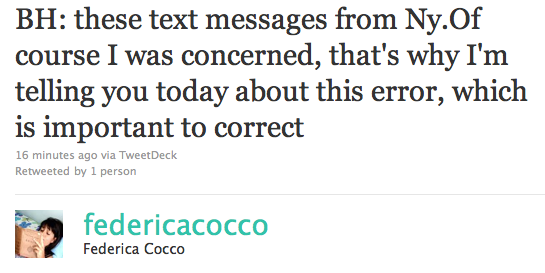
The questioning turned to the issue of the DNA sample, in which the two lawyers disagreed whether Assange needed to return to Sweden for the sample:
Hurtig: it was clear at that point they wanted to interrogate him, but amongst other things in other conversations with Lejnefors, it was not completely clear he could not be interrogated on the phone.
Montgomery: But you knew they had to take a DNA sample!
Hurtig: Not true. Both parties agreed the sex happened so why would you need DNA to prove that?
Montgomery: Because the condom broke.
Hurtig: That depends on whether the condom was worn and whether ejaculation happened.
Montgomery: This is something one must establish face to face.
Hurtig: Why?
Montgomery: To get the sample!
Hurtig: In that case why not take a saliva test or DNA test in England?
Montgomery: Prosecutors might not want to do that. They might want to take the sample in person.
Hurtig: I don’t agree with that. Think of last year’s case in Finland, the police went to Sweden to take a DNA test for Finland interrogation.
Montgomery: You agree that the absence of DNA test is a weakness in the case.
Hurtig: Sure, but at that point I didnt have a statement from Julian so I didn’t know what his position was. I can sense from your skills that you would’ve worked in the same way I did.
[3:30pm] Bjorn Hurtig takes the stand: Examination by Robertson
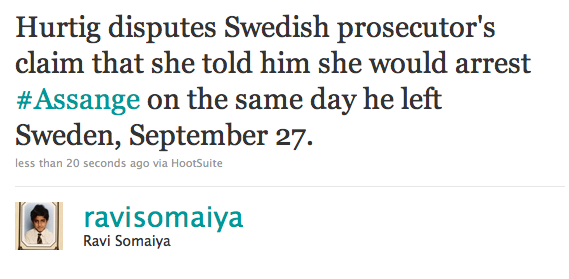
Bjorn Hrtig, Julian Assange’s lawyer during the correspondences between Assange and Ms. Ny, takes the stand to testify. Summary of events:
1. Mr. Hrtig stated that even though this case has already recieved a lot of media attention, it would still be unlikely that the hearing in Sweden would be open to the public.
2. Assange was not given documentation in English by the prosecution, which is a violation of his rights.
3. He recalls the difficulty and confusion he faced in trying to arrange an interrogation between Assange and Ms. Ny:
I asked her whether he was going to be interrogated, she said there was not enough staff for that. A policemen was ill. I asked that I wanted to be present at interrogation and asked if there was a replacement for that policeman. She said no, she wanted that particular policeman: Mats Gehlin. It seems that policeman had expressed views on Assange….
There was a fairly large gap until we were in contact again. I called Julian to tell him he was free to leave Sweden and continue his work. There were threatening statements made by politicians in the United States. In so far as the media has reported, politicians were saying he should be given the death sentence. As a consequence of this, Julian was obviously worried. It became a bit difficult to get hold of him. We agreed we would get in touch again once he had found a stable place…I got a text from Ny thanking me for letting her know about not being able to get in touch with Julian and that she’d be in touch again. I received a text message from Ny saying she wanted to interrogate on the 28th of September, but I couldn’t get hold of Julian.
(On September 30th) I asked him when he was available to be interrogated. That’s the first time I mentioned to him that he had to be interrogated. He said he could be back on October 9. (Ms. Ny) didn’t think it was a good idea to hold the interrogation on a Saturday, she said later in the week. I asked her whether there was a risk Julian would be arrested and she then told me he’d be detained (sic) but he was not wanted. She said, and this is important, that she was 90 to 98% sure that Julian would be immediately allowed to leave after the police invest. She said she believed a social collapse between Julian and the complainants had caused this…
On October 5th I received a text message from prosecutor saying she wanted to hold the interrogation on Oct 6. I tried but was unable to talk to Julian. At the time I was a defence lawyer in another case, during a break I got a message saying Assange’s interrogation had to take place on the 6th. That I should cancel all commitments…I sent an SMS to Lejnefors asking if there was going to be an interrogation…Shortly after she said ‘It’s not going to happen, you can go home.’
On Oct 8 I phoned her and discussed the possibility of holding a telephone interrogation with Julian…(Ny’s lawyer) said no to all suggestions. She gave me one reason in a text sent on January 11 2011.
4. Hurtig also recalls some of the classified information which he had limited access:
The content of the SMS was not good for the claimants. There were text messages speaking of revenge, and how to make money from the story. There was a text message from the woman who claimed she was asleep, in the text she she said she was HALF asleep.
[2:20pm] Australian Attorney General Responds
Assange’s defense was in the middle of interrogating Bjorn Hurtig when lunch was called. Owni will provide a full summary of the testimony after their break.
According to WikiLeaks Central, the Australian government has responded to calls for it to step up and defend Assange. The letter writes:
The Australian government has stated that the large scale distribution of hundreds of thousands of classified United States Government documents is reckless, irresponsible, and potentially dangerous. In regards to Mr. Assange, he is entitled to the same rights as any other Australian citizen, including consular assistance and the right to return to Australian. The Government will not be engaging in a running commentary on the WikiLeaks matter or the legal proceedings against Mr. Assange.
Looks like Assange is on his own today, as Australia clearly wants to put some distance between them and the man who enraged the entire diplomatic world.
[11:58am] Day 2 – first witness
The case finally started an hour after its previewed time, with Sven-Erik Alhem as the first witness. Alhem was a former Swedish chief prosecutor who criticized mistakes made in the previous investigation of Assange. During the examination, he made the following points:
1. The European convention gives a very important right to suspects of a crime: “The suspect has a right to be notified as soon as possible and in detail of what the charges consist of. He or she should be given the opportunity to give their version of events and comment on what has been said by the other party. A golden rule when it comes to all criminal prosecutions is that both parties should be heard.”
2. It’s possible (but not common) to conduct interviews abroad if meeting in person is not possible.
3. Alhem Believes there is too much focus on the closed trail issue in courts in Sweden. “In my opinion there’s been too much focus on the issue of closed doors. It balances the issues of the balanced parties…I have debated on the issue That means you don’t need to see sexual assaults embarrassing the claimants in any way. I’m in two minds about this issue.”
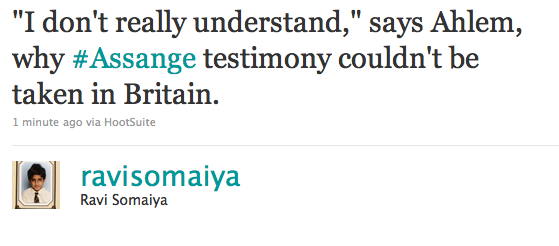
After initial questioning, Clare Montgomery conducted the cross examination. Before she began questioning Alhem, she asked Mr. Hurtig to leave the room. She began:
Montgomery: The statements made by Ms Ny and Hurtig – have you read them?
Alhem: No I haven’t, but I haven’t said anything about them
Montgomery: Do you think it would’ve been important to understand that before forming a view on the prosecution’s actions?
Alhem: I think this question should be put to Hurtig, I was asked to give my opinion on European convention issues. I don’t think there’s anything wrong with the EAW, if it was the case to not hold a hearing with the suspect. If that hearing did not live up to the demands, then you still have the opportunity to use the EAW. To avoid misunderstandings you can have an opinion on Mr Assange’s way of handling this. If I were in – how do you say it in English – in his shoes, I would’ve gone to Sweden. I think it would’ve been important to clear my name.
Montgomery follow with reading Miss Ny’s official testimony for the witness:
During the preliminary investigations I was in contact with Hurtig. Two witnesses interviews, that due to investigators sick leave in September 15-17, were held on September 20 and proved to be of importance to our position before interviewing Julian Assange. I requested a date ASAP, In order to prepare the ground for the appointmend so that the lawyer could also attend. I asked what times would be possible for Hurtig to attend, I had a number of contacts with him the following day. Due to these circumstances the interview was planned for Tues Sept 28. An unsuccessful search for Julian Assange’s whereabouts was carried out. During the next few days I was repeatedly in contact with Hurtig. On September 28, Hurtig told me he had not been able to contact Julian Assange. After that I took the decision to arrest Assange. Hurtig was informed of my decision. On September 30 Hurtig was in contact with Erika and said Mr Assange was abroad and would return so that an interview could be arranged for October 14, which we considered was not a suitable date. We heard he was due to give a lecture in Sweden on October 4. But he did not come to Stockholm. I once again contacted Hurtig by text message to discuss possible appointments for an interview. I was told Julian Assange was abroad but would be in touch again. By October 14 Hurtig had not managed to contact his client. As far As I know, Julian did not come to Sweden. Hurtig told me Julian was available for a phone interview. I refused because he is a rape suspect, so must be interviewed in person. Erika Laneforce also informed Hurtig that Julian was not a wanted man and hardly risked arrest. Hurtig said it would’ve been impossible for Julian to attend an interview in person discretely. As late as November 10 when Hurtig was told I intended to issue an EAW. On Nov 15 Hurtig issued a statement saying Julian could be interviewed by videolink or phone. I replied saying it was mandatory he attend the interview in person.
Alhem replied that if the events were under his own jurisdiction, he would have detained Assange immediately. “To be honest, this data does not correspond on the information I was given. I know of a hearing that was postponed because a policeman was sick, in this case it would’ve been all too easy to arrange for another interview.” Although when he attempted to clarify his views on legal proportionality and his right to be interviewed in the UK, Montgomery dismissed him as he wasn’t answering the question posed.
The questioning goes on to make the following points:
1. The EAW was acceptable method of finding Assange if DNA samples were a necessary part of the interrogation.
2. Whether the hearing in Sweden is closed or open is solely up to the discretion of the legal system in Sweden, although it is possible for the European Courts to appeal.
3. It would be impossible for the US to extradite Julian without “a media storm.”
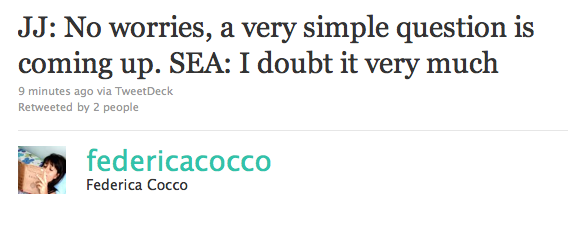
Julian’s lawyer begins the cross examination, questioning him if it was possible for DNA samples to be taken abroad. Alhem confirms his opinion that DNA sampling was a good reason for Julian to return to Sweden.
Finally after much grilling Alhem is discharged from the witness stand an a 10 minute break is called. Afterwards essential parts of this case will be made public (but not necessarily statements of various people).
[9:30am] Follow up from last night’s rally
Welcome back to day 2 of Julian Assange’s extradition case! Before the case starts in a little over an hour, we were able to clarify some of the information pertaining to events after the hearing yesterday. After day one of the extradition case, Julian Assange gave this statement:
For the past five-and-a-half months we have been in a condition where a black box has been applied to my life. On the outside of that black box has been written the word ‘rape’. That box is now, thanks to an open court process, been opened.I hope over the next day we will see that that box is in fact empty and has nothing to do with the words that are on the outside of it.We have seen that today and I would like to thank my supporters and my lawyers for continuing to help me.
Last night the support for WikiLeaks continued with a Defend WikiLeaks rally hosted by the Stop the War Coalition. Several prominent speakers gave passionate speeches on freedom of expression. In Tony Benn’s introduction to the rally (video), he stated “The demand for democracy is expressed all over the world…WikiLeaks is a very clear example of how that battle can be won.”
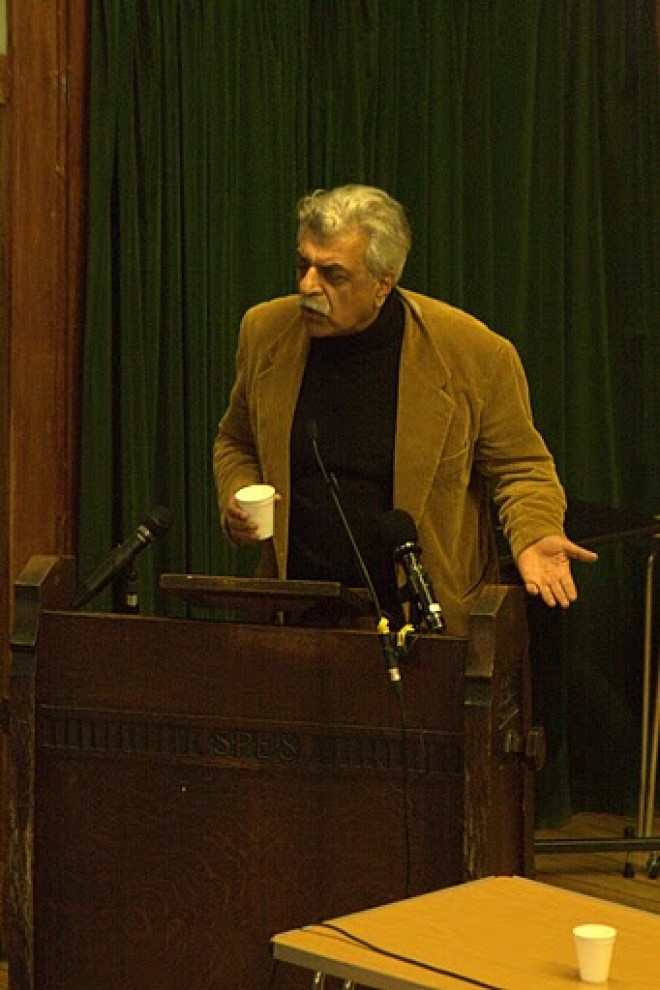
Tariq Ali: British Pakistani historian, novelist, filmmaker, political campaigner, and commentator.
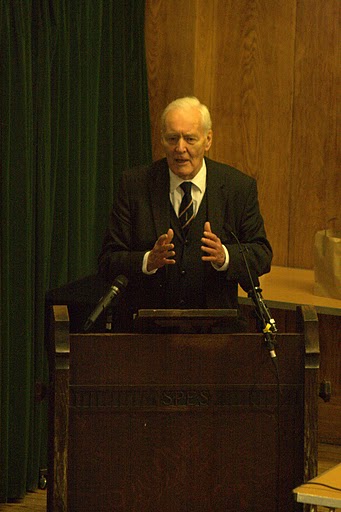
Tony Benn: Former Cabinet Minister and current President of Stop the War Coalition
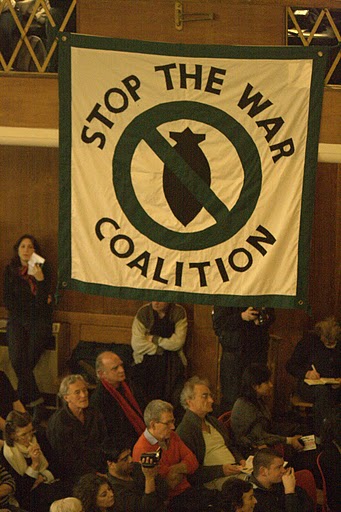
Supporters at Defend WikiLeaks rally
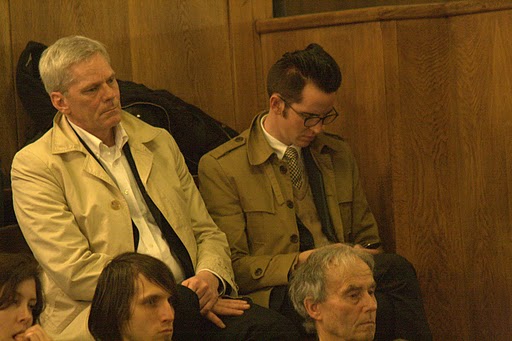
On the left is Kristin Hrafnsson, who is second in command at WikiLeaks.
Overall the rally was a success. WikiLeaks collaborators said they were happy about yesterday’s rally, as roughly 200 people showed up in support of the cause.
According to our correspondent in London, Assange is in court but the hearing will start either around 10:30 or 11am. Stay tuned as we keep you informed throughout the day.
Photo Source: Alex Norcliffe. All rights reserved.
[7:00pm] Day 1 of Julian Assange’s extradition case – A summary
During the preliminary case last month, we were left with the major points of Assange’s legal team. A major claim was the EAW was being misused, as the prosecution seemed to just want to interrogate Assange rather than try him. Clare Montgomery on the prosecution shot down these arguments, saying there was sufficient intent to bring Assange to trial and the use of the EAW was legal under Swedish law. Furthermore, she dismissed the notion that Assange could be extradited to the US.
The defense brought two witnesses to the case today. The first was Britta Sundberg-Weitman, a retired Swedish judge. She testified that this case was “extremely peculiar” as the women’s claims of sexual misconduct was not made in good faith. Montgomery counteracted by using certain technicalities between Swedish and EU law.
The second witness was Gorun Rudling, who had information to negate Ms. A’s story. He claimed the woman posted a revenge plan online and deleted twitter messages that showed contentment with her work at WikiLeaks.
Overall, this case will rest on the interpretation of the EAW. International law is complicated due to the intertwining of sovereign countries who have equal jurisdiction to their interpretation of legal matters. Will Sweden’s interpretation of international law stand up in the UK? Find out tomorrow during day 2 of Assange’s extradition case.
[6:33pm] Where are the protesters?
Since this morning, Assange’s fan club has not grown by much outside Belmarsh Court. There might have been more signs, but not a large number of supporters:
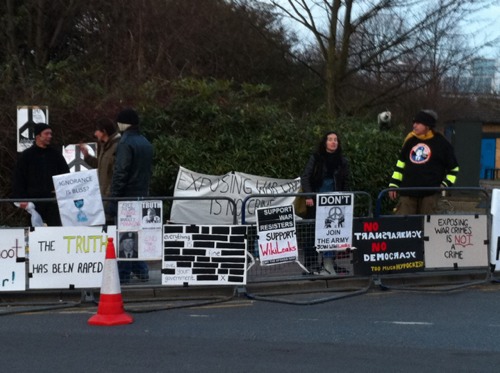
Maybe the typical Assange and WikiLeaks supporter prefers rallies to sitting outside a courthouse all day long. Tonight, the Stop the War Coalition is holding a “Defend WikiLeaks” rally in the UK at 7pm. Will more people show up for the cause?
There is no doubt Julien Assange is capable of gathering the crowds.
. Will tonight’s group show the same enthusiasm, or was Syndey’s success just a matter of a home game advantage?[5:51] Assange’s statement after day 1
As Julian Assange tries to give his statement, a woman shouts “No Justice No Peace!” and police intervene. Assange continues:
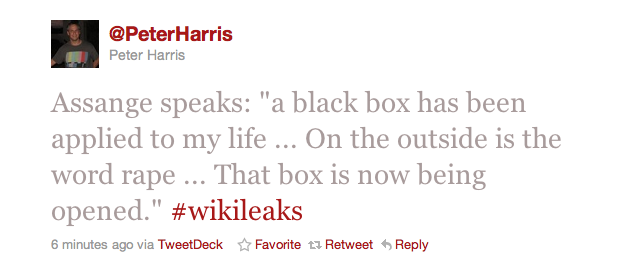 These are the brief words Assange gave the media, and then made his exit. The case will resume again tomorrow at 10am. In the meanwhile, Assange’s lawyers have released their full skeleton documents to the public.
[5:20] Cross examination
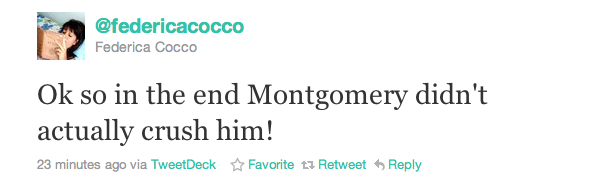 “What evidence have you seen on the prosecution exactly?” Montgomery asks as her first question. She then indicates that even though Rudling had read over 100 pages of evidence, it was not the police file but only the material that was sent to Assange. Furthermore, she inquires if Rudling knew why Ms. A had deleted those previous tweets. When Rudling didn’t know for sure, Montgomery clarified the tweets were deleted to prevent media attention and allow her to retain an anonymous status.
Rudling was discharged and the court is out of session for the rest of the day. Stay tuned for statements released after the court case along with extra commentary.
[5:01pm] Next witness: Gorun Rudling
“My native language is Swedish and if I dont understand the question, I’ll ask you again,” begins Gordling. “Are you a supporter of WIkielaks or Assange?” asks Sven-Erik Ahlem, one of Assange’s lawyers. ”No I am not, I think when you leak information you should be careful.”
Rudling goes on to recount how Ms A’s story was not completely accurate. Apparently he had contacted the police and notified them that Miss A had deleted tweets from her account which proved that she was happy with Assange’s company. She tweeted this after the 13th and 14th of August, the days around when the crime took place.
Addtionally, Ms. A had showed malicious intent by publishing a 7 steps to revenge manual. In it, she advised “remember what your goals are while you are operating, ensure that your victim will suffer the same way as he made you suffer.”
The rest of his written statement can be found online.
[4:10pm] Britta Sundberg-Weitman questioned again by Robertson
Roberston starts his reexamination by questioning Britta on whether she thought it was acceptable for Miss Ny to turn down Assange’s attempts to forge communication, which Britta confirmed it was not. Britta further added that instead while Ny was entitled to issue an EAW under Swedish law, she was not allowed to do this under European law.
[3:24pm] Montgomery’s cross examination
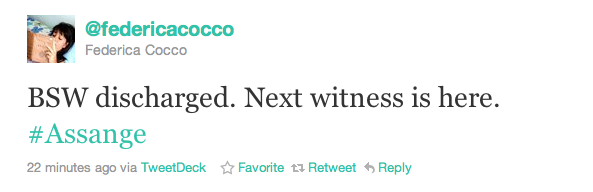
We are back after the lunch break for the continuation of the Assange case. Montgomery has just finished her cross examination, and the exchange could seriously undermine Britta Sundberg-Weitman previous testimony. Throughout the examination it appeared as though there were issues with translation as English is not Britta Sundberg-Weitman first language. In summary, it appears as though Britta Sundberg-Weitman may have conceded that Montogomery’s interpretation that Ms Nye could in fact issue a EAW may be correct under Swedish law. Additionally, Montgomery may have tried to prove that Hurtig knew and was given access to evidence despite the defence’s claim.
Below is our rough transcript of the events from our correspondent via Twitter:
Montogomery: Would you say you’re an expert in Swedish criminal law?
Britta Sundberg-Weitman: Well I have more than 30 years experience
Montgomery: What facts are your opinions based on?
Britta Sundberg-Weitman: Facts.
Montgomery: Is it just what you’ve been told by Assange’s legal team? Do you know for sure yourself what the prosecutor has done in prosecuting this case?
Britta Sundberg-Weitman: No I have followed from the beginning what the prosecutor has said in public.
Montgomery: Do you have any knowledge of Miss Ny’s communication between the prosecutor and Mr Hertig Before Assange left Sweden?
Britta Sundberg-Weitman: No
Montgomery: This is a hypothetical question. If as judge you were told the prosecutor had contacted the lawyer of the defendant, and the lawyer had said he couldn’t contact the suspect, would you have grounds to prosecute the case?
Brita Sundberg-Weitman: That’s a very hypothetical question indeed. That would be a case different from this one.
Montgomery: Only on the basis of what you’ve been told has happened. Ny only applied for a warrant because when she contacted Assange’s lawyer, she didn’t get a response.
Britta Sundberg-Weitman: I can’t know as a fact that Ms Ny refused to provide Assange and his lawyers with required information
Montgomery: Before a prosecutor can obtain a warrant for arrest, she has to go to the court. Ny went to the Stockholm district court. She also went to the Court of Appeal.
Britta Sundberg-Weitman: Ny took for granted that no change would happen. That’s disrespectful to the Court of Appeal.
Montgomery: The Svea court of appeal had determined that the issue was proportional.
Britta Sundberg-Weitman: There aren’t may jurists in Sweden interested in this legal principle. Most Swedish lawyers and judges believe the principle of proportionality is based on intuition. However that’s not correct.
Montgomery: Do you think that it was your duty to tell the Svea Court. court of appeal that that was your view?
Britta Sundberg-Weitman: But to me it’s obvious they were wrong.
Montgomery: Do you agree both the Svea court and the district court would have heard from Ms. Ny and Assange’s lawyer? Would the district court and the spare court of appeal heard from Assange’s lawyer? Was Mr. Hurtig at the Sveae court and the district court?
Britta Sundberg-Weitman: Ms. Ny was asked to explain herself before the Court of Appeal and was given 2 days.
Montgomery: Was Hurtig there or not?
Britta Sundberg-Weitman: I don’t think so, but I haven’t looked at that particular detail
Montgomery: Would the court have control over whether he was remanded or given bail?
Britta Sundberg-Weitman: we don’t have a bail system in Sweden. He would be either locked up or would have to report to police like he’s doing now
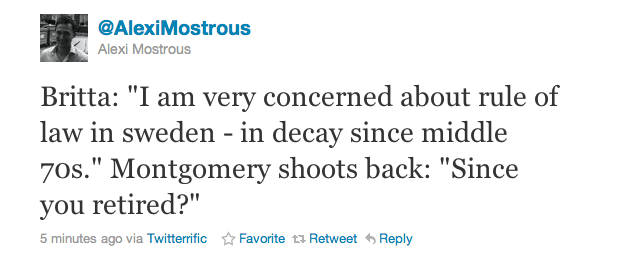
Montgomery: Does Sweden have an independent and impartial judiciary?
Britta Sundberg-Weitman: I’m afraid my answer is no
Montgomery: Is there a range views held by other experts that holds Sweden is capable of delivering impartial justice? Does Sweden accept the compulsory jurisdiction of the Strasbourg Court?
Britta Sundberg-Weitman: Yes
Montgomery: Another hypothetical question. If the decision to prosecute Assange had been made, Ms. Ny is entitled to issue an arrest warrant,isn’t she?
Britta Sundberg-Weitman: According to Swedish law she is
Montgomery: You think the framework directive says the right to issue a EAW in Sweden only arises once one has made the final decision to pursue custodian sentence? I suggest that there is no requirement for any particular point to have been reached in the formal procedures provided that the prosecutor has issued an arrest warrant:
Britta Sundberg-Weitman: You may be right
Montgomery: Do you agree that where the prosecutor as enough evidence he/she can pursue a prosecution?
Britta Sundberg-Weitman: Yes.
Montgomery: If there is enough evidence to warrant a conviction then it’s justified to prosecute?
Britta Sundberg-Weitman: yes
[1:55pm] The first witness: Britta Sundberg-Weitman
The first witness on behalf of Assange is Britta Sundberg-Weitman, who is a retired Swedish appeal judge. In 1981 she was promoted to the Court of Appeal, but retired in 2001 and has had an academic career ever since. The following is a rough transcript from Robertson’s examination:
Robertson: What is your view on the procedures concerning Assange case?
Britta Sundberg-Weitman: Extremely peculiar. My specialty is administrative law.
Robertson: What did you see in relation to the rule of law?
Brita Sundberg-Weitman: She was under an obligation to not confirm whether Assange was being investigated. This was a breach of confidentality, although she could not be punished because one has freedom of expression. It’s not a good thing but it doesn’t break Swedish law (He goes on to say that the reaction to Assange was hostile in Sweden, as most people take for granted that he has raped two women)… Ny in particular is “against men.”
Robertson: It would appear Miss Ny is in favour of locking up innocent men?
Britta Sundberg-Weitman: Well, I don’t think she’s like that…I honestly cannot understand her attitude against Assange. It looks malicious. It would’ve been so simple to have him heard whilst he was in Sweden. She could’ve agreed to hear him on the telephone, videolink. etc.
Robertson: Are prosecutors allowed to hear suspects on the phone?
Britta Sundberg-Weitman: Yes, it’s in the manual. It’s recommended. There is no special legal rule saying that video interviews can’t be done.
Robertson: Nothing discourages the use of telephone interviews.
Britta Sundberg-Weitman: Correct. She wants to get him to Sweden, no matter what he says. I think her intention is to have him arrested and maybe let him suffer for a bit so he can get softer.
Robertson: She asked for him to be detained incommunicado?
Britta Sundberg-Weitman: I’m surprised, It doesn’t say that in the decision.
Robertson: It’s in the decision by the district court. Is that normal?
Britta Sundberg-Weitman: Yes, it’s normal. He can’t be given a chance to influence the witnesses.
Robertson: What about mutual legal assistance?
Britta Sundberg-Weitman: Yes that’s a possibility, there’s a special manual on that. When the suspect is abroad, mutual legal assistance is possible. It’s regulated by a convention and it’s encouraged.
Robertson: There’s a rule that the preliminary investigation should be conducted as expeditiously as possible, is that correct?
Britta Sundberg-Weitman: Ah yes, that’s a very important part of the procedure. Very often it’s not respected at all and nothing happens.
Robertson: Is it important in Sweden for prosecutors to ask the suspect if he wants any evidence or withnesses examined? Is it necessary for the suspect to be shown all evidence against him?
Britta Sundberg-Weitman: YES, once they decide to prosecute.I think before they decide to prosecute they need to show all evidence to the suspect.
Robertson: Was the decision to issue an arrest warrant a breach in the principle of proportionality?
Britta Sundberg-Weitman: Yes. An authority must never use more harsh means than what is necessary for his/her objective to be pursued. This principle has not been respected at all. I dont think you can do more harm to a person than has been done in this case. He is known as a rapist worldwide!
Robertson: EAW involves him going to Sweden, being held incommunicado and given a secret trial.
Britta Sundberg-Weitman: Yes
Robertson: Do you think this has become a political issue in Sweden?
Britta Sundberg-Weitman: Very much so, very much so.
Robertson: Mr. Bergstrom’s attacks on Mr Assange have been widely reported.
Britta Sundberg-Weitman: Yes
[12:56] The European Arrest Warrant: who can issue it and for what purposes?
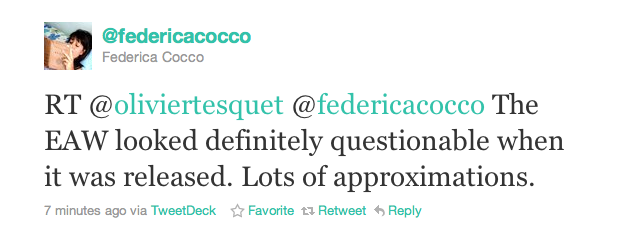 Much of the defense’s case rests on the the misuse of the European Arrest Warrent. On 20th of August, in the middle of Assange’s interrogation, the prosecutor in Stockholm leaked that Assange was being investigated. The press contacted the complainant and she confirmed, which is illegal under Swedish law.
After the case was dropped, Ms Ny decided to reappoint herself to the investigation. On September 14th, a representative of Assange inquired whether Ms Nye would pursue the case, and she let time pass before notifying Assange that he had to be interrogated again. When asked whether Assange could be interviewed via skype or when they tried to make an appointment with Ms. Nye, she brushed off the suggestions. According to the defense, Assange was prepared for 5 weeks to be interrogated and Ms Ny did not follow up .
Ms. Ny said she was authorised to pursue a EAW, and called herself the “director of public prosecution.” Assange’s lawyer has questioned whether Marianne Ny was entitled to issue EAW, as arrest warrants need to be issued by an authorised official and not a private citizen. He also goes on to affirm that the EAW warrant was issued just for questioning, not for actual charges brought against Assange. Roberston explains, “At this stage, Ms Ny could herself be removed by the prosecution general. So we’re not at a stage where they’re irrevocably committed to prosecution. How can they say its prosecuting warrant when Assange has been interrogated without charges?”
The court has taken a 15 minute break, and later the defense has two witnesses which will testify.
[12:30] What is considered rape? UK vs Sweden
According to the defense, “None of these charges allege that Assange reasonably believed the woman did not consent.” What is interesting about this statement is that Robertson used the legal term charges instead of allegations. Does this indicate that Assange’s legal team recognizes Mongomery’s previous argument?
Robertson continues, “The prosecution describes the charge as a ‘minor offence’. That is a contradiction in terms. Rape in the UK is not a minor offence and minimum sentence is 5 years. Either the allegations are that there was enforcement of intercourse, or lack of consent, or both.” Thus, Robertson summarizes that what is considered “minor rape” under Swedish law does not amount to rape in any other country.
Roberston says that in the course of the evening, there were “no less than three acts of consensual sex.” In the forth and controversial instance when she thinks he’s not wearing a condom, she lets him continue and afterwords they joked about it (although there is dissonance whether it was both of them or just Assange making light of the situation).
[12:06pm] Part II: Is extradition to the US a real possibility?
Montgomery continues here prosecution, stating “It is impossible to argue that a fair trial would not take place in Sweden, The country is a signatory to Human Rights convention. In terms of the alleged threat of extradition to the US, These claims depend on a factual hypothesis…which is unsubstantial. Not based on any factual event. Also, in the case in which extradition to the US is requested, UK could intervene.” In short, Montgomery shoots down the defense’s argument, claiming that the possibility of extradition to the US is merely rhetoric to raise support for their own side.
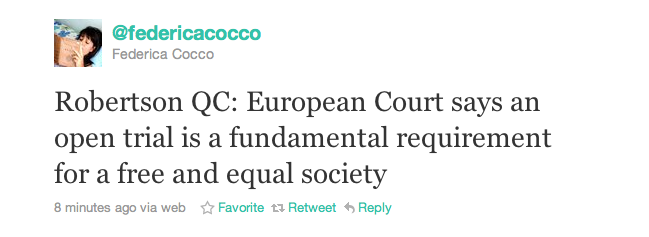
Robertson on Assange’s defense team has now spoken, claiming that if the case was brought to Sweden it would be impossible to have a fair trial due to the court’s policy of keeping the media out of the courtroom. ”You cannot have a fair trial if the press and public are excluded from court. That’s what would happen in Sweden.” He goes on to affirm, “Because of the danger of prejudice in this particular case it is even more important that the trial be completely open.” Robertson mentions as well that The Sweden has had a poor record concerning its treatment of detained foreigners, and has been criticized by the European convention.
[11:37] Assange just extradited for questioning?
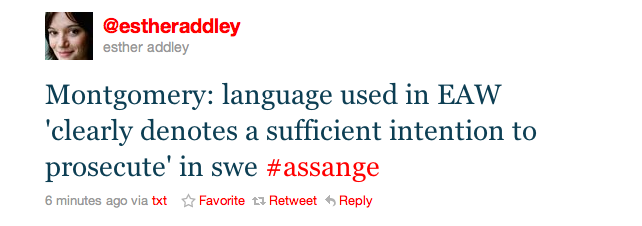
“Definition of rape in Sweden is the deliberate violation of a woman’s sexual integrity by penetration,” says Clare Montgomery. ”In the case of Miss W, Mr Assange had sexual intercourse with her and exploited the fact that she was asleep.” She goes on to say that Assange was fully aware of the fact that Ms W would only consented to have sex with him if it was protected. Apparently, these are offenses under English law as well. This brings in the question if he should be prosecuted in the UK, or extradited to Sweden.
There was also the previous point brought by the defense that the prosecution did not actually bring up any charges, but rather wanted to bring him in just for question. If this were the case, then it would be an abuse of the European Arrest Warrent. Montgomery clarifies her position, stating “This particular arrest warrant undoubtedly meets all requirements of the European framework directives,” as there is an intention for prosecution (In fact, Miss Nye told Assange she would make an application for an arrest warrant on the day Mr Assange left). According to legal procedure, there is first be an interrogation following extradition. “The court cannot assume his presence is only required for questioning,” says Montgomery, meaning that there is a strong intent to try him in Sweden for sexual assault. It appears that out of Assanges 7 points, number 2 has just been overturned.
[11:15am] Case begins
Everyone appears to be in their places, and it has been reported that Assange appears relaxed in the courtroom. Judge Howard Riddle has just confirmed Assange’s name and address, thus officially starting the hearing.Apparently the case is being recorded, which is unusual. Perhaps it is a precautionary measure given how the justice system has tripped over itself concerning this case in the past?
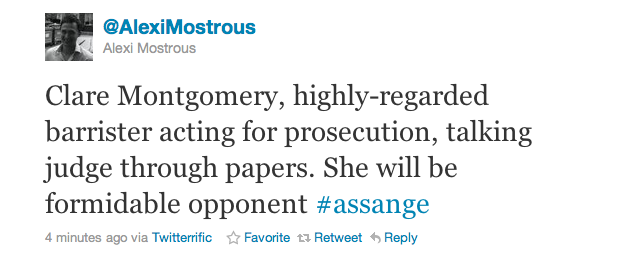
Baroness Helena Kennedy will be defending Assange today, while Clare Montgomery is representing the prosecution. While the skeleton arguments have already named both women (who were entitled to remain anonymous under Swedish law), the case hearing will continue to refer to them by Miss A and Miss B.
 The case proceeds as Miss A accuses Assange of three sexual assault charges. Miss B adds that she is accusing him of rape.
[10:47am] The media circus
With the outbreak of WikiLeaks and the following aftermath, it is difficult to relate this personal court hearing outside this context. For any other person, just type of sexual misconduct hearing wouldn’t even move the media. But it is clear that the hype is not about what he may or may have not done, but rather it’s about who he is as a celebrity.
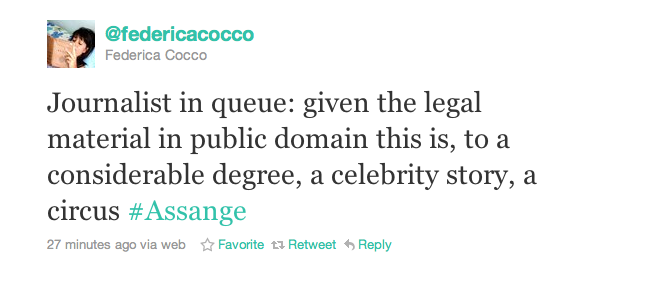
So the media is gathered around the court, along with fashion designer Bella Freud. Given that the actual events of the case are deeply embedded in the wikileaks scandal can the courts and public remain objective? To say that the verdict will be interesting is an understatement.
[10:14] The calm before the storm
The doors have not opened quite yet, but the cue is already long and waiting with anticipation. During the last preliminary hearings, there were a few protesters but nothing too over the top. Will there be more of a scene in the actual case over the next two days? Some protesters have already started to gather, with a couple dressed as Guantanamo detainees for an added dramatic effect. Apparently though the rest are sleeping in this morning….
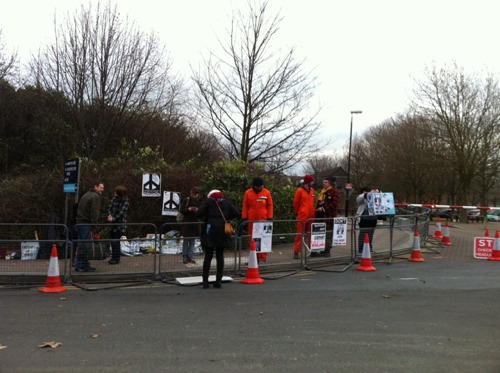 It appear as though Assange has just shown up to the Belmarsh Court, so this show should begin soon….
[9:42am] Is extradition to the US a real possibility?
According to Assange and his legal team, they believe there is a possibility of being extradited to the US if Sweden wins this case. Is this a real possibility? For most European nations, it is illegal to extradite people to countries where the death penalty is an option. But will this hold up under the pretext of “terrorism?” According to OwniEU’s @federicacocco “Britain and the U.S. signed a fast-track extradition treaty in 2003 intended to speed the transfer of terror suspects. Since it came into force in April 2007, 23 people have been extradited from the U.K. to the U.S.” Sweden as well has also extradited people to the US as well.
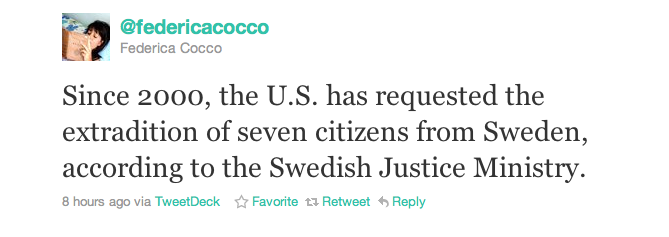 So despite the European norms concerning extradition in possible death penalty cases, it remains unclear if Assange could be forced into the US.
[8:15am] What about WikiLeaks?
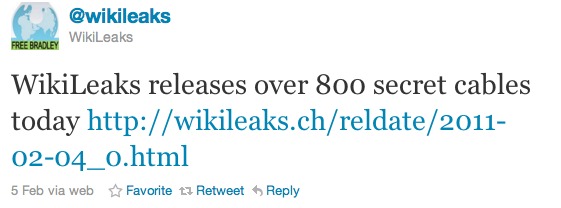
Throughout Assange’s extradition case, he made clear that WikiLeaks would continue to publish diplomatic cables. This last Saterday, the whistleblowing site released over 800 secret diplomatic cables. Did the timing of this dump have anything to do with Assange’s case today? Probably, as it seems impossible to separate the rape case and Assange’s work.
The Guardian also reviewed the aftermath of the diplomatic cables around the world, and how it has affected the international community.
US embassy cables: WikiLeaks and the month that shook diplomacy – video
[8:00am] ” We here at WikiLeaks recognize the difference between secrecy and privacy”
Last year in August, Assange was on top of the world. He had defied the world’s superpower with the Afghan War diaries, which would soon be followed by the world’s largest military and diplomatic leaks in history. He was a superstar in Sweden, and was in the process of giving interviews and applying for a residence permit. Now, he is doing everything he can to prevent returning to this country.
During last summer’s visit he had sexual relations with two women, known as Miss A and Miss W. Both of these women claim they were raped; one attests she was asleep during the encounter and while the other women says Assange intentionally ripped the condom. Both of these women are seeking to have Assange brought back to Sweden from the UK, leading to a scandal that has affected the credibility of both WikiLeaks and its editor.
The spotlight was back on Assange, but now with a notorious glare. He was brought into custody by the UK police, and on January 11th he had his preliminary court hearing. Assange’s lawyers released their skeleton arguments against extradition, which according to the Associated Press include “he has not been charged with a crime, because of flaws in Swedish prosecutors’ case – and because a ticket to Sweden could land him in Guantanamo Bay or on U.S. death row.” The prosecution has not yet released their arguments to the public.
While the scandal has outraged feminist organizations and insists that Assange be brought to justice, Assange equally insists that the entire case is a politically stunt. A few days ago he released a video for supporters, asserting his right to keep governments accountable without persecution. “We believe in transparent power, not in transparent people,” he says.
💬 Discussion
No comments yet. Be the first to comment!