Last Friday’s event at De Balie, The Populist Front, was useful to clear up some ideas – or renew some doubts – about art and politics, which had been on my mind since early 2009, when I went to Berlin to visit a group exhibition titled Political/Minimal. That show featured top-notch contemporary artists tackling political or social issues by using minimal forms. At the time my conclusion was that the more art tries to be beautiful, curling up in self-referential white cube aesthetics, the more it gets far from politics, which require a more compromising language, like that of mass media.
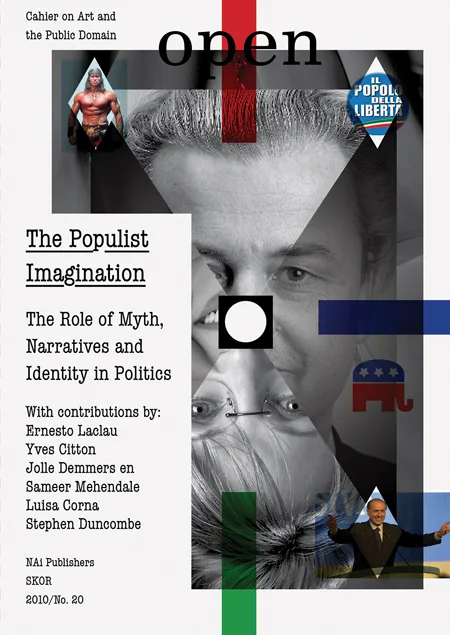
If art itself wasn’t at the core of the conference in Amsterdam – which followed the publication of Open20: The Populist Imagination (reviewed here) – artist talks were the culmination of an exhausting 8 hour ride into theoretical territories, refreshed by occasional images. While all the speakers presented compelling arguments and examples, giving a perfect introduction to the essays in the volume, I have to admit I was expecting more visual relief, given the conference format.

The first session of the day was particularly thick with concepts. After an introduction by Marijn Oudenampsen, Rudi Laermans went into detail with a conceptual synthesis of populism. The main focus was the “populist triangle”, a diagram of populist rhetorics where an Elite/Establishment is on top, opposed by the People and the Leader, together at the bottom.
Oliver Marchart followed, presenting an interesting distinction between populist and democratic demonstrations, mentioning Euro MayDay, the Zapatistas and the LGBTQ movement. According to the political theorist, populism – which he calls a strategy – is marked by the attempt to establish a chain of equivalence across social groups, while self-questioning is a democratic twist that only some groups embrace. Sarah Farris closed the panel by analyzing the appropriation and simplification of women rights issues as a strategy of right-wing parties to oppose Islamic immigration.
The second panel dealt more with aesthetics. First John Kraniauskas discussed how Eva Peròn and her melodramatic image mediated between her husband and the working class, then art critic Sven Lütticken described how Dutch art is used as a political instrument by conservative groups, either claiming realism as a nationalist value or deeming art itself a left-wing hobby. According to Lütticken, the only solution to this “art VS culture” clash is for artists to search for autonomy. Aukje van Rooden’s presentation closed the first part of the panel explaining how, in modern politics, the proverbial Emperor is always naked, and contemporary leaderships are sustained by a precarious balance between belief and disbelief.

The concluding two hours were dedicated to practitioners, namely media artist Steve Lambert – via Skype – and Russian art collective Chto Delat?, already known to the Amsterdam public because of their recent show at SMART Project Space.
Lambert began by explaining some of his “utopian projects”, like the release of a fake edition of the New York Times, featuring fictional good news only, or impossible projects for San Francisco streetcars. As the artist also explains in Open 20, in some cases utopian visions such as those spread by populist rhetorics can help people imagine new and progressive directions for society.
Chto Delat?’s relation to populism is a different one, more related to the simplification and the othering process described by Laermans and Farris in the first panel. After screening their last video, The Museum Songspiel, founding members Dmitry Vilensky and Olga Egorova engaged in a heated Q&A with the audience.
The piece is a sort of Brechtian theatrical satire on the role of art in society, where a group of immigrants escaping deportation seek asylum in a museum. They are at first incorporated into a performance by a good-willing artist, but after the piece becomes a success they are eventually arrested. Having themselves announced a workshop in collaboration with real deportees for their show at SMART, the group’s satire felt pretty self-ironic. When asked if they really believe in the power of art, the artists replied that art, like everything, is full of contradictions and that community projects, especially with a limited time, do not really work (a position shared by other politically-active artists like Martha Rosler). Art does need funding from the state, but – if necessary – the autonomy mentioned by Sven Lütticken is the only, unlikely alternative. In this context the role of the artist is that of a self-taught educator, printing magazines and organizing workshops and screenings, like the Russian collective.
Showing a socially-oriented approach to art-making, groups like Chto Delat? claim the public sphere with the linguistic power artists are known for. Influenced by theater and popular demonstrations, their work is rooted in mass communication, be it storytelling or adbusting. Their art is structurally political.
Other artists are political in a much different way. Without going as far as the Political/Minimal show in Berlin, I will take the example of Mika Rottenberg’s solo show currently at De Appel. Her video art pieces depict women’s bodies as creepy production machines, in a visually mysterious Marxist critique of female exploitation. While Rottenberg’s sophisticated visual language may be too obscure for a mass audience and thus confined to the art circuit, the artist, as a member of the Infinite Foundation, tries to reinvest art revenue in socially-oriented community centers around the world.
On one hand we have art as a linguistic filter for political ideas, working as a medium and often adopting the compromising language of irony, on the other a more introverted and self-referential practice finding a political outlet by recycling income in socially-productive enterprises. One position can be criticized for taking part in the same art system it satirizes, the other for remaining in its comfort zone while lending a patronizing hand to the unfortunate.
The age-old, dadaist lesson of art tending towards life has been learnt, but the conflict now seems twofold. On the inside, an aesthetic dilemma between communication and beauty. On the outside, an economic struggle for survival.
—
Photo credits: Flickr CC TACHAS and x-ray delta one
💬 Discussion
No comments yet. Be the first to comment!