
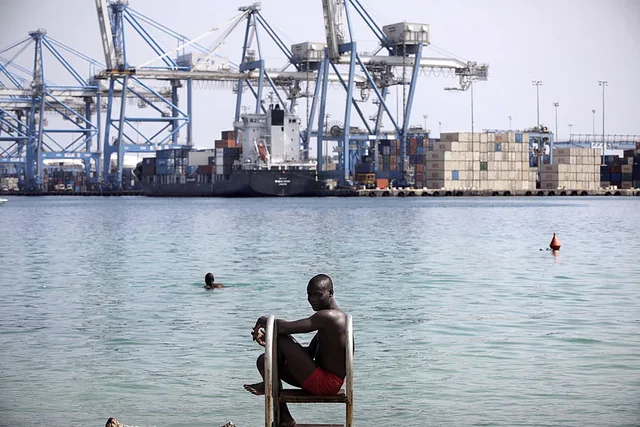
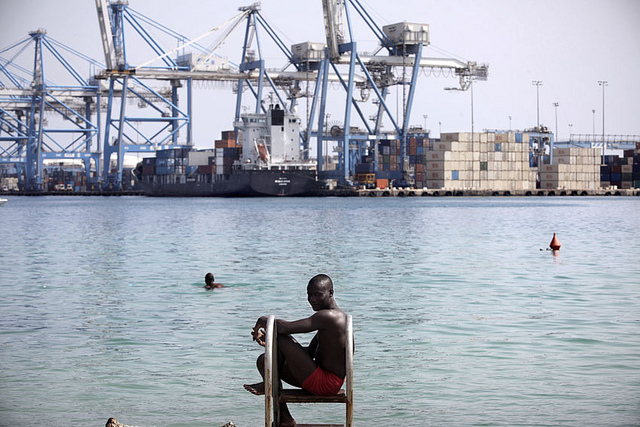
Walking along the Marsa industrial harbour, the open centre lies grey in the dazzling March sun which tends to elicit subliminal smells of a nearby river. A bunch of young African men are sitting around some improvised benches across the entrance door. They do not hide their glares when reporters pass by them to enter their grounds – a former school building rebuilt to house African migrants.
European visitors appear to be rare, even though a wave of international journalists conquered this small island nation in the Mediterranean over the last weeks due to its literally close ties to Gaddafi’s Libya. CNN, BBC – the whole international community has been watching how thousands of Americans, British and Chinese were being temporarily evacuated from Tripoli and Benghazi to Malta.
It is also here where African refugees come first to escape the dangers of their countries of origin, mostly Somalia, but also Eritrea, Sudan and Nigeria. Their stay, however, in most cases is permanent.
Ahmed Bugri, Director of the Foundation for Shelter and Support to Migrants (FSM) says:
You have to understand that we are responsible for the emergency arrivals of the bigger numbers of refugees in the past years.
It is a “men only” centre, he explains, with an average age of 24 years – “so they are young and very active”. Due to the “dangerous sea crossing”, in Malta there are only “very few women and children” who are then put in the other open centre in Hal Far, separated from the single men.
The refugee camps in Malta are a joint venture of outside organizations and the government, which ultimately pulls the strings. Bugri’s NGO is running the open centre in Marsa under the supervision of the Maltese Ministry of Foreign Affairs which finances the project. His smile is big and forthcoming. It seems to say ‘journalists are welcome, we have nothing to hide’. Still, he has to contact “the big boss” in order to let the press take a look around.
This is how far I can go to do you a favour. I have no problem in you interviewing anyone and seeing the conditions as long as the Press Secretary of the Ministry involved is saying ‘go ahead’.
Everyone, including Bugri and the Maltese authorities, know that they do not hold a place of shiny white knights rescuing poor Africans – far from that. Money is an issue, as well as racism outside these walls. Bugri friendly gives two reasons bricked behind the failure of Africans getting a job, and finding a life, in Malta:
One, Malta has a very seasonal job market, so especially in the winter these men do not get jobs. This means they are forced to stay here because they cannot pay the rent any longer. So, for people to be safe,” he rests on that word, “people tend to stay here. Secondly, repatriation is an extremely difficult job as well as relocation in itself is a very slow process.
After “the big boss” has given his ‘ok’, Bugri shows us around. In a dimmed room at the very end of the enclosure, groups of men play cards, billiard or just sit on a 70’s couch starring at the TV box. Burgri refers to the “biggest common place” as the “Sudanese restaurant”.
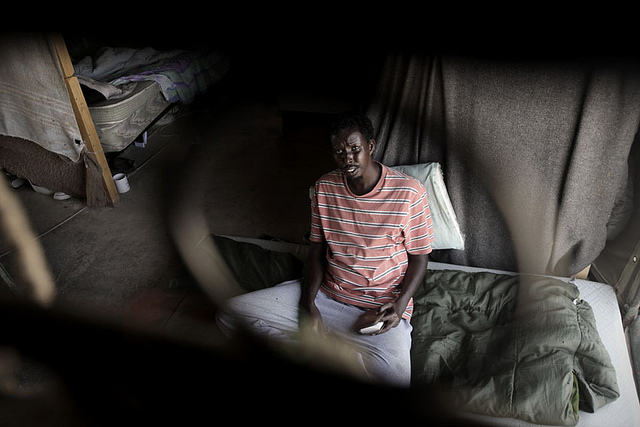
“This is our life”, says open centre resident Mohammed Hassan matter-of-factly while showing his room. It is more a mattress and a locker reduced to his personal space amidst 35 other bunk beds, and three disgusting toilets in which excrements still swim atop. The 28-year-old Somali left a message on his locker when he was thinking about his girlfriend in Mogadishu: ‘I love you, I miss you’ written in black ink. He knows he won’t be able to tell her this in person, not as long as the civil war continues. However, every resident gets half an hour per week on the computers downstairs in the Information and Education building to get in contact with their families abroad, and the world.
If the situation got better tomorrow and they had the choice and money, they would go back immediately, says his friend 29-year-old Eude Mohammed Eyalan who also comes from Somalia. They both arrived in Malta in 2006 after some desperate journey across Ethiopia, Sudan, to Libya’s coast before “waiting a year and paying some money” to spend three days on a boat with 27 other refugees. Since then they have been in Malta’s prison for another year, and got released into “freedom”, which for now has been the open centre.
“White in, black out” is how they perceive the principal behind migration. However, they add: “We do understand that there is no space for so many Africans. Malta is small.” When asked about their dreams before coming to Europe, they laugh bitterly. “We came here to change our lives”, they say.
We thought Europe is better than Africa but we haven’t improved our lives as we lived it in Somalia.
Also Liban Mohammad Ahmad expresses the same disappointment in Europe. The 27-year-old Somali is eager to talk in the bus 113 from Valetta via Marsa to his destination Hal Far, the second open centre which is often referred to as “tent village”. “That night the police caught me here in Malta I will never forget,” Ahmad tells while his friends in the overcrowded bus are listening. It is one of the rusty-old Maltese buses in yellow and orange colours in which the sign ‘Love is God is Love’ hangs next to Madonna figures. He tries to speak louder than the roaring engine:
We were on the seashore and tried to look for a resort place. People saw us and called the police. We asked them where we are. They said ‘Malta’. We asked, ‘Is this part of Europe?’ And they said ‘Yes’, and we were relaxed and ready to rest. They promised they would help us – but their help was jail.

According to Maltese law, detention is automatic and mandatory for all irregular migrants, including asylum-seekers. So, before they are released into an open centre like the one in Marsa or Hal Far, refugees have to be kept behind bars for a maximum of one year.
“The time we spent here in Malta so far was for being in jail and having a rough life,” Ahmad sums up.
Trust me, no one can live like that. No one was sitting back home imagining life in Europe like this. There is no good water to drink, no good food, no good life, no education – not for us. Everyone is suffering now.
Ahmad’s escape trip to Europe is similar to the ones told by the residents of the open centre in Marsa:
The situation at home was at its worst when I left Mogadishu in 2007. I was crossing Djibouti, Eritrea, and Sudan to Libya – and then I took a small, rough boat to Malta. I had to cross the desert first. It was so hot at that time. Maybe hundreds of people were lying in the sand waiting to die. There was no water, no food. Some of us were also beaten by soldiers.
First crossing countries, taking a boat, being put into jail in Malta, then being released into the open centre – this is the procedure. The final step into having a life in Europe is still pending for most of them.
I have four starving children and a wife in Somalia, but I cannot help them because I can’t even provide for myself here. I left them in a troubled area, promised them to get help in Europe. Everybody at home was talking about Scandinavia. My dream was to go to Norway.
However, “You can’t get out of the camp!” Ahmed says. “Once you escaped to another European country, and you tell them that you are from Malta where it is very hard to get a life, the authorities still say that you are Malta’s responsibility and then they send you back.” This was exactly what happened to Ahmed. He crossed the borders to Holland, stayed there for one year and a half before moving further north to Norway. In Oslo, the police caught him, and sent him back to Malta three weeks ago. This gives a vivid portrayal of the Dublin Regulation, a European law saying that illegal immigrants, when picked up by authorities on their onward journey into the continent, are always sent back to the land on which they first set foot on.
We do not feel welcome yet in the European Union,” Ahmed concludes for his friends who cannot speak English well enough to express themselves. “All we felt was jail so far and hard work for little money, so that you cannot live from it.”

Director Bugri knows the issues. He has heard all the stories, and still can only do so much. On top of the law which ties these refugees to Malta’s highly skilled labour market, the open centres are overcrowded, and characterized by poor hygiene and inadequate health care. This is no secret and well reported. Still, the authorities – Maltese and European alike – have not significantly improved the conditions. Asked whether there are preparations for a possible refugee wave from Libya, Burgi says that there are plans to half the mosque by pulling up a wall to create more space for another set of narrow bunk beds. He replies:
It is a concern as we’ve already reached our maximum capacity of 600 people – an overflow. Having more people will be a problem. But if they come, you can’t stop them.
💬 Discussion
No comments yet. Be the first to comment!