
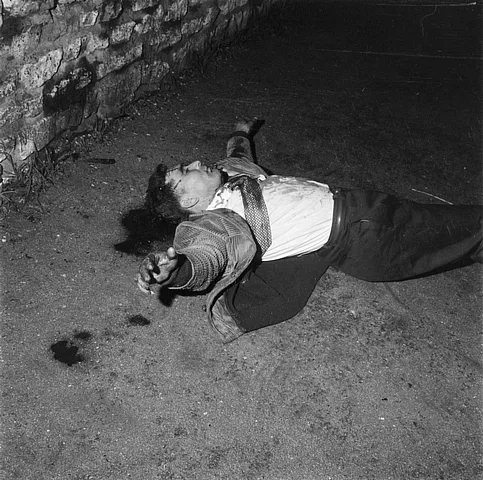
October 17, 1961/ Photo copyright Elie Kagan/BDIC
The events that preceded the demonstration of October 17 and the roundup of nearly 12,000 Algerians form a taboo chapter in the history of France. Yet the archive of documents published by OWNI leave no doubt about the police violence which occurred in the country, shrouded in silence by the Prefect Maurice Papon, .
From September 1958, the Fédération de France du Front de libération nationale (FLN), the armed wing of the Algerian liberation movement operating on the French mainland, claimed responsibility for several deadly attacks against their opponents the Mouvement national algérien (MNA). Papon decided to declare war against the FLN.
The temperature rises
The year of 1961 represented a turning point: the number of police victims of FLN attacks had increased threefold. The tone had hardened between supporters of the FLN and the Prefect. The war the group were fighting had extended to all French citizens of Algeria. The Algerian community, living mainly in the slums of Paris and its surroundings, became the target of the police.
The account of Gérard Monate, deputy to François Rouve, secretary general of the General Police Union (SGP), thus explains:
The police have developed a sense of being abandoned by the justice system and political authorities. The idea to sort the problem out themselves took hold in their mindset and led them to dramatic abuses, especially given that the senior and mid-level hierarchy did nothing to diffuse the atmosphere, quite the opposite in fact. [...] So we saw it start and get worse: racketeering, any money found on an Algerian was “confiscated”; the beatings during all the arrests; [...] mindless harassment: for example, the emptying of latrines onto the floor of the arrested Algerian workers (cells).
Here is his full account:
Others are “simple” accounts, like that of public representative Pierre Hénault who sent a letter to Maurice Papon on September 14, 1961. In it he denounced acts of violence during an identity check.
In the above letter, Pierre Hénault says:
[...] agents were conducting a search of Muslims looking for possible weapons, which I find absolutely normal. However, what is much less (normal) is the manner in which it was carried out. Notably an officer who, after conducting the search, violently struck an Arab, who had not otherwise resisted, while the crowd signalled its disapproval of him (the officer).
Maurice Papon forwarded the letter to his services. The case was closed on November 3, 1961, as evidenced by the response of the director general of the municipal police, who did not consider it useful to conduct a hearing with the officers who had been present:
As the complainant does not specify whether he was a witness, it is first of all possible to doubt the veracity (of the account), and secondly to surmise it has been reported to him by a third party who does not have the best feelings towards the police.
In a tense climate, the imperative to ensure that the troops continued to “faire le tri” (“sort things out”) within the French Muslim population meant that a clear guideline was in place: support the troops no matter what they do.
Papon adds fuel to the fire
At this point Maurice Papon, guarantor of public order and urban security, could have acted to calm the gathering storm. Instead, memos exchanged between different key figures of the time indicate that he was in favor of a battle between the police and members of the FLN, or French Muslims in general.
On September 22, 1961 he addressed his lieutenants and officers:
I ordered your superiors and managers to strongly take back the offensive in every area by harassing political and administrative organizations and terrorists of the rebellion. [...] Furthermore, I decided that action be taken to put out of harms way the suspects, the layabouts, the pimps and the bosses of the débits-hôtels. [...] Let me express to you know now my satisfaction with the results achieved.
It shows an absolute opposition to cooperation that’s difficult to believe, coming as it did three months after the opening of a dialogue between the Provisional Government of the Algerian Republic (GPRA) and the French government.
For his part, Gérard Monate’s conclusion is clear:
There was a constant silence which for us was akin to complicity [...]. Maurice Papon’s speech came at this dramatic moment, during the funeral of one of our comrades killed in action in September, (where he said) – “for every blow received we will give back ten.”
A flurry of complaints
French Muslims from Algeria – more often referred to as FMA by the police – had been persecuted by the police well before the curfew established for all Algerians by Maurice Papon. In amongst all the complaints appeared one, filed in June 1961. Two men had accused the police, in great detail, of trying to kill them by pouring gasoline over them, while a third man had been beaten up. All three were aged about 30.
But right from the outset, the remarks of the officer responsible for receiving complaints exonerated the officers:
Reason does not allow us to countenance that French police officers in uniform could have been involved in such acts on a public street.
Berkani Ramdane was another who filed a complaint of assault and battery following police violence on September 18 and October 18.
Maurice Papon’s only response was to declare the curfew mandatory for French Muslims on October 5.
In response, they called for a peaceful demonstration on October 17, 1961.
Photo Credit: Elie Kagan, with permission from the Bibliothèque de Documentation internationale contemporaine, copyright Elie Kagan/BDIC
Illustrations: Loguy for Owni /-)
💬 Discussion
No comments yet. Be the first to comment!