
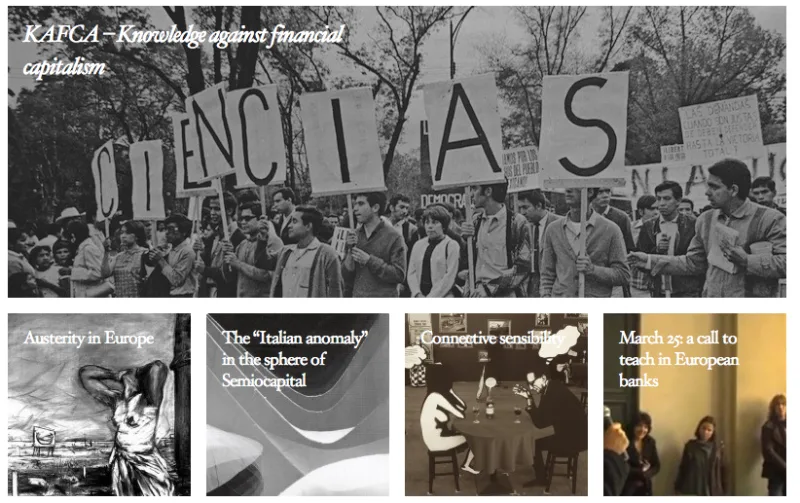
When it comes to imagination and its social implications, both empowering and dangerous, few are as experienced as Franco “Bifo” Berardi. As a media activist, the Italian philosopher and agitator was among the founders of both the legendary Radio Alice, in 1970s Bologna, and Orfeo TV, the first street TV experiment in Italy. As a prominent theorist associated with Italian “operaismo”, Bifo is one of the main references in the international debate on semiocapitalism and precarious knowledge workers (also known as the “cognitariat”).
Despite his status of international intellectual (and in part because of it), Bifo is a precarious worker himself. Like many other teachers, he found himself caught in the infamous and much discussed reform of Italian universities, putting public knowledge institutions through a deep crisis. As a response, he publicly endorsed and participated in the “teach-in” demonstrations that the Knowledge Liberation Front organized in banks across Europe on the last March 25-26.
In order to create an imaginative yet institutional alternative to the decaying university structure – and diffuse a healthy and visionary skepticism about the current situation and the future – Bifo and other European thinkers are now working on something called the European School of Social Imagination (SCEPSI). What the school will exactly be is not clear yet, but they have a location (the small and mountainous state of San Marino) and a website (scepsi.eu, both in Italian and English). The former will host a conference about the project on May 21, the latter features several texts dealing with subjects that range from the demonstrations mentioned above to the state of Italian Theory.
In order to get more information we reached Berardi via e-mail. He was kind enough to answer a few questions.
OWNI: Insurrection and demonstrations are very active actions, but the most common reaction to them is to criticize the absence of an alternative vision to the current system. For this reason, the idea of a “school of imagination” sounds very urgent. But how are you going to teach imagination?
Franco Bifo Berardi: We cannot teach imagination, of course. We can try to re-activate imagination. This is why I think that art and therapy are the crucial tools of change at the present.
OWNI: In a text published on Rekombinant.org, you theorized the “image-dispositif” as a tool to generate progressive action in the collective imaginary from within. Is this going to be one of the activities of the school or is it going to focus on more discursive practices?
FBB: The School will be acting on a level of concept-creation and elaboration. But, in my opinion, creating concepts is not only a discursive practice as you say. Concepts are tools, as stated by Deleuze and Guattari; tools for building the architecture of daily life. But you cannot act conceptually if you don’t act simultaneously at the level of communicational dispositifs. Art, Poetry, Critical Thought, and scientific imagination have never been so close in the common effort to build a new bridge on the abyss of the non-being of Sense. We are falling in this abyss because the bridge of friendship has been destroyed, by thirty years of Neoliberal capitalism and financial dictatorship.
OWNI: The launch of SCEPSI follows a series of teach-in demonstrations, where knowledge workers have been called to gather in banks and discuss. Is the school going to work as a series of teach-ins or will it have its own place with scheduled lectures? Is it going to be more of a forum?
FBB: What SCEPSI will be is the topic of the Conference of May 21st. As far as I know, during 2012 we want to organize four seminars: two in San Marino, one in London, and one in Helsinki. The format of the seminars will mix research, lecturing, and media practices together.
OWNI: How is the school going to support itself financially?
FBB: The friends who host the Conference have found the funding to start. In the future, our activity will be hosted and financed by European institutions (art museums, universities) who have already declared their intention to support the project.

OWNI: Every school needs teachers. Who is going to teach? What disciplines or courses will there be?
FBB: Our teachers will be people like Iritt Rogoff, director of the Visual Culture Institute of the Goldsmith Academy, Akseli Virtanen, writer and economist from Helsinki, Christian Marazzi, Author of Language and Capital, and many other thinkers who, during the years, have been able to mix social action and knowledge.
OWNI: The choice of San Marino seems quite significant. Can you explain how the project came to be, and why is it happening there?
FBB: San Marino is a wonderful metaphor. It’s a place of people who have always been free, pirates and smugglers. This is what we need in the field of knowledge: smugglers and pirates. They will save the legacy of the social civilization and will hand it down to the future generations. Incidentally, San Marino is not part of the European Union, although they smuggle euro-money. San Marino is the stronghold, the metaphoric abroad of everywhere, the no-homeland.
OWNI: As a Europe-oriented initiative, how and with whom is the school going to network across the continent? Are you going to involve people from other continents as well, maybe in the future?
FBB: Let’s not go too far. The project has been nurtured in London, Helsinki and Bologna, and the project is to expand a network of institutions for the autonomy of knowledge. We share the same project that our friends of Università Nomade have been developing for years. We share the rebellion of students like those of the Knowledge Liberation Front, who want to imagine a future free from capitalist dogmas.
Thanking Franco “Bifo” Berardi for participating in the interview, we look forward to hear his keynote speech at the Post/autonomia conference, which will take place at the University of Amsterdam and SMART Project Space between May 19 and 22. Along with him, the event will feature other interesting thinkers (Italian and not) and explore many of the issues SCEPSI is also meant to address.
—
Photo Credits: Flickr CC batintherain
💬 Discussion
No comments yet. Be the first to comment!